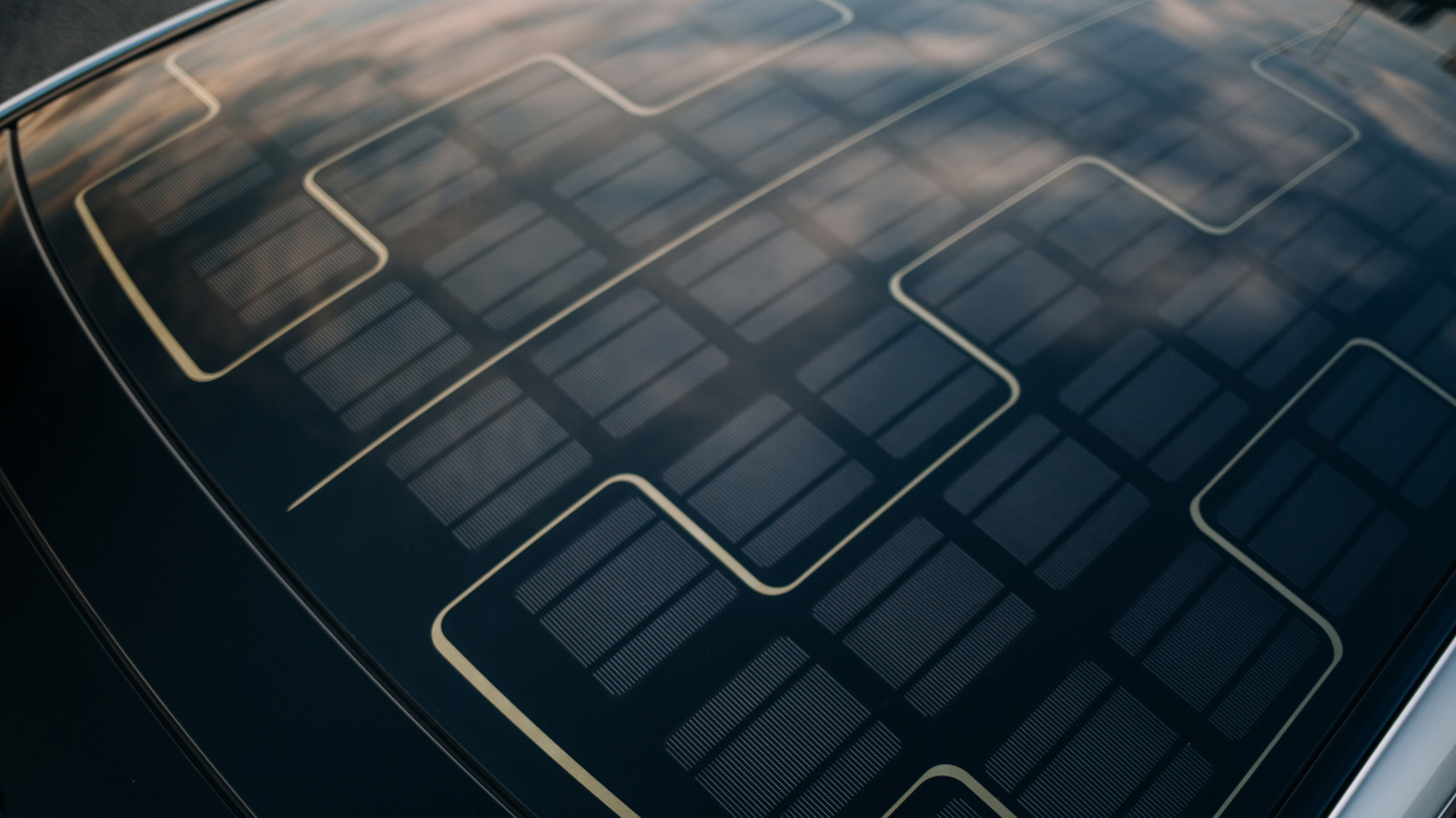
Putting solar cells on an electric vehicle’s roof has an immediate appeal: sunlight could return some energy to the battery while the car is parked, reducing the amount of electricity needed from a plug. But a calculation based on a photovoltaic roof prototype shows why the idea is helpful in the right conditions rather than a replacement for conventional charging.
A report from the Fraunhofer Institute for Solar Energy Systems describes integrated photovoltaic cells that produce about 19.5 watts per square foot under nominal conditions. Using a 21.5-square-foot roof area, that works out to roughly 420 watts of peak power.
That is meaningful generation for a small surface, but an EV roof has only a limited area and its output depends heavily on location, weather, shade and the amount of usable sunlight. The calculation illustrates both sides of vehicle-integrated solar: it can deliver useful energy day after day, yet it cannot match the energy available from a dedicated charging session.
What the prototype figures suggest
Fraunhofer’s estimate for its solar roof is approximately 6.2 miles of additional driving range per day in peak summer conditions. For Freiburg, Germany, the institute’s annual figures assume no shade and point to about 10% more range over a full year.
Those figures are not a universal guarantee for every car or climate. They depend on solar exposure and the vehicle’s energy use. A roof that sits under trees, inside a garage or in persistent cloud cover cannot collect the same energy as one parked in direct sun. Likewise, a more efficient vehicle can travel farther on the same solar-generated electricity than a less efficient one.
The key point is that a solar roof works continuously whenever conditions allow. Its value is therefore cumulative. A few miles added on many days can become a measurable share of annual driving, especially for owners whose vehicles spend long periods outdoors.
A Model 3 example in Los Angeles
The article applies the same roof-area assumption to a Tesla Model 3 and a location with strong solar resources. Tesla does not list the car’s roof area, so the calculation uses the 21.5-square-foot figure from the Fraunhofer example. At 19.5 watts per square foot, the estimated peak output remains 420 watts.
For Los Angeles, the calculation uses an average of 5.62 peak sun hours per day. Multiplying 420 watts by 5.62 hours produces about 2.36 kilowatt-hours of electricity. Edmunds testing cited in the article found that a 2026 Model 3 Standard averaged 0.23 kilowatt-hours per mile.
Dividing the estimated daily solar energy by that consumption figure yields about 10.3 miles of additional range per day before energy losses. The article puts that at roughly 3% of the Model 3 Standard’s stated 321-mile EPA range.
Seasonal variation changes the result. Using 6.14 peak sun hours in summer raises the estimate to about 11.2 miles per day. Using 5.03 peak sun hours in winter lowers it to around 9.2 miles. These estimates assume direct exposure and do not include losses, so they are best read as an illustration of potential rather than a promised real-world result.
Why solar is an assist, not a substitute
The daily-range calculation explains why solar roofs are not yet a standard feature on mainstream EVs. Even in a sunny location, a roof-sized panel has a finite output. It can add energy steadily, but it does not provide the large amount of electricity typically associated with plug-in charging.
That does not make the technology irrelevant. For a driver with a short commute, an extra several miles per day could offset part of routine travel. For other owners, the benefit could help preserve battery charge while a vehicle is parked. Over a year, the contribution can become more substantial than the small daily number first suggests.
Vehicle efficiency is central to the outcome. Automakers already pursue aerodynamic shapes, covered underbodies, retracting door handles, low-rolling-resistance tires and heat pumps to reduce consumption. Solar generation and efficiency work together: the less electricity a vehicle needs for each mile, the more miles a fixed-size solar roof can add.
The practical takeaway
Solar roofs can make an EV modestly more self-sustaining when conditions are favorable. Fraunhofer’s prototype figures and the Los Angeles Model 3 example indicate a plausible daily contribution measured in miles, not a transformation that eliminates charging.
For buyers and manufacturers, the sensible question is not whether rooftop solar can power an entire electric-car lifestyle by itself. It is whether incremental range, delivered quietly while the car is exposed to sunlight, justifies the cost, integration and design trade-offs. The answer will vary with climate, parking habits, vehicle efficiency and how much value an owner places on a steady source of supplemental energy.
This article is based on reporting by Jalopnik. Read the original article.
Originally published on jalopnik.com