Lamborghini adds a new roof architecture to the Temerario
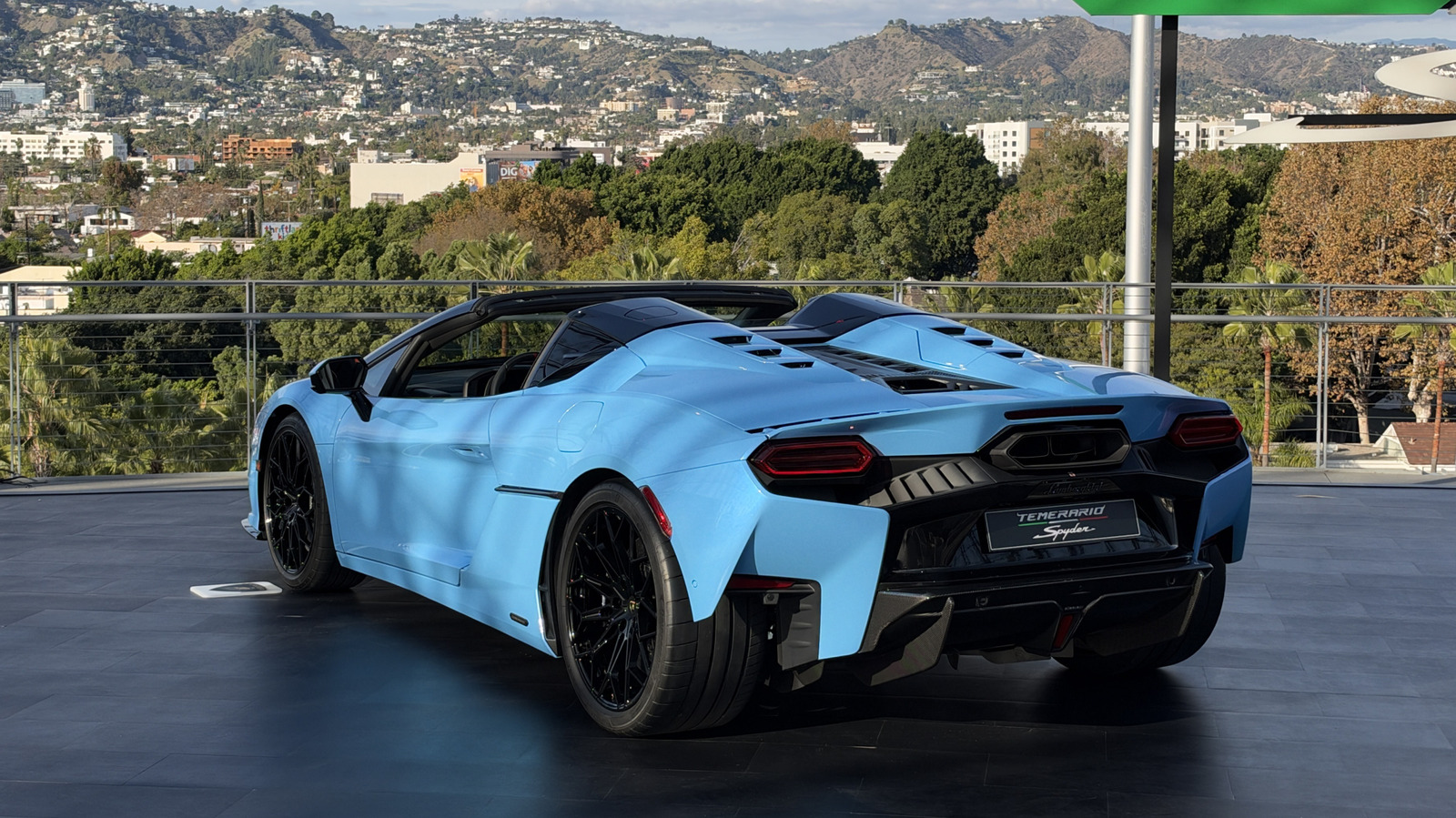
Lamborghini has unveiled the Temerario Spyder, a convertible version of its Temerario supercar that introduces a first for the company: a powered retractable hardtop.
The car made its world debut at the Academy Museum of Motion Pictures. Lamborghini has built open-top supercars since the Silhouette in 1976, but the Temerario Spyder is the brand’s first convertible to use a powered retractable hardtop rather than a more familiar roof arrangement.
The company says it selected the hardtop format to combine comfort, driving precision and aerodynamic efficiency. The technical focus is not only the presence of a powered roof, but the way that roof is stored. Lamborghini says the system uses a patented operating mechanism that differs from conventional retractable hardtops.
Two roof panels stow vertically behind the seats
Instead of lying flat across the rear deck when opened, the Temerario Spyder’s roof is split into two panels. Those panels stow vertically behind the seats, ahead of the engine.
That placement is central to the design. According to the report, a more conventional roof arrangement would have raised the car’s centre of gravity by 0.3 inches and shifted it 0.4 inches closer to the rear axle. The vertical stowage arrangement is intended to avoid that outcome while preserving the car’s profile.
The roof mechanism uses 10 electric actuators, rather than traditional electro-hydraulic circuitry. Lamborghini says the electric approach makes the system smoother, quieter and more compact. In a performance car where packaging, mass distribution and airflow can all influence the finished product, those details help explain why the roof is being presented as the centrepiece of the Spyder rather than a straightforward body-style change.
Retractable hardtops have appeared across the wider auto industry for years, but Lamborghini’s implementation puts the roof in a position closer to the engine than to the usual rear-deck storage area. The system therefore has to coexist with the car’s powertrain and cooling needs while maintaining the visual drama expected of an open-top Lamborghini.
Styling carries over the Temerario identity
Much of the Spyder’s exterior remains recognisably Temerario. With the roof in place, its profile and roofline are largely similar to the coupe’s. The convertible has two prominent cowls on the decklid behind the seats, each with three vents.
Where the coupe has a smaller side quarter window, the Spyder introduces a new intake element. The engine cover is designed to show the V8 engine, while additional intakes, vents and aerodynamic elements distinguish the open car’s rear section.
Lamborghini is also offering a new livery option that adds black accents to the interior, including detailing around the headlights, alongside further personalisation choices. Such options are familiar territory in the high-end supercar market, but the additional roof architecture gives the new model a more substantive technical distinction than a cosmetic special edition.
An open-top model designed around dynamics
Convertibles can pose an engineering challenge because removing a fixed roof changes structural and packaging requirements. Lamborghini’s stated emphasis on driving precision and aerodynamic efficiency suggests that the company is positioning the Spyder as a car designed to retain the character of the Temerario rather than simply offer open-air motoring.
The report’s centre-of-gravity figures underline that objective. Positioning the folded roof vertically behind the cabin is presented as a way to limit changes to the car’s balance. Replacing an electro-hydraulic mechanism with electric actuators is also intended to keep the mechanism compact.
The Temerario Spyder arrives roughly a year after customers began receiving the Temerario coupe. Its reveal gives Lamborghini a new flagship-style interpretation of the model line while also testing a roof format the company has not used before in a production convertible.
For buyers, the headline will likely be the visual transformation from coupe to open car. For the company, however, the Spyder is also a statement about packaging: the roof must fold, stow and operate without overwhelming the engine bay, changing the car’s proportions or imposing a larger penalty on its centre of gravity.
The result is an open Temerario whose defining feature is neither a removable panel nor a conventional folding roof, but a compact pair of electrically operated panels stored upright immediately behind the cabin.
This article is based on reporting by Jalopnik. Read the original article.
Originally published on jalopnik.com