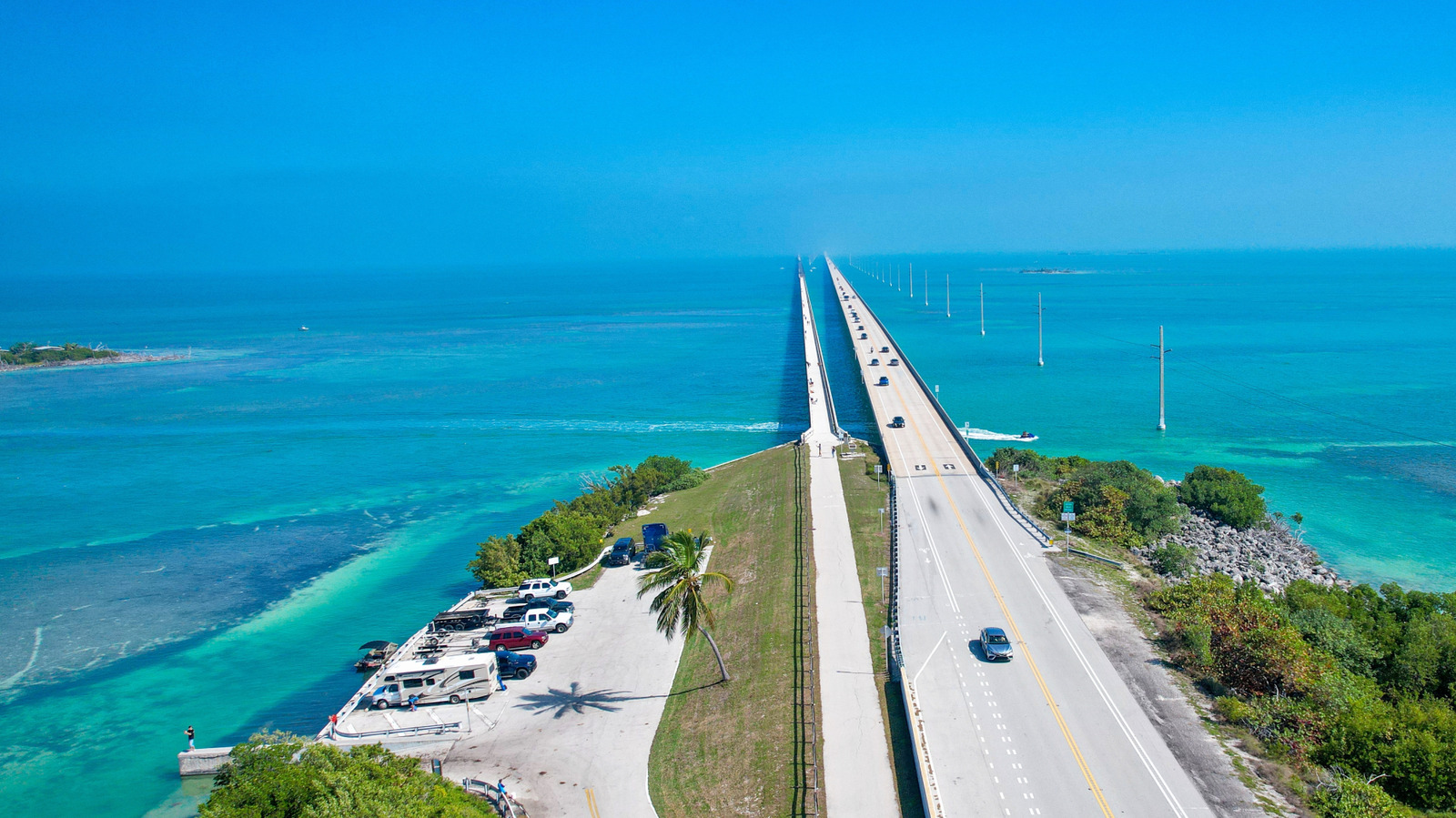
A Highway That Shouldn't Exist on a Map
Look at southern Florida on any map and the Florida Keys look marooned — a scatter of islands trailing off toward Cuba, seemingly unreachable except by boat or plane. The obvious question follows: can you really just drive out there? The answer is yes, and the reason is a piece of infrastructure that began life as something else entirely.
The Overseas Highway runs 113 miles across open water, stitched together by 42 bridges. It carries drivers from the mainland to Key West, the southernmost point in the continental United States. But it was never designed for cars. It was born as a railway, built over the sea by a man who loved trains and happened to have the fortune to indulge that passion.
From Rail to Road: How the Route Came to Be
Henry Flagler's Railroad Ambition
The driving force behind the original structure was Henry Flagler, a real estate developer and cofounder of Standard Oil. Flagler was a committed train enthusiast, and his ambition was to push rail service all the way down the island chain. The result was a railway laid across more than a hundred miles of water — an undertaking that, in its day, resembled nothing so much as the fantastical sea trains of animation and manga rather than anything rooted in ordinary civil engineering.
For a brief period in the early 1930s, that vision worked. Travelers could board a train and ride all the way to Key West. What they could not do was drive there. The islands were a rail destination, not a road trip.
A Storm, Then a Federal Rebuild
The arrangement did not survive the decade. A hurricane destroyed large portions of the rail line, and the railway's era effectively ended with it. Three years later, in 1938, the U.S. government intervened — not to restore the trains, but to rebuild the spans for automobiles.
With that decision, the Over-Sea Railroad became the Overseas Highway. The same water crossings that had once carried rail cars were repurposed for rubber and asphalt, and for the first time, visitors could drive the hours down to Key West instead of watching the scenery slide past a train window.
It was a genuine engineering achievement. But it also fixed the character of the route for good: what had been a scenic journey became, by design, a means of getting somewhere.
What the Drive Is Actually Like
There is a gap between the Overseas Highway's reputation and the experience of traveling it. The bridges do cross genuinely beautiful water, and the islands along the way are thick with striking vegetation. Yet the road itself is, in the end, mostly just a road — for the bulk of its length, a single lane in each direction. Wider, four-lane sections exist, but they are the exception rather than the rule.
That geometry shapes everything about the trip:
- Between the islands, there is no shoulder wide enough to pull over and take in the view.
- The spans cross long, gorgeous stretches of water, but the only vantage point is through a windshield or side window.
- When you do exit onto an island, what greets you is often not scenery but commercial strips, including the familiar combined fast-food outlets that anchor so much American roadside development.
One driver who has traveled the route as far as Plantation Key — the second in the chain of islands — described it plainly: the water is spectacular, the islands are lush, and the road is a road. The scenery is something you pass over rather than something you stop inside.
An Engineering Marvel in Service of the Destination
That mismatch is the strange legacy of the 1938 conversion. Aboard a train, nearly everyone is a passenger, and the point of the journey is the journey. A railway over 113 miles of water makes sense as a sightseeing experience: the bridges are the attraction, and the travelers are there to look out at them.
Convert those same bridges to a two-lane highway and the logic inverts. The spans stop being destinations and become obstacles to clear on the way to somewhere else. The structure remains remarkable — an engineering feat by any measure — but the drivers crossing it are focused on the road ahead, not the water beneath.
It is worth noting what the Overseas Highway is not. It does not hold the record for the longest stretch of U.S. highway without exits. That distinction belongs to another Florida road entirely. The Keys route is famous for its bridges and its setting, not for the barrenness of its interchanges.
In one sense, the outcome is exactly what the man behind the original railroad would have wanted. Flagler owned resorts at the far end of the line, so a route that moves people efficiently toward a destination — rather than distracting them along the way — served his commercial interests perfectly.

Why the Route Still Matters
Nearly a century after the federal rebuild, the Overseas Highway remains the only practical way to drive to Key West. The trains that once ran the route are gone, and while Florida's modern passenger rail service is faster, the same coverage has also noted that speed has come alongside a troubling safety record. The road, for all its limitations, is what survived.
That survival is the real story. A railway built on the whim of a wealthy enthusiast was wrecked by a hurricane, salvaged by the federal government, and handed to motorists. The result is a 113-mile corridor of concrete and steel spanning 42 bridges over open water — a route that thousands of drivers cross every day without fully registering what it took to put it there.
Whether that is a triumph or a missed opportunity depends on whether you are the one driving. For anyone who loves gazing out over long, beautiful stretches of ocean, the Overseas Highway offers an ideal vantage point that it never quite lets you use. For everyone else, it is simply the way you get to the Keys.
This article is based on reporting by Jalopnik. Read the original article.
Originally published on jalopnik.com