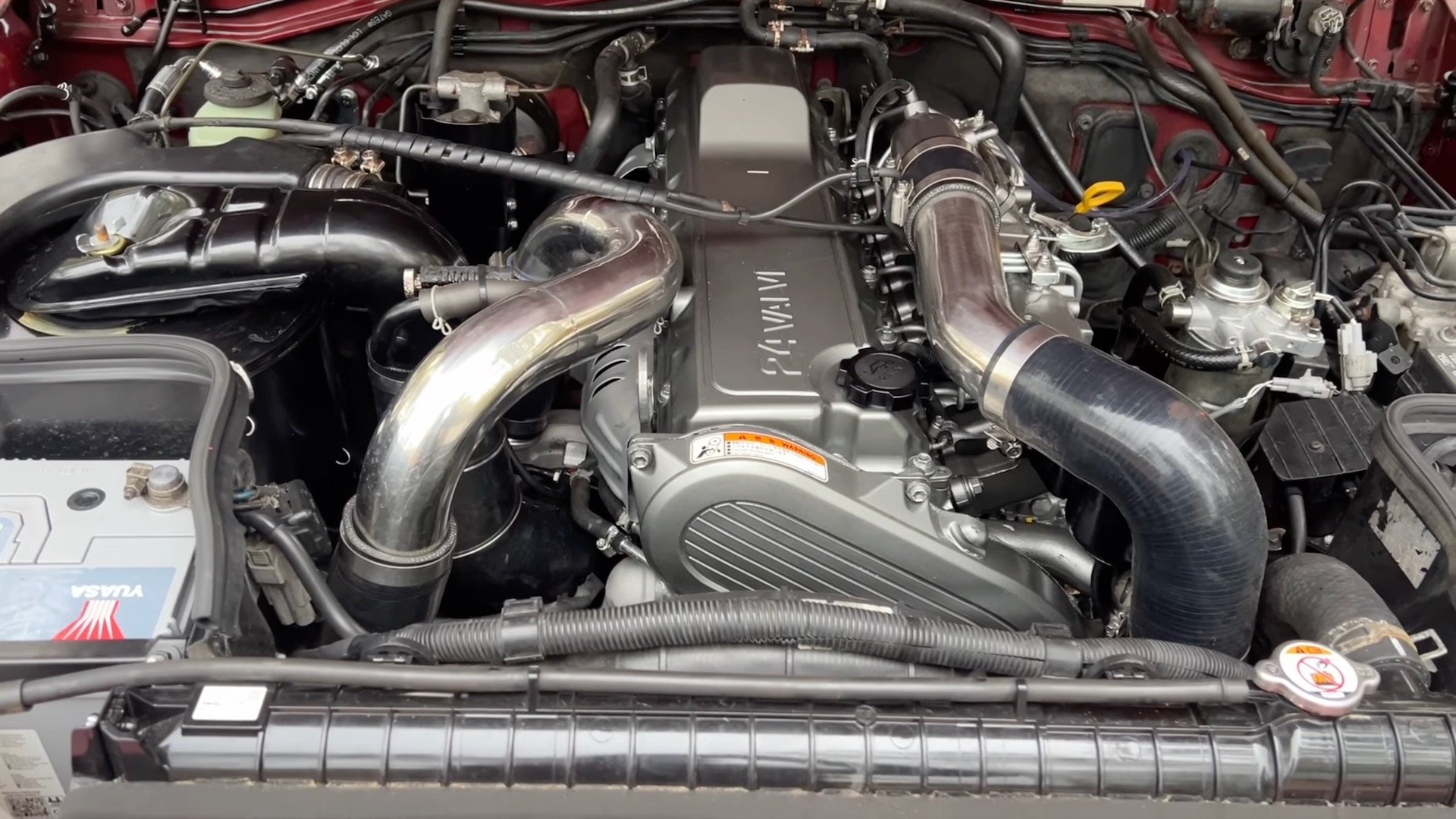
Engine swaps usually stay within the automotive world. A performance car might receive a more powerful engine from another car, while a truck or SUV project may draw from commercial or industrial machinery. One 80-Series Toyota Land Cruiser build takes the second route, using a Yanmar marine diesel engine to substantially change the vehicle’s performance.
The result is not an unrelated powerplant forced into an unsuitable chassis. The Yanmar 6LP is described as a marine version of Toyota’s 1HD-FT, a 4.2-liter turbodiesel inline-six that was briefly offered in the 80-Series Land Cruiser. That family connection helped make the swap feasible, though several important changes were still necessary.
From marine engine to Land Cruiser power
The Land Cruiser left the factory with a 4.2-liter turbodiesel inline-six, but its original engine used a 12-valve configuration. The replacement engine has 24 valves. According to the build description, that helps the Yanmar produce 320 horsepower, about twice the output of the stock 12-valve engine.
The performance difference is significant for a vehicle not known for acceleration. The builder reports that the Land Cruiser’s zero-to-60-mph time fell from 16 seconds to 8.8 seconds. The claim is especially notable because the vehicle retained its stock air intake, which the builder says is known to restrict power in these engines.
Yanmar is a Japanese company associated with diesel engines and heavy equipment, including construction equipment. Its 6LP illustrates a common engineering path in which an automotive engine design is adapted for a marine role. In this project, the process runs in the other direction: a marine descendant of a Land Cruiser-related engine returns to a road-going Toyota.
Adapting a boat engine for road use
Family resemblance does not mean a direct bolt-in installation. Marine and automotive engines operate with different cooling, packaging and instrumentation requirements. The project therefore involved replacing or reworking several components to make the Yanmar unit compatible with the Land Cruiser.
The seawater pump used for marine cooling was removed, and the vehicle received a plumbed-in Toyota cooling system. The Yanmar oil sump and oil pickup were replaced with Toyota parts to provide the necessary clearance. The injector pump was also changed for a Toyota equivalent because the Yanmar version did not have a threaded connection point for a tachometer.
Those details show that the core engine was only one part of the conversion. Cooling, lubrication packaging and engine-speed instrumentation all needed to be addressed before the marine-derived diesel could function as part of the Land Cruiser’s road-going drivetrain.
A transmission change for usable cruising
The engine is paired with a Toyota H152 gearbox, identified as a higher-ratio version of the five-speed manual transmission used by the Land Cruiser from the factory. The gearing is intended to make the added diesel performance more useful beyond short bursts of acceleration.
With that transmission, the builder reports that the Land Cruiser can maintain 60 mph at 1,600 rpm. For a heavy four-wheel-drive vehicle, that low engine speed at highway pace points to the role gearing plays in a successful swap. More horsepower alone does not determine how an engine behaves in daily driving; transmission ratios determine whether torque and rev range translate into tractable road performance.
The project also received a broader mechanical refresh, according to the source. That is consistent with the demands of fitting substantially more power into an older vehicle. The engine, gearbox and supporting systems must operate together, particularly in a vehicle intended for work or off-road use.
An example of cross-sector engineering
The build is a striking example of how designs can travel between transportation sectors. Automotive engines have long appeared in marine applications, and the source notes that Lamborghini also once made marine engines. The Yanmar installation shows that a related engine can, with appropriate modifications, be brought back into an automotive setting.
It should not be mistaken for a simple recommendation to install any marine engine in an SUV. This conversion benefited from a close link between the 6LP and Toyota’s 1HD-FT, plus access to Toyota-compatible components for the cooling, sump, pickup, injector pump and transmission arrangement. Those specifics are central to why the project could work.
Even so, the Land Cruiser demonstrates the appeal of looking beyond conventional donor vehicles. A marine diesel, selected because of its relationship to an existing Toyota engine, delivered a reported 320 horsepower and transformed the acceleration of an 80-Series platform without abandoning the diesel character that suits a rugged utility vehicle. It is a specialized build, but it is also a reminder that useful engineering ideas do not always stay in their original industry.
This article is based on reporting by The Drive. Read the original article.
Originally published on thedrive.com