A Lotus Seven Reimagined for the Oval
Few cars embody a design philosophy as literally as the Lotus Seven. Colin Chapman's minimalist roadster was the clearest expression of the maxim he is arguably better known for today than for founding Lotus in the first place: simplify, then add lightness. The Seven was so pared back that it originally reached customers as a kit, and it still does under the Caterham name. So when an unnamed builder took that formula and bent it toward circle track racing with a big American V8, the result was destined to be strange, loud and memorable. That machine has now appeared for sale on Bring a Trailer.
Chapman Never Planned for This
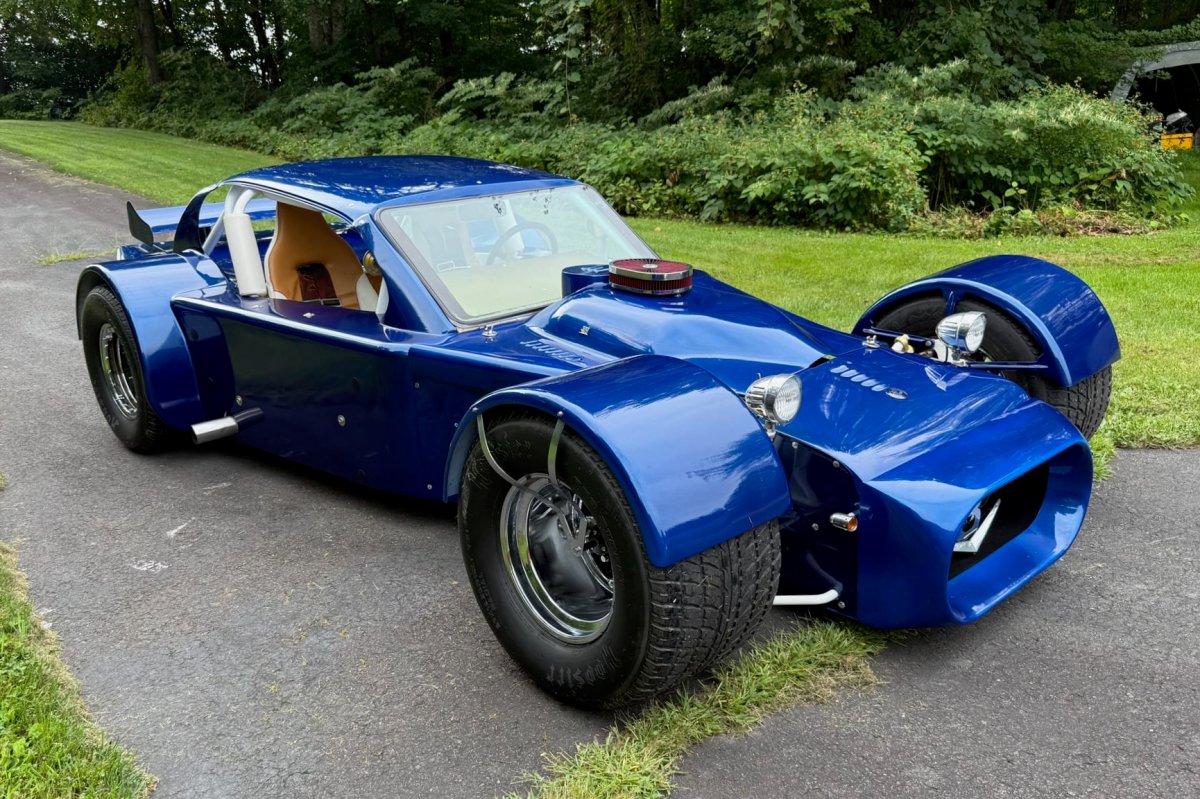
Under Chapman's direction, Lotus competed in Formula 1, the Indianapolis 500 and a long list of lower-level categories, so the marque's racing pedigree is not in question. What is in question is whether anything about circle track racing — or a V8 wedged into the Seven's featherweight chassis — ever crossed his mind. It almost certainly did not. Someone went ahead anyway, building a Seven-style car set up for oval competition. That car is the one now listed, and its proportions make immediately clear that lightness was not the guiding principle behind it.

Bodywork Built for Contact, Not Corners
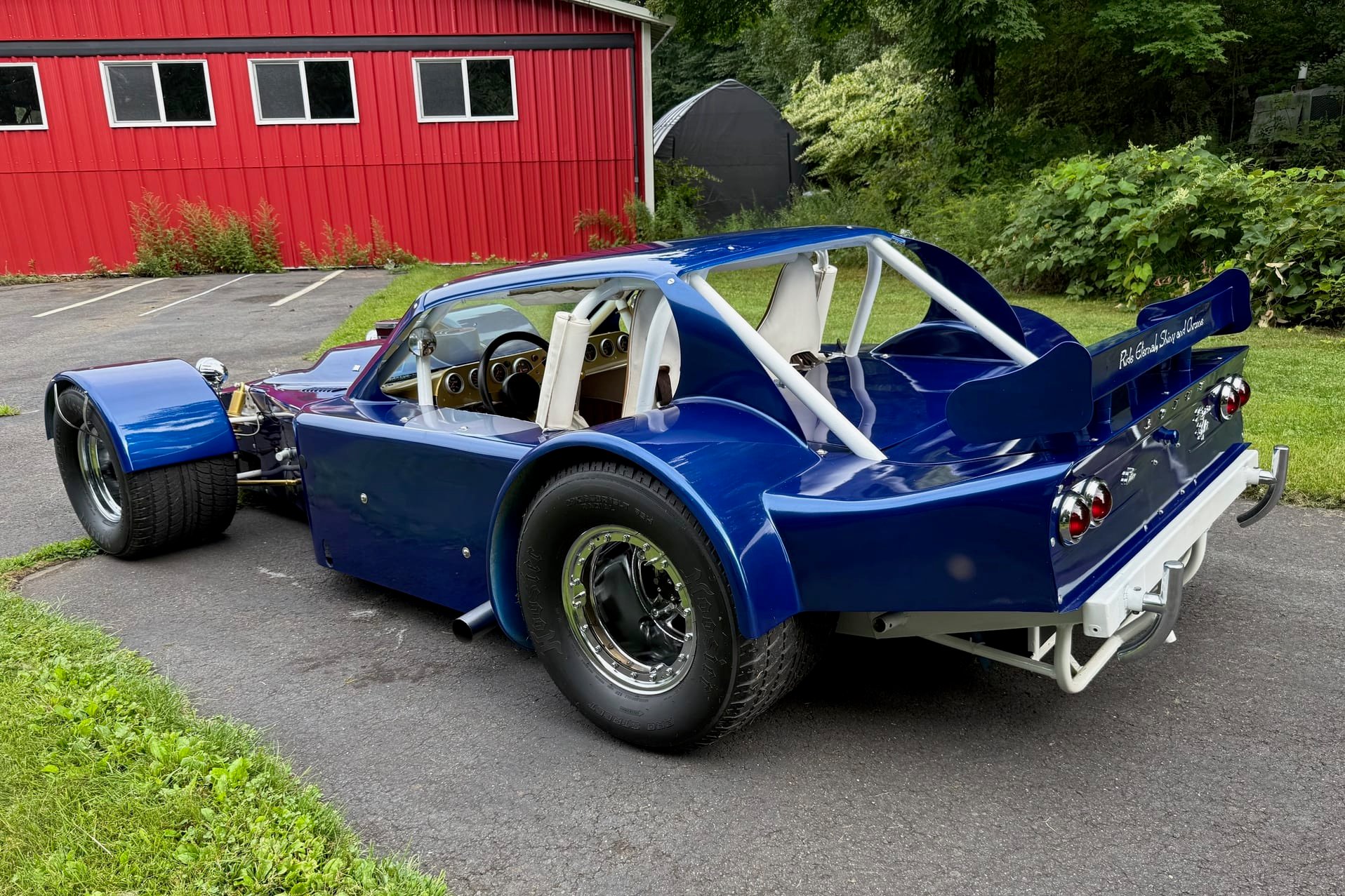
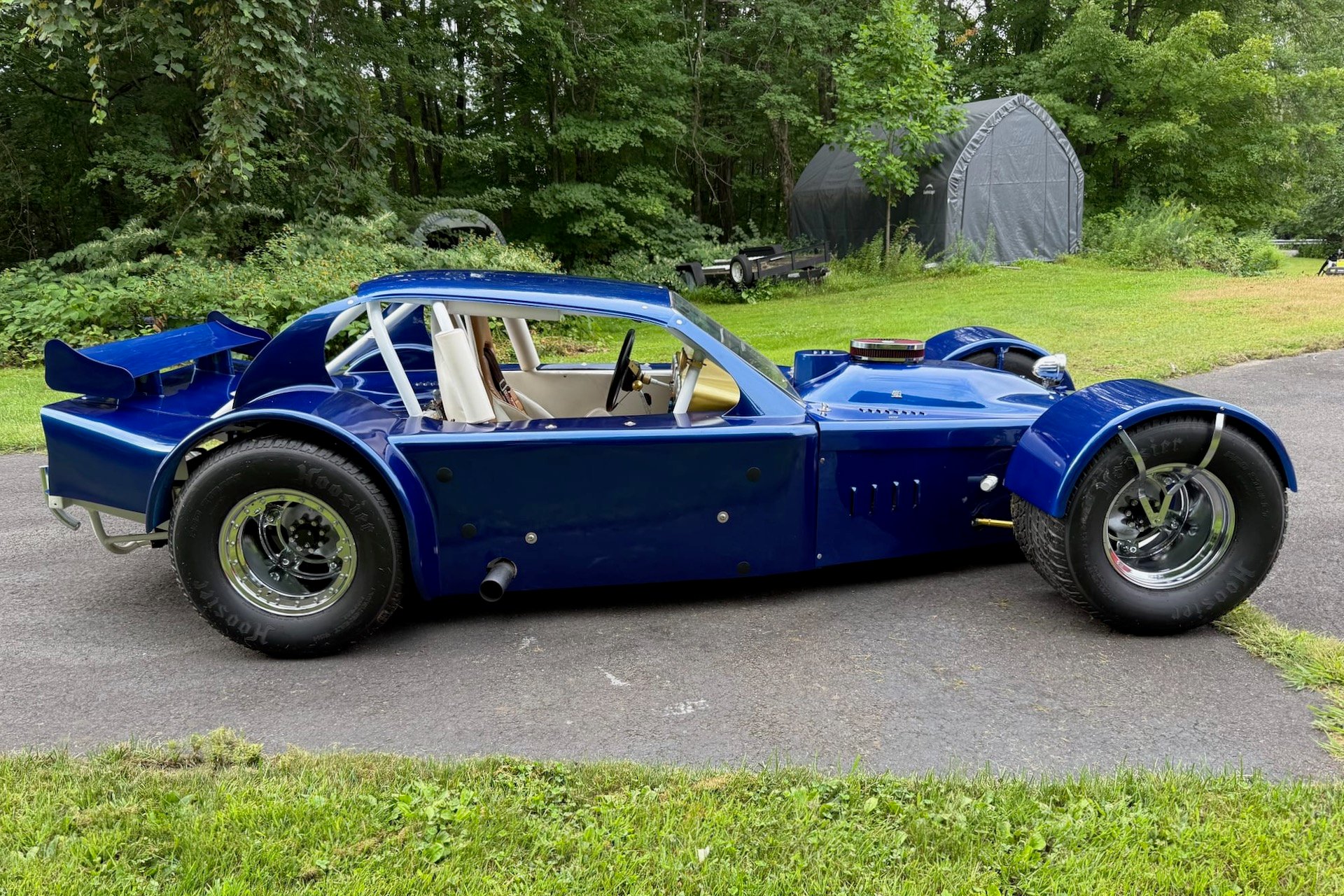
Seven-inspired bodywork is stretched over a tube-frame chassis with an integrated roll cage, a structure far removed from the spindly frame of the original. The roof is steel, while the rest of the body is fiberglass, a practical combination for a car expected to trade paint. The silhouette reads far more as circle track racer than Seven, and the details reinforce that impression from every angle.
The wheels measure 15 inches wide, and a substantial hood bulge sits where the Seven's delicate bonnet once was. Together they erase any trace of the car's dainty proportions. At the rear, the builder added push bars, four taillights and a spoiler carrying a quote from Mad Max: Fury Road — an odd flourish for a machine set up to run asphalt rather than the dirt that would supply a genuinely post-apocalyptic mood.
A Chevrolet V8 Where a Small Four Once Lived
If the circle track configuration and bulging hood left any doubt about what sits beneath the bodywork, the grille settles the question. The traditional "7" emblem has been replaced by an "8" nested inside a "V," and the hardware backs up the badge. Power comes from a blueprinted 409-cubic-inch Chevrolet V8 displacing 6.7 liters.
Induction is handled by a Holley four-barrel carburetor, and drive reaches the rear wheels through a Tremec five-speed manual transmission and a Winters quick-change locking differential. That rear end is a telling detail: a quick-change setup lets a team swap gear ratios to suit different tracks without tearing the axle apart, a feature drawn straight from circle track practice.
- Engine: blueprinted 409-cubic-inch (6.7-liter) Chevrolet V8
- Fuel delivery: Holley four-barrel carburetor
- Transmission: Tremec five-speed manual
- Differential: Winters quick-change locking unit
- Chassis: tube frame with integrated roll cage
- Body: steel roof over fiberglass panels

An Interior Dressed Beyond Race Car Norms
The cabin is more finished than most dedicated race cars manage. Fixed-back bucket seats wear two-tone leather upholstery, and the transmission tunnel and shifter boot are trimmed to coordinate with them. A custom dashboard and shift knob finished in gold round out the interior, a combination that works surprisingly well against the blue bodywork and the white chassis and roll cage. It is a reminder that whoever assembled this car was not simply chasing lap times — they cared about how it looked while doing it.
The Paperwork Is Its Own Story
The car was allegedly built in the 2000s, which raises an obvious question: how does something assembled that recently end up with a Lotus identification plate? The listing says the vehicle carries such a plate and is titled as a 1974 Lotus Elite. That is a substantial stretch, since nothing about the machine resembles an Elite. The title itself comes from Montana, which may ease or complicate the process for a future owner depending on where they live.
Anyone worried about registering a car that is so plainly not a 1974 Lotus Elite has a simpler option: trailer it to a track. That is where a machine engineered for oval racing belongs, and it is where the mash-up of British lightweight heritage and American V8 muscle makes the most sense.

Why Anyone Would Build It
The appeal of a project like this lies in the collision of two worlds. On one side sits the Lotus Seven, a car whose entire identity comes from doing more with less. On the other sits the small-block Chevrolet V8, an engine family synonymous with brute force and abundant, affordable power. Marrying them produces something that honors neither tradition exactly, yet the result has a logic of its own: a lightweight British shape wrapped around a tube frame, fed by 6.7 liters of Detroit iron, and sitting on wheels wide enough to shame a purpose-built stock car.
Purists may wince. Chapman, whose cars chased down more powerful machinery through cornering speed rather than straight-line muscle, might have too. But the builder clearly had a vision and executed it deliberately, from the push bars at the rear to the gold trim inside. For anyone who appreciates automotive oddities — and the Bring a Trailer audience reliably does — this is a machine worth watching when the hammer falls.
This article is based on reporting by The Drive. Read the original article.
Originally published on thedrive.com