The Rebel Riders and the Rise of the Extreme Vespa
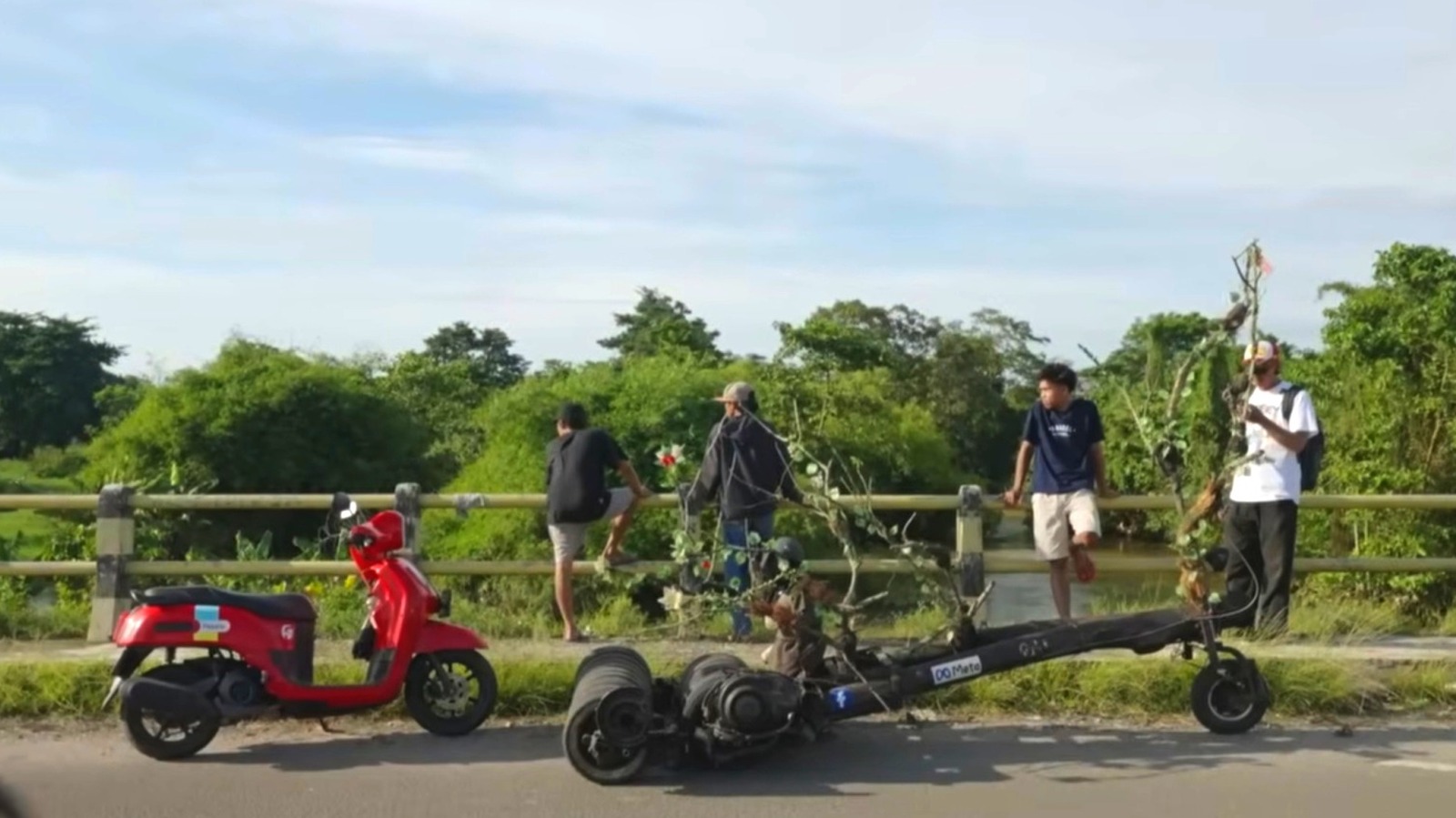
Customizing a Vespa is a familiar ritual for owners around the globe, but almost nowhere is that instinct pushed further than in Indonesia. There, a sprawling, loosely connected network of builders known as the Rebel Riders produces machines they simply call Extreme Vespas. These builds often bear no visual resemblance to the Italian scooters they began life as. Frames are fabricated from whatever material happens to be available — sheet metal, bamboo, rubber, and in at least one case an actual tree branch — turning the machines into something closer to rolling folk sculpture than to anything you could buy in a showroom.
What keeps an Extreme Vespa tethered to the Vespa name is a single mechanical detail. Beneath all the welded-on scaffolding, improvised bodywork, and hand-bent tubing sits a 98 cc Vespa engine. That one component is the only thing that makes these contraptions Vespas at all.
A Builder Culture That Traces Back to Vespa Itself
In a sense, Indonesia's most radical builders are following a path Piaggio laid down first. During its earliest decade, the company spent a great deal of energy thinking past the conventional scooter, producing unusual racing models designed for record-setting runs. Modifying and reimagining the machine was built into the brand from the start.
Racing Experiments and a Military Contract
Vespa's willingness to go sideways extended into genuinely strange territory. The manufacturer even produced a compact tactical vehicle for the French army, a footnote that illustrates just how far the platform could be stretched when someone had a specific purpose in mind.
Britain's Mod Scene and Amphibious Scooters
For ordinary riders, the best-known customization tradition emerged in Britain, where mod culture turned scooters into canvases. Riders layered on enormous arrays of lights and polished add-ons, arranging them artfully across the front fairing. Other enthusiasts went further still, engineering Vespas capable of crossing the English Channel. The lesson in all of these cases is the same: owners insist on making their two-wheeled machines unmistakably their own.

How the Vespa Became a National Institution
Indonesia's relationship with the Vespa runs far deeper than hobbyist enthusiasm. Piaggio opened a factory in Jakarta in the 1970s, and the small two-wheeled vehicle quickly became part of the fabric of daily life. Reporting from National Geographic indicates that roughly 85 percent of islanders own a scooter of some kind. The Vespa enthusiast community that grew alongside that ownership became one of the largest anywhere in the world, trailing only Italy, the brand's home country.
The 1997 Financial Crisis
Then came the Asian financial crisis of 1997. Prices surged, and for many islanders a new Vespa moved out of reach. Ownership suddenly became a question of maintenance rather than purchase, and riders began looking at aging machines and spare parts with fresh eyes.
Production Ends, Reinvention Begins
The Jakarta factory ceased Vespa production in 2001, closing off the supply of new scooters entirely. Anyone still in need of affordable transportation had one clear option: repair and repurpose the old Vespas and their components into machines of their own design. As builders grew more inventive with salvaged parts, they discovered a crucial fact — a 98 cc Vespa engine can be adapted to fit practically anything. That discovery is the foundation on which the entire Extreme Vespa scene rests.
Anatomy of an Extreme Vespa
The results defy easy categorization. What follows is a rough sketch of the form:
- Materials: Builders work with sheet metal, bamboo, rubber, and whatever else can be sourced, including a literal tree branch used as a structural element.
- Capacity: Some builds are designed to carry one or two riders, while others are engineered — or at least attempted — to transport upward of eight people at once.
- Powertrain: A 98 cc Vespa engine, the single defining link back to the original scooter.
- Condition: In many photographs and videos, tires are worn down to the treads or completely blown out.
- Support system: Dozens of fellow riders are typically on hand to help when a build falters or fails.
Engineering at the Very Edge of Reason
These machines are assembled with what can generously be described as questionable rigidity. Structural integrity is not the guiding principle of an Extreme Vespa build, and safety occupies a similarly low position in the hierarchy of priorities. Observers watching footage of the creations will notice worn or destroyed tires, improvised steering, and frame geometry that would alarm any conventional engineer.
Yet the community compensates in ways that a factory never could. When a build breaks down — and they frequently do — a crowd of other riders typically materializes to help get it moving again. The scene functions as a mutual aid network as much as a hobby, with collective labor filling the gap that individual engineering cannot.
Neo and the Personalities Driving the Scene
Like any subculture, the Extreme Vespa world has its recognizable figures. Among the best-known is an Indonesian builder named Neo, who operates online under the handle neovespapohon_87. He recently spoke with the YouTuber Sam about his creation, one of the most visible examples of what the scene can produce. Such figures serve as a bridge between Indonesia's builders and the wider internet, where footage of their machines travels far beyond the neighborhoods where they are assembled.

Why the Extreme Vespa Endures
The appeal of this movement is not difficult to understand once the history is clear. A financial crisis, a closed factory, and an enormous population dependent on two-wheeled transport created the conditions. Necessity supplied the first push, and creative pride did the rest. Builders who could not buy new machines learned to construct their own, and over time the constraint became a form of expression.
What emerged is a subculture that sits at an unusual intersection: part transportation solution, part folk art, part community ritual, and part engineering dare. An Extreme Vespa is not a scooter that has been tastefully accessorized. It is an entirely new object grown around a small, stubborn engine — proof that in Indonesia, the Vespa never stopped being something you make for yourself.
This article is based on reporting by Jalopnik. Read the original article.
Originally published on jalopnik.com