A Race Built for Contact Ends in Chaos
An endurance event whose entire appeal rests on traffic crossing itself at speed delivered exactly the kind of ending its format invites on Sunday. The 50th Annual 3-Hour Figure 8 Championship at the Indianapolis Speedrome finished not with a trophy presentation but with a driver climbing into a rival's cockpit, a pit-lane confrontation involving spectators, and a felony charge filed in Marion County.
It is worth separating the Speedrome from its far more famous neighbor in Indianapolis. The short track where this unfolded sits roughly 24 miles from the Indianapolis Motor Speedway, and the two venues have almost nothing in common beyond geography and four wheels. One hosts the biggest spectacle in American motorsport; the other runs a race whose whole premise is that cars will eventually hit each other.
Video of the sequence spread quickly across social media. Brayton Laster, posting on X, called it one of the most unbelievable stretches of behavior he had ever seen at a racetrack, and the clip was still being shared days later as fans tried to piece together the order of events.
The Fight for the Lead Turns Personal
The trouble began with about ten minutes left in the three-hour race. Jeffrey Shackelford, wheeling the No. 28 car, and Mark Tunny in the No. 3T collided while battling for the top spot. That first contact was standard short-track fare — the sort of thing that happens when two drivers want the same piece of real estate at the same moment.
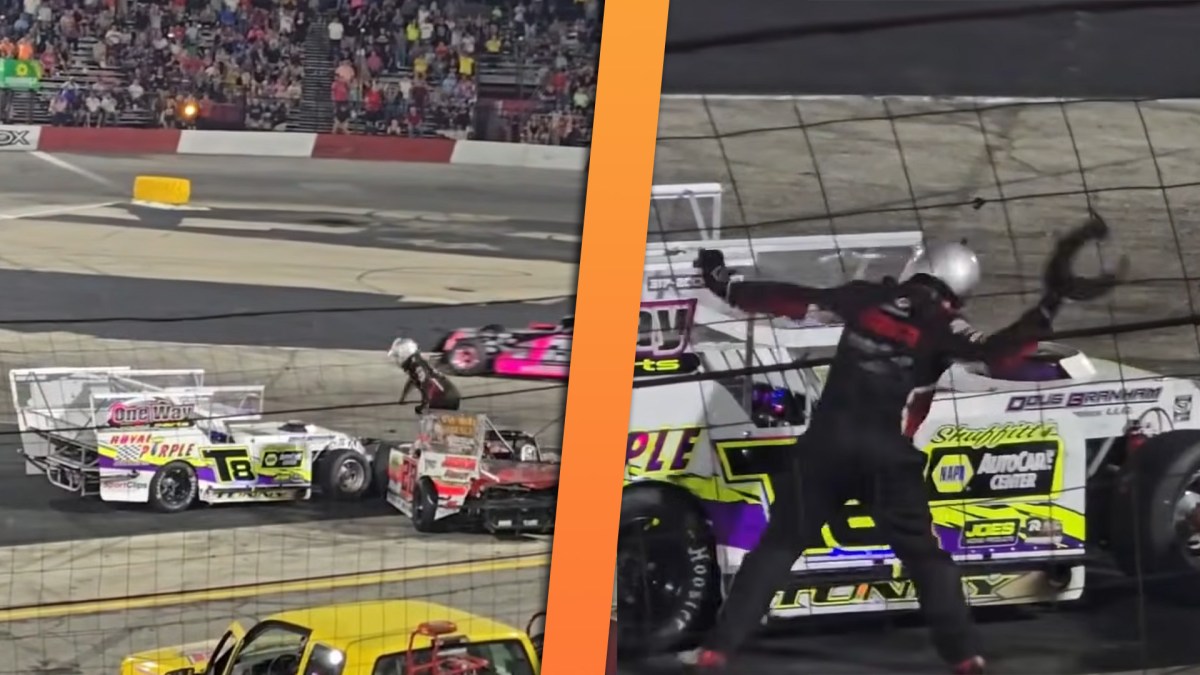
What followed was not. Minutes later, Mark Tunny hit Shackelford again, spinning the No. 28 out of contention. Then came the strike that turned a racing dispute into a brawl: Dana Tunny, Mark's brother, was circulating in the No. T8 — a car running roughly 200 laps down — when he drove hard into Shackelford's car as the No. 28 tried to rejoin the action.
A driver who is 200 laps behind has no stake in the finishing order. That is precisely what made the hit read as retaliation rather than competition, and the crowd reacted accordingly.
From the Track to Hand-to-Hand Confrontation
Shackelford remained stationary as Dana Tunny pulled away. Moments later, Shackelford began climbing out of his car — and video appears to show Dana Tunny crossing the track to hit him once more.
Shackelford's answer was immediate and physical. He climbed into Dana Tunny's car to go after the driver, then threw his helmet into the cockpit before a police officer managed to restrain him. The sequence — a stopped car, a driver out of his belts, another car arriving at speed, and then two men tangled in the same cockpit — is about as far from a racing incident as a short track can produce.
The confrontation drew a police response on the spot, and the clip of Shackelford clambering into the No. T8 became the defining image of the night. Onlookers described it as one of the most chaotic scenes they had witnessed at a short track, with the crowd near the fence reacting in real time as the altercation unfolded.
Pit Lane: A Swerve That Set Off a Crowd
The evening was not finished. As Dana Tunny later drove through the pit area, police say he swerved toward Shackelford's pit crew and nearby spectators, according to reporting from Fox 59 and CBS 4. Nobody appears to have been struck, but the gesture triggered a rush of people who attacked the car, punching and kicking it as it moved through the pits.
Pit lanes are the worst possible place for that kind of maneuver. Crew members, officials, and fans stand within arm's reach of moving cars, and a swerve aimed at people on foot escalates a racing feud into something with real potential for serious injury.
![Volkswagen's new electric hot hatch delivers more power than the Golf GTI [Images]](https://electrek.co/wp-content/uploads/sites/3/2026/09/Volkswagen-ID.3-GTI-EV-side.jpeg?quality=82&strip=all&resize=1200,628)
Two Felony Counts in Marion County
The Marion County Prosecutor's Office ultimately charged Dana Tunny with two Level 6 counts of criminal recklessness, according to Essentially Sports. One count relates to the final hit on Shackelford's car at a moment when Shackelford was standing on it. The second relates to his alleged conduct in pit lane.
That structure says something about how authorities viewed the night: the on-track contact that injured no one still drew a charge because a person was exposed on the car, and the pit-lane swerve drew one because bystanders were in the path of a race car.
Why Figure 8 Racing Produces These Moments
The Figure 8 format is exactly what the name promises. Late model cars run laps for hours on a course where the two directions of travel intersect, meaning every driver periodically crosses the path of everyone else. Time the crossing well and you gain position; time it poorly and you get hit broadside at speed.
Three hours of that produces a specific kind of fatigue and frustration. A partial list of what the format asks of competitors:
- Continuous racing across a multi-hour distance on a small oval
- Repeated high-speed crossings through the same intersection
- Constant judgment calls about whether to lift or commit
- A field that inevitably spreads out, putting much slower cars in the leaders' path
The 3-Hour Figure 8 Championship leans into all of it. Contact is not an unfortunate byproduct of the race; it is built into the premise, and the event's 50-year history has produced no shortage of wreckage.
The Bigger Questions Left Behind
What happened Sunday raises issues that go beyond one rivalry between two families of drivers. Track officials will have to consider how much tolerance the format allows for retaliation, particularly when cars many laps down become weapons in someone else's dispute. Sanctioning bodies elsewhere have long wrestled with where hard racing ends and intent begins, and this incident hands them a clear example.
There is also the question of pit safety. A crowd attacking a moving race car is dangerous for everyone involved, and the fact that it happened after a driver allegedly aimed his car at people on foot will likely factor into any review of the night's officiating.
For now, the on-track outcome is secondary to the legal one. A race designed to manufacture contact generated a fight, a police response, and a felony case — and the video of all of it will keep circulating long after the 50th running of the event fades from the calendar.
Whatever the prosecutor's case ultimately produces, the episode has already become part of the Speedrome's folklore — the 50th anniversary edition of a race famous for mayhem delivering mayhem on schedule, just not in the form anyone expected.
This article is based on reporting by The Drive. Read the original article.
Originally published on thedrive.com