A False Dawn Over the Himalayas
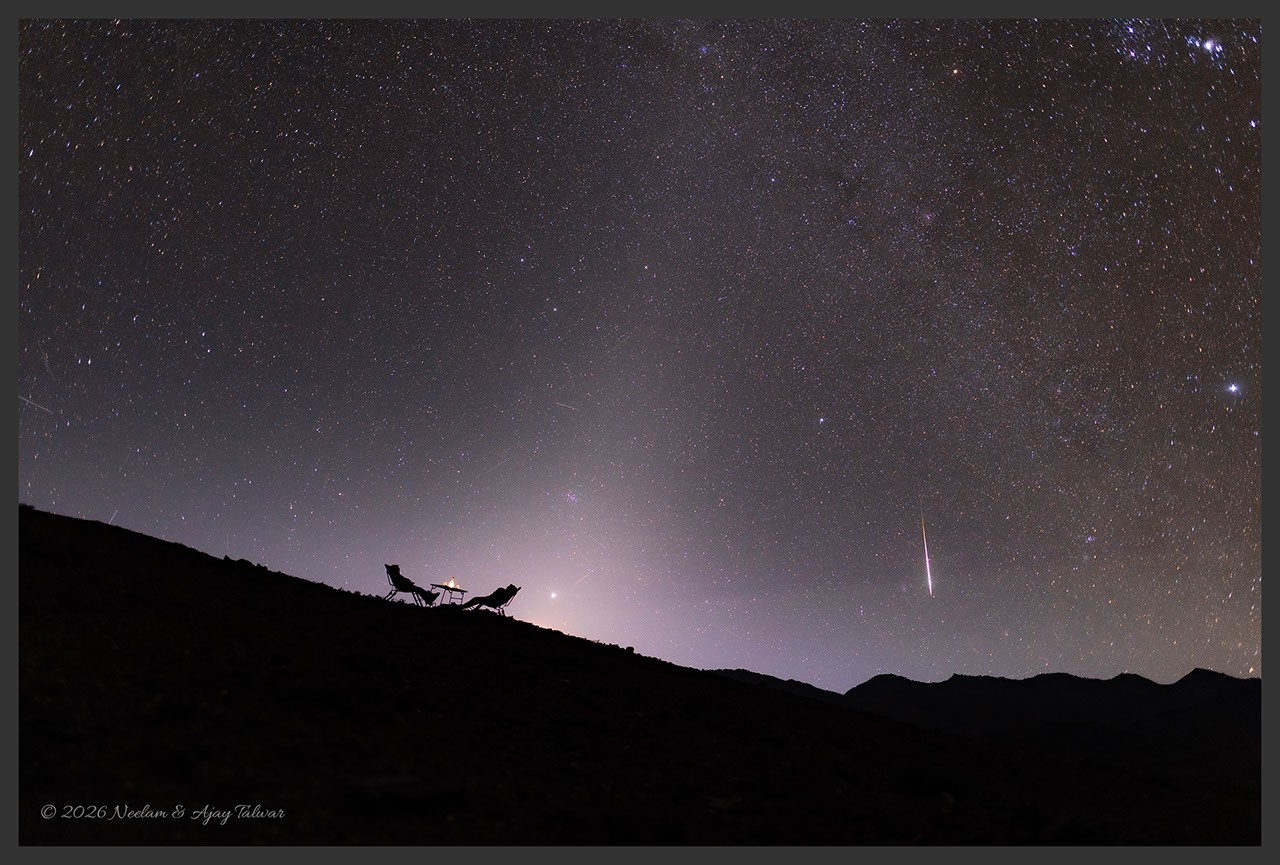
The Astronomy Picture of the Day for September 19, 2026 presents a serene but scientifically rich night skyscape titled "A Zodiacal Night." The image, released through NASA's APOD channel, captures a luminous band of zodiacal light arcing across a dark sky moments before astronomical twilight began. The photograph was taken during September's star party at the Hanle Dark Sky Reserve in Ladakh, India, from an altitude of roughly 4,500 meters — a location that the APOD entry describes as a haven for dedicated stargazers and astrophotographers.
Credited to Neelam and Ajay Talwar of TWAN, the picture is part of APOD's long-running daily series, which features a different image or photograph of the universe each day alongside a brief explanation written by a professional astronomer. The entry is authored and edited by Jerry Bonnell, Cecilia Chirenti, Robert Nemiroff, and Keighley Rockcliffe, and is offered as a service of ASD at NASA's Goddard Space Flight Center, NASA Science Activation, and Michigan Technological University.
What the Zodiacal Light Actually Is
Zodiacal light is often called the false dawn, a name that hints at why it has historically confused observers. It appears as a soft, cone-shaped or band-like glow that can be mistaken for the first hint of sunrise — except that it shows up well before any true dawn light reaches the sky. In the APOD frame, the glow is visible against a backdrop that remains genuinely dark, which is exactly the condition the phenomenon requires.
The APOD explanation notes that the zodiacal glow is produced by sunlight scattering off interplanetary dust. That dust is spread through the inner solar system, and when sunlight strikes it, some of the light is back-scattered toward observers on Earth, creating the faint luminous band that traces the plane of the solar system across our night sky.
Because the signal is so faint, zodiacal light is essentially invisible from most populated areas. Seeing it demands a sky free of artificial light pollution, low atmospheric moisture, and a dark window before twilight begins — a combination that explains why this particular photograph came from one of the most carefully protected night-sky sites in the world.
Hanle: A High-Altitude Haven for Dark Skies
The Hanle Dark Sky Reserve sits in Ladakh, in the Indian Himalayas, at about 4,500 meters above sea level. That elevation matters. Thinner air at high altitude scatters less light, and the reserve's remote setting keeps urban glow far from the horizon. The result, as the APOD entry puts it, is a setting that serves as a refuge for hardy stargazing and astrophotography enthusiasts willing to travel to reach it.
The image was recorded during a September star party at the reserve, an event that brings observers together under conditions most of the world has lost. The scene itself is a demonstration of what such a site makes possible: not just bright planets and familiar constellations, but the subtle, diffuse structures of the solar system that ordinary skies erase.
Reading the Frame: Jupiter, Mars, and M44
According to the APOD description, the composition layers several objects into a single view. Bright planet Jupiter appears immersed in the faint zodiacal glow near the eastern horizon — visually embedded in the dust-lit band rather than sitting apart from it. Meteors also streak through the night sky during the exposure.
Following the zodiacal band upward toward the zenith leads the eye to the open star cluster M44, a well-known gathering of stars that stands out against the fainter background. Near the center of the frame, a yellowish-tinged Mars is visible, adding a second planet to the scene. Together, the two planets, the star cluster, the meteor trails, and the diffuse zodiacal band turn a single photograph into a layered map of the inner solar system and the deeper sky beyond it.
The arrangement is also a reminder of how much of the night sky is structured rather than random. The zodiacal band follows the plane where dust concentrates, and the planets in the frame happen to sit along that same broad pathway — the reason the glow carries the name "zodiacal" in the first place.
Juno's Dust Detections and a Martian Connection
Perhaps the most intriguing detail in the APOD entry concerns where that interplanetary dust may come from. Serendipitous detections of interplanetary dust by NASA's Juno spacecraft suggest that Mars itself is a source of the dust responsible for back-scattering sunlight and creating zodiacal light in Earth's night sky.
That proposal reframes a phenomenon people have observed for centuries. Rather than treating zodiacal light as the product of a diffuse, anonymous cloud, the Juno-based suggestion points toward a specific planetary contributor: material associated with Mars, spread through interplanetary space, illuminated by the Sun, and visible from Earth as a gentle glow in the dark.
The idea fits neatly with the composition of the photograph. Mars appears in the same frame as the zodiacal band, and the APOD text explicitly links the two — a planet in view, and the faint light around it potentially shaped by debris from that very world.
APOD's Archive Is on the Move
The September 19 entry also carries a practical note for regular readers: APOD's main NASA site is relocating from apod.nasa.gov to science.nasa.gov/apod. The archive, submissions page, index, search, calendar, RSS feed, and educational resources all remain part of the same daily offering, and the series continues its format of pairing each image with an astronomer-written explanation.
Adjacent entries in the archive underscore that continuity. The previous day's image, dated September 18, 2026, featured Messier 33, the Triangulum Galaxy, while the following day's listing teased only sunny days ahead.
Why This Image Matters
"A Zodiacal Night" is more than a pretty picture. It documents a class of sky phenomenon that most people will never see, records it from a reserve built to protect exactly that kind of observation, and connects it to active spacecraft science about the origin of the solar system's dust. For readers following astronomy, dark-sky conservation, or planetary science, the image works on all three levels at once — a false dawn over Ladakh that also happens to be a window into the dust between the planets.
This article is based on reporting by science.nasa.gov. Read the original article.
Originally published on science.nasa.gov