A challenge to the “ice giant” label
Uranus and Neptune have long occupied an odd place in planetary science. They are typically grouped as the solar system’s two “ice giants,” distinguished from Jupiter and Saturn by the idea that beneath their hydrogen and helium atmospheres sits a vast mantle rich in water, ammonia, and methane, above a rocky core. That framework has shaped how scientists discuss the planets’ structure for decades.
A newly submitted study to The Astrophysical Journal, as described by Universe Today, now argues that this picture may be incomplete or potentially wrong in a fundamental way. Using a series of computer models, a research team from the University of California, Los Angeles proposes that the interiors of Uranus and Neptune may be dominated not by deep icy layers, but by a magma ocean.
If the model is borne out, it would not just revise a nickname. It would force a reconsideration of how two major planets in our own solar system formed, evolved, and transport heat. It could also affect how researchers interpret a much larger population of worlds beyond the solar system.
Why Uranus and Neptune remain so uncertain
The debate persists in part because direct data are limited. Uranus and Neptune have each been visited only once, by NASA’s Voyager 2 spacecraft in 1986 and 1989, respectively. Despite years of observation, modeling, and theory, planetary scientists still do not have a settled explanation for several key aspects of these worlds, including the details of their interior structure, unusual magnetic fields, and heat behavior.
The conventional model has been useful because it distinguishes Uranus and Neptune from the gas giants. Jupiter and Saturn are also mostly hydrogen and helium, but Uranus and Neptune were thought to contain a much larger proportion of so-called icy materials in their deep interiors. In planetary science, “ice” in this context does not necessarily mean frozen surfaces like terrestrial ice sheets. It refers to volatile compounds such as water, ammonia, and methane that are expected to exist under extreme pressure and temperature conditions deep inside the planets.
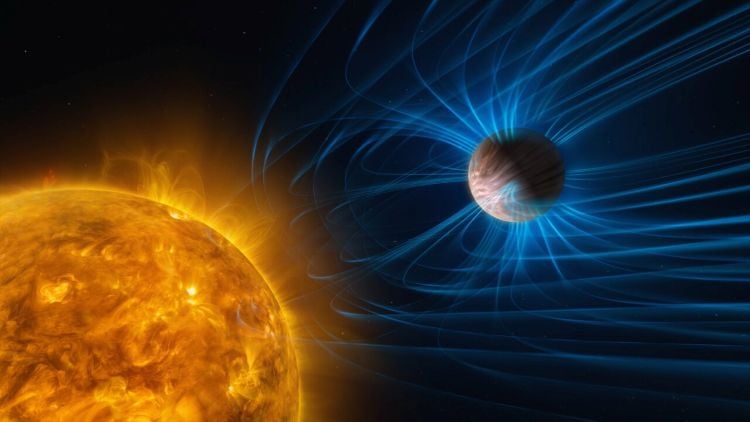
Even so, some observed properties have remained difficult to fit neatly into that layered picture. The source text notes that studies of the planets’ magnetic fields and heat distribution have continued to puzzle scientists. That is the opening the new UCLA-led modeling effort attempts to address.
What the new model proposes
According to the report, the researchers used computer simulations to test interior compositions and processes for both planets, with the explicit goal of confirming or challenging the long-standing “ice giant” framework. Their result points to a different internal architecture.
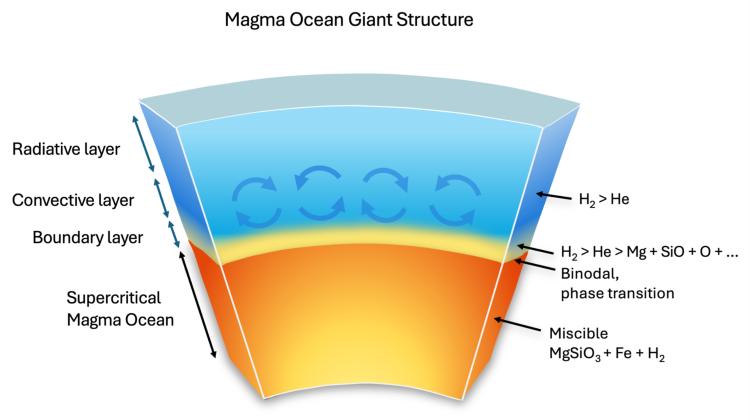
In the proposed model, the outermost layer remains a hydrogen and helium atmosphere that transports heat upward and radiates it into space. Beneath that lies a boundary layer containing several elements and compounds, including hydrogen, helium, magnesium, silicon monoxide, and oxygen. Below that, rather than a vast icy mantle, the model envisions a magma ocean made up of silicate, iron, and hydrogen.
That structure is a substantial departure from the standard picture. Instead of treating Uranus and Neptune as planets whose interiors are defined primarily by “ices,” it suggests a deep molten interior more closely associated with rocky material under extreme conditions. The label “magma worlds” is therefore provocative, but it follows directly from the study’s central claim about composition.
Why the model matters beyond nomenclature
The significance of the paper is not only semantic. Interior models affect how scientists explain planetary magnetic fields, thermal evolution, and long-term formation histories. If Uranus and Neptune contain magma oceans, that could help explain some of the observations that have not fit comfortably within older models.
The source text does not present the new framework as definitive. It explicitly notes that this is one among a number of possible models. That caution matters. Planetary interiors cannot be observed directly, so researchers infer them from external measurements, physical theory, and simulations. Competing models can coexist until new data constrain them more tightly.
Still, even as a candidate explanation, the UCLA team’s proposal appears important because it offers a coherent alternative to a long-standing assumption. For planets so central to comparative planetology, an alternative model with explanatory power immediately becomes consequential, especially when the old consensus has left some questions unresolved.
The exoplanet connection
The implications extend beyond Uranus and Neptune themselves. The study’s authors, as summarized in the source text, argue that these planets can serve as analogs for sub-Neptune exoplanets, which are described as the most common type of exoplanet in the galaxy. Those worlds typically range from roughly one to 4.5 times Earth’s radius.
That category is especially interesting because the solar system offers no close, well-understood twin to many of those exoplanets. If the internal makeup of Uranus and Neptune has been misunderstood, researchers may also need to revisit how they think about the formation and evolution of similar-size planets orbiting other stars.
In that sense, the study reaches into one of the biggest unresolved issues in exoplanet science. Astronomers have found enormous numbers of planets that do not map cleanly onto the familiar terrestrial and giant-planet categories of our own system. Better models for Uranus and Neptune could therefore provide a more useful template for interpreting a common class of alien worlds.
What comes next
For now, the findings remain part of an active scientific debate rather than a settled rewrite of planetary textbooks. The study has been submitted to The Astrophysical Journal, and the source text frames the result as a potentially important new interpretation rather than a final answer. That is appropriate for a field where observations are sparse and models carry much of the explanatory weight.
But the broader takeaway is clear: Uranus and Neptune remain far from fully understood, and even their basic classification may be less secure than their familiar nickname suggests. A magma-ocean interior would represent a major shift in how scientists describe the solar system’s outer planets and how they connect those planets to the broader exoplanet population.
Sometimes the most revealing discoveries do not come from a new spacecraft image or a dramatic instrument reading. They come from revisiting old assumptions with better models and asking whether a name that once seemed settled still matches the evidence. In the case of Uranus and Neptune, that question is now open again.
This article is based on reporting by Universe Today. Read the original article.
Originally published on universetoday.com