An unusual radio galaxy leaves a dramatic mark
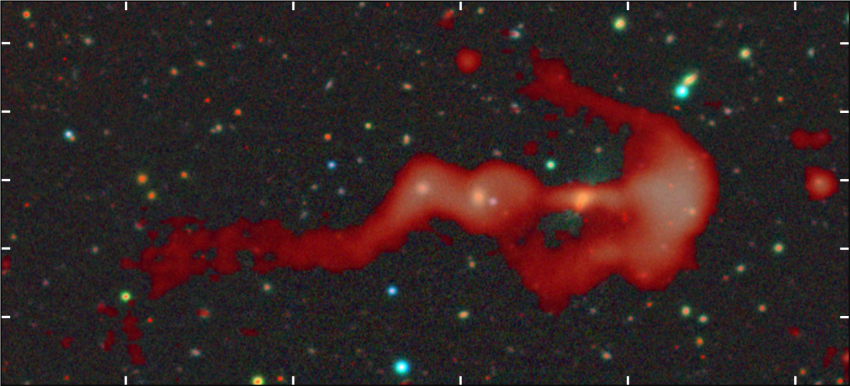
Astronomers have reported an exceptionally strange radio galaxy whose shape suggests it is racing through the gas between galaxies fast enough to create a giant bow shock. The object, named RAD-BAARG, was described as unlike the standard textbook picture of radio galaxies, and researchers say it may provide one of the clearest radio views yet of a galaxy falling headlong into a dense cluster environment.
The discovery, covered by Universe Today, centers on a structure nearly 1.8 million light years across. Rather than displaying the familiar symmetry of many radio galaxies, RAD-BAARG shows an uneven, distorted form: one side features a narrow jet feeding a broad arc of radio emission, while the other twists into an S-shaped structure before fading into a tail. That asymmetry is one of the strongest clues that something more dynamic than a conventional jet system is underway.
Why the shape matters
Most radio galaxies are recognized by paired jets launched in opposite directions from the region around a central black hole. Over enormous distances, those jets inflate lobes that often look broadly balanced. RAD-BAARG breaks that pattern. Its shape instead points to strong interaction with the environment around it.
The research team believes the galaxy is plunging into a massive cluster and moving faster than sound can travel through the hot gas that fills intergalactic space there. When an object moves supersonically through a medium, it can compress material ahead of it into a curved front known as a bow shock. The comparison is familiar in other settings: a boat pushes up a wave at its bow, and a supersonic aircraft generates a shock in air. In this case, the medium is the sparse but still physically consequential gas that permeates galaxy clusters.
That matters because space between galaxies is often imagined as empty. In reality, clusters contain hot, thin gas that can shape galaxies moving through it, especially at high speeds. If RAD-BAARG is indeed generating a bow shock, astronomers may be seeing direct evidence of those environmental forces sculpting a radio galaxy on a colossal scale.

A rare radio view of a predicted phenomenon
According to the report, shocks of this sort have been hinted at in X-ray observations before, but rarely seen so clearly in radio light. In RAD-BAARG, the plasma supplied by the central black hole appears to be illuminating the shock structure, turning what would otherwise be difficult-to-see physics into a visible radio feature.
That makes the object especially valuable. Bow shocks in cluster gas are not unexpected in theory, but capturing one in a form that is both large and morphologically distinct is harder. The radio emission offers a way to map where energetic particles and magnetic fields are interacting with the compressed gas, producing a picture of galaxy infall that is unusually direct.
The result is not merely a striking image. It is also a laboratory for studying how active galaxies evolve inside crowded cosmic environments. A galaxy falling into a cluster experiences pressure, turbulence, and gravitational complexity that can bend jets, distort lobes, and redistribute energy far from the galaxy itself.
How it was found
The discovery came from the LOFAR Two-metre Sky Survey, a major low-frequency radio mapping effort designed to detect faint radio structures across the sky. Low-frequency observations are particularly useful for tracing older and weaker emission that brighter or higher-frequency surveys can miss. That capability appears to have been central to identifying RAD-BAARG’s sprawling and unusual shape.
LOFAR, the Low Frequency Array, has become an important instrument for finding enormous and delicate radio features because of its sensitivity to diffuse emission. In a case like this, that sensitivity can reveal not just the presence of jets, but the environmental imprint left on them over time.
The report also notes a notable human detail behind the discovery. RAD-BAARG was first noticed not by a professional astronomer working at a major observatory, but by a student working remotely from the Himalayas. That makes the find a reminder that modern survey science is increasingly collaborative and can open meaningful paths for distributed participation in research.

What RAD-BAARG could reveal
If follow-up work confirms the interpretation, RAD-BAARG may help astronomers better understand how galaxies behave when they enter dense clusters at high speed. One question is how the jets from supermassive black holes interact with the external medium when the host galaxy itself is moving rapidly. Another is how shocks and turbulence affect the transport of energy through the intracluster gas.
Those are not niche issues. Galaxy clusters are among the largest gravitational structures in the universe, and the movement of galaxies through them plays a role in shaping both the galaxies and the cluster environment. Radio galaxies, because they inject energetic plasma over vast distances, are especially important actors in that process.
RAD-BAARG may also sharpen the distinction between intrinsic and environmental explanations for odd radio shapes. Astronomers often have to ask whether a distorted jet is being bent by motion through external gas, by changes in the black hole engine, or by gravitational interactions with neighbors. An object with such a pronounced arc and tail structure could become a benchmark case for testing those ideas.
A discovery with both scientific and observational value
For now, the immediate significance of RAD-BAARG is that it appears to provide an unusually clean view of a galaxy in motion through cluster gas, with a shock front traced in radio emission on an immense scale. That alone makes it notable among known radio galaxies. Its asymmetry, apparent bow structure, and cluster setting combine into a system that researchers describe as unlike any previously studied by the lead astronomer over decades of work.
Equally important, the discovery underscores the power of deep, sensitive sky surveys. As instruments like LOFAR continue to map the radio universe with higher fidelity, astronomers are likely to find more objects that do not fit older categories neatly. Those outliers often end up being the systems that teach the most.
RAD-BAARG may be one of them: a giant, distorted radio galaxy that not only looks unusual, but may also be exposing the shock physics of a fast cosmic plunge in a way astronomers have long expected and only rarely seen.
This article is based on reporting by Universe Today. Read the original article.
Originally published on universetoday.com