A small galaxy is offering a bigger clue to one of cosmology’s oldest questions
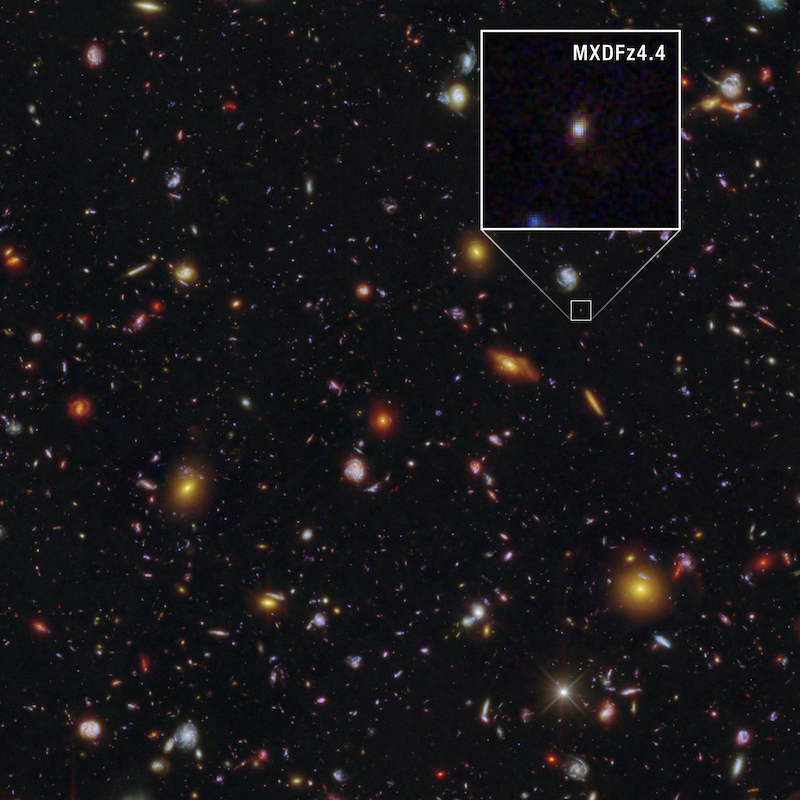
Astronomers studying the early universe say they have found an unusually clear example of a galaxy helping to transform the cosmos from opaque to transparent. The object, known as MXDFz4.4, is being seen as it existed about 1.4 billion years after the big bang, when much of the universe was still emerging from what researchers describe as a fog of hydrogen gas. According to the supplied source material, the Hubble Space Telescope detected ionising light from this galaxy, a finding that could sharpen scientists’ understanding of how the universe passed through the Era of Reionisation.
That era marks one of the most important transitions in cosmic history. After the big bang, matter cooled enough for neutral hydrogen to form, and that gas absorbed much of the ultraviolet light trying to move through space. The result was a universe that was not yet fully transparent to the kinds of radiation produced by hot young stars. Over time, something changed that. Radiation from early sources began stripping electrons from hydrogen atoms, turning the gas ionised and allowing light to travel more freely across enormous distances.
The unresolved question has long been what sources drove that change and how efficiently they did it. MXDFz4.4 does not answer the entire problem on its own, but the supplied report presents it as the first galaxy of its kind observed this close to that early epoch while still showing the very radiation capable of clearing surrounding hydrogen.
Why this detection matters
The central significance of MXDFz4.4 is not merely that it is old. It is that Hubble was able to detect ionising light from it at all. In the framework described by the source text, that light should have been heavily suppressed by the hydrogen-rich environment of the early universe. Yet astronomers still saw evidence of it, suggesting that at least some galaxies were producing enough intense radiation, and opening enough channels through their own surrounding gas, for that energy to escape into intergalactic space.
The report says the previously earliest galaxy observed leaking this kind of light was seen at a cosmic time of 1.6 billion years after the big bang. MXDFz4.4 pushes that observational frontier earlier, to 1.4 billion years. In cosmological terms, that shift is meaningful because it moves direct evidence of escaping ionising radiation closer to the era when reionisation was still actively reshaping the universe.
Researchers also appear to think MXDFz4.4 is not unique. The source says astronomers suspect it is far from alone, implying that compact, intensely star-forming galaxies may have been more common contributors to reionisation than direct detections have so far revealed. If so, the new observation is valuable not just as a record-setter, but as a template for what to search for next.
A galaxy small in size, intense in output
One of the striking details in the supplied text is the mismatch between MXDFz4.4’s size and its activity. The galaxy is described as around one hundred times smaller than the Milky Way, yet forming new stars about ten times faster. That combination points to an environment packed with young, hot, massive stars capable of producing large amounts of ultraviolet radiation.
Those stars are central to the reionisation story. Massive stars emit the energetic light needed to ionise hydrogen, but they also live briefly and die violently. The source text says the team believes anywhere from half to all of MXDFz4.4’s ionising ultraviolet light may be escaping into space. It also notes that supernova explosions from short-lived massive stars can punch holes through surrounding gas, opening routes for more radiation to stream outward.
That picture matters because it offers a concrete physical mechanism rather than an abstract statistical contribution. A galaxy like MXDFz4.4 may be clearing its own neighborhood by combining two effects at once: sustained production of intense ultraviolet light, and repeated structural disruption of the gas that would otherwise trap that radiation. In that sense, the galaxy is not merely bright. It is dynamically making itself more transparent.
How multiple observatories contributed
The detection relied on more than one telescope. Hubble played the pivotal role because the galaxy’s light has spent more than 12 billion years traveling to Earth and has been stretched by the expansion of the universe from ultraviolet into visible wavelengths that Hubble can detect. That wavelength shift is a standard consequence of cosmic expansion, but here it becomes a practical observational advantage: radiation once emitted in the ultraviolet arrives in a form that an Earth-orbiting observatory can capture.
The supplied article says the James Webb Space Telescope was then used to estimate the galaxy’s mass and reconstruct its history, while the Very Large Telescope in Chile helped determine its precise location. That multi-observatory approach reflects the way frontier astronomy now works. No single instrument necessarily provides all the needed answers. Instead, researchers combine the strengths of different telescopes: Hubble for the key detection in accessible wavelengths, Webb for physical characterization, and ground-based facilities for positional confirmation.
Even within that collaboration, Hubble’s role is notable. Years after the launch of newer observatories, it remains capable of producing results that alter the timeline of what astronomers can directly observe in the early universe. In this case, it helped identify a galaxy that may sit closer to the heart of the reionisation era than previous confirmed examples.
What the finding does and does not establish
The supplied source frames the discovery as the closest look yet at the moment the universe cleared, but that should not be mistaken for a claim that one galaxy single-handedly solved reionisation. Rather, MXDFz4.4 provides evidence that galaxies with extreme star formation and strong escape of ionising radiation existed early enough to contribute materially to the process.
That distinction is important. Reionisation was a global transformation occurring over an extended period, not a one-time event triggered by a lone object. The significance of MXDFz4.4 is that it strengthens a leading explanation: numerous energetic, compact galaxies may have collectively supplied the ultraviolet output needed to ionise vast amounts of intergalactic hydrogen.
The source text also implies that astronomers are still dealing with observational scarcity. If this is the first such galaxy seen this close to the dawn of time, then direct examples remain limited. That makes each detection disproportionately useful, because it constrains models that otherwise rely heavily on inference. Researchers can compare simulated early galaxies with actual properties such as size, star-formation intensity, and inferred escape fraction of ionising light.
A clearer path into the universe’s early history
What makes this finding compelling is the way it joins a dramatic cosmic question with a specific, measurable object. Reionisation is often described in broad theoretical terms, but MXDFz4.4 gives that transition a tangible face: a compact galaxy crowded with hot stars, blowing holes in its own gas and letting energetic light leak into the wider universe.
That does not close the case. It does, however, move the evidence base in a useful direction. By pushing the known frontier of escaping ionising radiation back to 1.4 billion years after the big bang, astronomers gain a closer observational anchor for understanding how the universe’s long hydrogen fog began to lift.
If additional galaxies like MXDFz4.4 are found, the picture could sharpen quickly. Scientists would be able to test whether this object is exceptional or representative of a broader class of early systems. For now, the message from the observation is more focused: at least some small galaxies in the young universe were powerful enough, and porous enough, to help make the cosmos transparent.
This article is based on reporting by Universe Today. Read the original article.
Originally published on universetoday.com