Why Habitable Zones Alone Are Not Enough
When astronomers first began cataloguing worlds beyond our solar system, the search for life-friendly conditions rested on a single, tidy benchmark: an exoplanet sitting inside its star's habitable zone, the band of orbital distances where liquid water could plausibly persist. That criterion was treated as a reasonable proxy for an Earth-like world, and for a long while it framed most of the conversation about habitability.
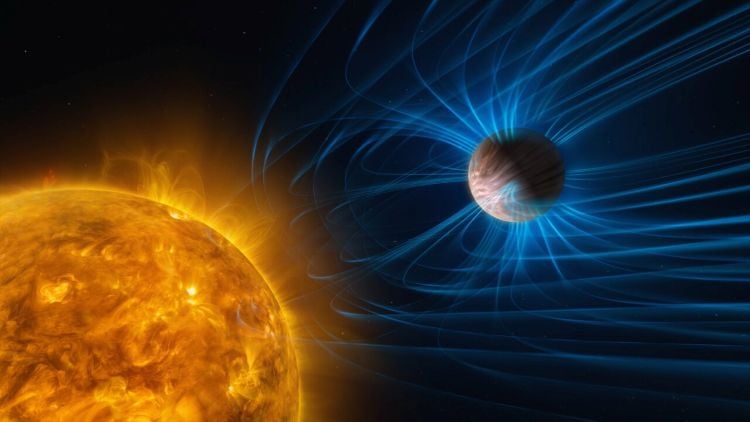
That picture has become considerably messier. Researchers now understand that many stars are far more active than our own Sun, meaning planets orbiting within the habitable zone of such stars can be subjected to radiation levels that Earth would never survive. The zone may be in the right place, but the environment inside it can still be brutal.
In response, attention has shifted toward another ingredient that makes Earth livable: its magnetic field. By deflecting harmful charged particles, Earth's magnetosphere acts as a planetary shield, and astronomers increasingly regard a similar field as a prime characteristic to look for when judging whether a distant world could resemble our own. The problem is that planetary magnetic fields are extraordinarily difficult to observe across interstellar distances.
A New Chapter in the SKA Science Case
That observational gap is the subject of a chapter in Advancing Astrophysics with the SKA II, a 2026 science book sponsored by the Square Kilometre Array Observatory (SKAO). An international team of scientists contributed the chapter, arguing that the SKA — a next-generation radio facility — could transform how magnetic fields are studied not only on exoplanets but also on ultracool dwarfs, or UCDs.
The researchers' case rests on an unusual strategy: rather than treating exoplanets as an entirely new problem, they propose building directly on decades of radio astronomy aimed at small, dim stars. The chapter draws on mathematical equations and computer models to explore what the SKA might realistically achieve, positioning the telescope as a potential turning point for a research area that remains, by the authors' own framing, in its early infancy.
Ultracool Dwarfs as a Radio Laboratory
UCDs are stars smaller and cooler than the Sun, and the category includes brown dwarfs — objects that fall between Jupiter and the Sun in size but never grew massive enough to ignite sustained nuclear fusion. Despite their faintness, UCDs have been producing detectable radio waves for decades, giving astronomers a long-running dataset to work with.
That history matters. The only recent hint of a magnetic field on an exoplanet came from radio waves that could indicate auroral emissions, a signal type that is still novel in the exoplanet context. For UCDs, by contrast, radio detections are familiar territory. The chapter therefore treats these small stars as natural test beds whose behaviour can inform how the SKA searches for, and interprets, magnetic activity on planets.
From Known Sources to Unknown Worlds
By anchoring the search in objects already known to emit radio waves, the team aims to reduce the guesswork involved in hunting for signals from exoplanets. The underlying physics of auroral radio emission should, in principle, translate between a brown dwarf and a planet, making UCDs a practical calibration point for a much harder measurement.
What the SKA Could Actually Measure
According to the chapter, the SKA's capabilities could allow far more than a simple yes-or-no answer about whether a planet has a magnetic field. The authors describe a scenario in which detected auroral radio signals serve as the entry point for characterising an exoplanet's magnetic environment in detail.
- Auroral radio signals: the primary signature that would reveal a magnetic field's presence.
- Magnetic field properties: using the radio emission to constrain the field itself.
- Radiation belts: the trapped-particle regions that surround magnetised planets, Earth included.
- Potential satellites: the possibility of identifying accompanying bodies, a topic the researchers touch on only once in the paper, using the term "exomoon."
The inclusion of radiation belts is significant because these structures are a direct consequence of a sustained magnetic field interacting with its star's particle environment. Detecting them remotely would give astronomers a far richer portrait of a planet than a single detection could provide.

Interferometry and Astrometry: The Tools Behind the Search
The chapter outlines two observational techniques as central to this work. Interferometry combines data collected from multiple telescopes, effectively creating the resolving power of a much larger instrument — an approach essential for pinpointing faint radio sources at enormous distances. Astrometry, meanwhile, relies on precise measurements of distances and the movements of stars, providing the positional framework needed to connect a radio signal to a specific planetary system.
Together, these methods would let the SKA not only spot candidate emissions but also place them in a reliable astrophysical context. That combination is what separates a promising anomaly from a measured property of a distant world.
A Field Still Finding Its Footing
The researchers are careful to present this as a beginning rather than a finished technique. Exoplanet magnetic field science is young, with only recently reported radio waves offering a possible sign of a field through auroral emission. The SKA's contribution, as described in the chapter, would be to take the well-established study of UCD magnetism and extend its logic outward to planets.
If that extension works, the payoff reaches beyond planetary science. Magnetic fields influence how atmospheres survive, how radiation is absorbed, and ultimately whether a world in a habitable zone can hold onto conditions that life might tolerate. Refining that criterion would sharpen the target list for future atmospheric studies and biosignature hunts.
The Bottom Line
For years, habitability discussions revolved around orbital distance. The SKA chapter pushes the conversation toward something harder to see but arguably just as decisive: the invisible shielding that surrounds a planet. By leveraging decades of radio observations of ultracool dwarfs and deploying interferometry and astrometry, astronomers hope the SKA can begin detecting and characterising magnetic fields, radiation belts, and possibly even moons around distant exoplanets — turning a long-theorised marker of Earth-like conditions into an observable one.
This article is based on reporting by Universe Today. Read the original article.
Originally published on universetoday.com