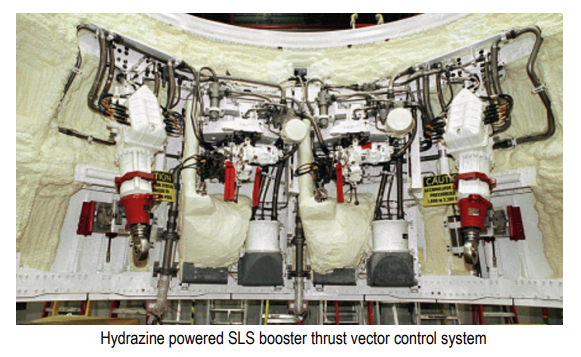
NASA has published a technical bulletin flagging freeze–thaw exposure as a significant and often underestimated hazard for hydrazine monopropellant systems. Written for teams that operate propulsion and auxiliary hydrazine hardware, the document consolidates decades of flight experience into a single risk profile, showing how a phase change that begins barely above freezing can ripple through an entire spacecraft system — cracking lines, distorting valves, degrading seals, and ultimately limiting mission life.
The bulletin is distributed across NASA's engineering community, with Jonathan E. Jones of Langley Research Center listed as the contact for further information, and a downloadable PDF version accompanying the summary. Its stated purpose is twofold: to communicate the risks associated with freeze–thaw cycling in hydrazine systems, and to provide general recommendations for mitigating damage, operational hazards, and loss of system reliability in both propulsion and auxiliary applications.
A Propellant That Freezes Just Above Zero
Hydrazine's defining thermal quirk is easy to overlook. The compound, chemically N2H4, freezes near 1.6°C — a threshold that can be reached in shaded structures, during long coast phases, or in ground handling environments that would hardly register as extreme. Once the transition begins, the material no longer behaves as a simple liquid, and the hardware containing it absorbs the consequences.
NASA's thermodynamic data reinforce that point. Density and pressure both shift substantially across hydrazine's phase transition, which is why propellant lines are considered particularly sensitive to freeze–thaw stress. A line that performs flawlessly at ambient temperature can become a structural liability when the propellant inside it changes state and then changes back.

Lessons Carried Forward From Three Sources
The bulletin's warnings are grounded in historical experience rather than theory alone. Three threads of evidence shape its conclusions:
- Space Shuttle auxiliary power units. Hydrazine lines on the shuttle APU systems were vulnerable to a two-stage failure: contraction during freezing, followed by over-expansion during thaw, with enough force to burst plumbing. Flight rules reflected the severity of that risk by permitting no more than two freeze–thaw cycles before a system was treated as degraded or failed.
- Voyager's propulsion systems. As hydrazine temperatures approached the freezing and slush formation range of roughly 0.1°C to 1.6°C, the missions faced scenarios that could have been mission-threatening. Preventing frozen lines, blockages, and thruster malfunction required detailed thermal modeling rather than simple temperature monitoring.
- Thermodynamic property studies. Confirming the physical basis for the concern, hydrazine's density and pressure behavior across phase transitions shows why propellant lines are so exposed to freeze–thaw stress.
Together, these lessons form the foundation on which the bulletin builds its risk identification and mitigation guidance.
Six Critical Risks Identified
The bulletin organizes the consequences of freeze–thaw exposure into six categories, each of which can impair a system independently or compound the others.
Structural Damage and Superpacking
As hydrazine freezes, it contracts. That contraction draws additional propellant into confined lines, creating what the bulletin describes as "superpacked" conditions. When the material thaws and expands again, the resulting pressure can rupture lines or fittings outright.
Valve, Seal, and Diaphragm Compromise
Elastomeric components and precision valve seats are exposed to differential thermal expansion — different materials responding to the same temperature swing at different rates. The result can be cracking, distortion, or a loss of sealing capability. Voyager's thermal assessments specifically highlighted how susceptible long stainless steel runs were to asymmetric temperature profiles.
Line Blockage and Slush Formation
Hydrazine does not always make a clean transition between solid and liquid. Partially thawed propellant can remain slushy, restricting flow, altering mass flow rates, and setting up thruster hard starts or misfires at exactly the moment a system needs to perform reliably.
Hazardous Leaks
Damage caused by freezing can allow hydrazine to escape its confinement. That outcome carries significant toxicity and reactivity concerns, along with serious exposure hazards for ground crews working around the affected hardware.
Loss of System Reliability
Even when hardware survives a freeze–thaw event without visible failure, it does not come through unchanged. As documented across shuttle operations, hydrazine systems exposed to these cycles become life limited, eroding redundancy and reducing overall mission availability.
Thermal Margin Uncertainty
Perhaps the most subtle risk is one of measurement. Voyager's experience demonstrated that simple temperature readings cannot reliably establish a line's true internal temperature. That gap between measured and actual conditions means engineers may be operating with less thermal margin than their instrumentation suggests.

Why the Bulletin Matters
Hydrazine remains central to propulsion and auxiliary functions across a wide range of vehicles, and much of that hardware is designed to sit dormant for extended periods before being called on. Freeze–thaw exposure quietly undermines that readiness. A system that has cycled through freezing and thawing may still pass superficial checks while carrying cumulative damage that only reveals itself during a critical maneuver.
The bulletin's value lies in consolidating institutional knowledge that might otherwise remain scattered across program documentation. By connecting shuttle flight rules, Voyager thermal analysis, and propellant property data into a single framework, it gives engineers a common reference for identifying where risk concentrates — the confined line segments, the elastomeric seals, the long stainless runs exposed to uneven temperatures — and where monitoring alone may be insufficient.
Its second function is prescriptive. The bulletin is intended to supply general recommendations for mitigating damage, operational hazards, and reliability loss, with the full PDF available for teams that need the complete guidance. Readers seeking more detail can reach Jonathan E. Jones at NASA's Langley Research Center.
For mission planners, the takeaway is straightforward: hydrazine's 1.6°C freezing point is not a comfortable buffer but a narrow boundary that flight hardware periodically crosses. Treating each crossing as a potentially life-limiting event — and designing, testing, and operating accordingly — is the posture the bulletin advocates.
This article is based on reporting by NASA. Read the original article.
Originally published on nasa.gov