A Milestone Orbit and a Supernova Worth Waiting For
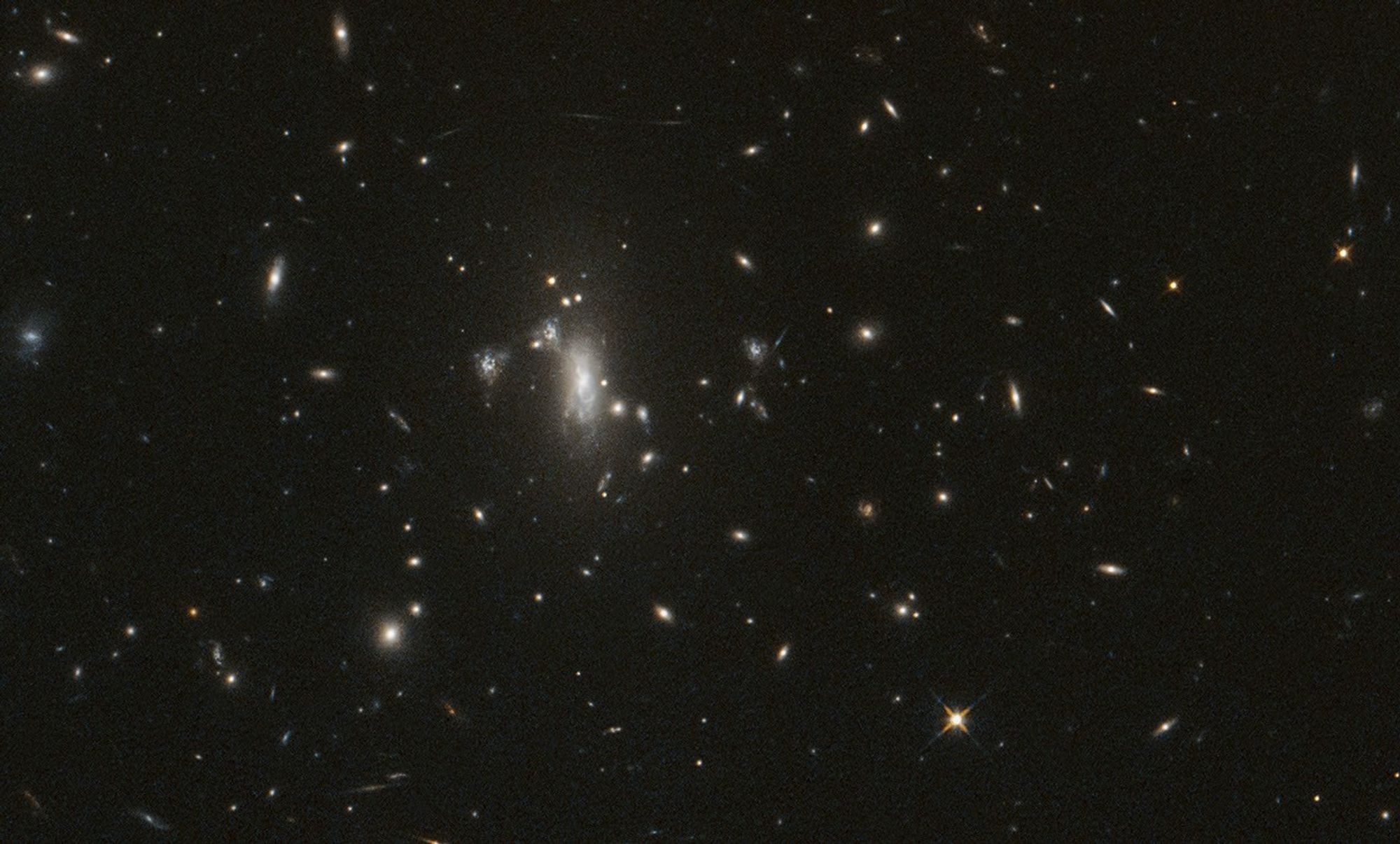
NASA's Hubble Space Telescope has added another entry to a career already crowded with them. On Sept. 19, 2026, the observatory captured a new view of MACS J0417, a massive galaxy cluster whose gravity warps and magnifies the light of objects far behind it. The same day, Hubble completed its 200,000th orbit around Earth — a milestone NASA highlighted alongside the new image, which was published on Sept. 23, 2026 by the agency's HQ Web Team.
Neither development is an isolated curiosity. The MACS J0417 observations form part of a repeated monitoring campaign, and the target of that campaign is a supernova that astronomers expect to show up more than once.
A Cluster That Behaves Like a Lens
MACS J0417 appears slightly left of center in Hubble's frame, but its visual placement is the least interesting thing about it. The cluster is a gravitational lens: its enormous mass bends the path of light passing near it, so radiation from remote galaxies and other distant objects arrives at the telescope magnified and distorted. NASA describes the cluster as bending and magnifying light from objects far behind it.
That property makes clusters like MACS J0417 valuable tools. Astronomers effectively borrow the gravity of the foreground cluster to build a natural telescope, one that can bring faint, extremely distant sources into view or brighten them enough to be studied in detail. The tradeoff is complexity — lensed images are stretched, sometimes duplicated, and often require careful modeling before they can be interpreted.
Hubble's new image is not a standalone portrait. It is one frame in a series, gathered so researchers can track changes over time rather than capture a single moment.
Supernova Athena and the Case of the Returning Explosion
The object at the center of that monitoring effort is supernova Athena, discovered in 2025 by NASA's James Webb Space Telescope. Athena is predicted to reappear between now and early March 2027, giving astronomers a defined window in which to look for it again.
A supernova that can be observed more than once is a rare and scientifically valuable thing. The effect arises from the lensing geometry: when a foreground cluster redirects light from an explosion in the distant background, that light can travel along more than one route to reach the telescope. Paths of different lengths produce different arrival times, so astronomers see the same event at staggered moments, with gaps set by the shape and mass distribution of the lens in between.
Watching for Athena's return is therefore a waiting game with a deadline. The forecast window runs from now through early March 2027, and every additional appearance adds data to the record. Hubble's repeated passes over MACS J0417 are the mechanism by which those appearances can be caught.
Why the Timing Matters So Much
Recording when Athena reappears — and how long the intervals between appearances last — is not just a scheduling exercise. NASA notes that the timing of the supernova's reappearances can help researchers map the mass of MACS J0417, which serves as the magnifying foreground lens, and can refine our understanding of the expansion rate of the universe.
The two goals are linked. The delays between lensed images depend on how mass is arranged inside the cluster, so measuring those delays offers a way to probe the lens itself, including material that is otherwise difficult to detect. In turn, a well-characterized lens helps astronomers use the distant supernova as a benchmark for studying how the cosmos expands. Time-delay measurements of this kind have long interested cosmologists precisely because they lean on geometry and gravity rather than on brightness alone.
Refining the expansion rate is one of the more consequential pursuits in modern astronomy, since different measurement techniques have produced results that do not fully agree. Any independent method that can contribute a data point carries real weight, which is why a single reappearing supernova can punch above its weight.
200,000 Orbits and Counting
While Hubble was training its instruments on MACS J0417, the spacecraft was quietly closing out a much simpler statistic. On Sept. 19, 2026, it finished its 200,000th orbit around Earth.
Taken on its own, an orbit count is just arithmetic. In context, it is a measure of endurance. Hubble has kept working through decades of observing cycles, returning images and data that NASA credits with transforming our understanding of the universe. The 200,000th orbit and the MACS J0417 image landed on the same day, a coincidence that neatly captures what the mission has become: an observatory that is simultaneously a historic institution and an active, working instrument.
What to Watch For Next
The immediate priority is Athena. Between now and early March 2027, astronomers will be looking for the supernova to appear again in observations of MACS J0417. Each detection sharpens the timing record and improves the mass model of the cluster, feeding back into the broader question of cosmic expansion.
The key facts of the campaign:
- Hubble captured an image of galaxy cluster MACS J0417 on Sept. 19, 2026, with the cluster positioned left of center in the frame.
- MACS J0417 acts as a gravitational lens, bending and magnifying light from objects far behind it.
- Supernova Athena was discovered in 2025 by NASA's James Webb Space Telescope.
- Athena is predicted to reappear sometime between now and early March 2027.
- Measuring the timing of those reappearances can help map the cluster's mass and refine understanding of the universe's expansion rate.
- Hubble completed its 200,000th orbit around Earth on Sept. 19, 2026.
Whatever Athena does next, the observation campaign connects two very different scales of astronomy: the slow, massive architecture of a galaxy cluster and a single star's explosive end, made visible again and again because gravity arranged the light into a delayed sequence. Hubble, having just finished its 200,000th lap around the planet, is the instrument doing the looking.
The image is credited to NASA, ESA, and STScI, with M. Pascale of UCLA; image processing was handled by J. DePasquale of STScI.
This article is based on reporting by NASA. Read the original article.
Originally published on nasa.gov