Asteroids do not come with a warning label. While no known asteroid is currently on a collision course with Earth, astronomers are finding thousands of new ones every year, and the possibility of a future impact is real enough to justify serious planetary-defense planning. The DART mission proved that a kinetic impactor—essentially a large rod designed to push an asteroid off its trajectory—can move a small asteroid. But the technique has a significant limitation, and a team at Beihang University is proposing a different approach: use a new type of solar sail to strike a hazardous asteroid head-on.
Why asteroid defense needs multiple options
The case for developing more than one deflection method begins with uncertainty. The catalog of near-Earth objects keeps growing, and even though none of the known asteroids is currently headed for Earth, the next dangerous object could be discovered with limited warning. Deflection is not a single technology but a family of possible responses, each with different timing, mass, and energy requirements.
DART demonstrated one of those responses. By crashing into the small asteroid Dimorphos, the mission showed that a kinetic impactor can alter an asteroid’s motion. That result was a milestone for planetary defense. It did not, however, solve every operational problem. The geometry of the DART encounter is especially important, because it shaped how much energy the spacecraft could deliver.
What DART proved and what it left unresolved
DART succeeded by moving a small asteroid with a kinetic impactor, a big rod designed to push the asteroid off its trajectory. The mission proved that the basic technique is viable. But DART had one big flaw: it was traveling in the same direction as the asteroid and approached from behind. The impactor was launched while the spacecraft was in orbit around the asteroid, which meant the collision geometry was constrained by the asteroid’s own motion around the Sun.
That approach can work if there is enough warning. It would, however, require years of orbital mechanical maneuvering to pull off. The impactor has to catch up with the target, match its direction, and then strike it. In a real emergency, those years may not be available. A faster, more direct option would be valuable—especially one that can deliver far more energy per kilogram of spacecraft mass.
The energy argument for a head-on impact
Deflecting an asteroid with an impactor comes down to one simple factor: energy. The more energy transferred from the impactor to the asteroid, the more the asteroid will move. And energy increases with the square of velocity. In other words, the faster an object hits, the more energy it imparts to its target.
DART smashed into Dimorphos at about 6 kilometers per second. That is a respectable speed, but it was limited by the fact that the spacecraft was coming from the same direction as the asteroid. According to the new paper from Beihang University, an impactor using a solar sail can approach an asteroid from the opposite direction—akin to a wrong-way highway driver—and smash into its target at around 100 kilometers per second. That higher closing speed would impart something like 230 times the force per kilogram of impactor mass compared with the DART test.
That difference matters enormously for mission design. A head-on strike at 100 kilometers per second would allow a relatively small impactor to transfer a large amount of momentum. Instead of relying on brute-force mass, a solar-sail impactor could exploit velocity to make every kilogram count.

The retrograde problem
The catch is getting the spacecraft moving in the opposite direction. Almost everything orbits the Sun in a counter-clockwise direction, including Earth. When something launches from Earth, it is already moving that way. Reversing that direction and entering a clockwise, or retrograde, orbit requires a lot of energy, to put it mildly.
Chemical rockets are not capable of it. The tyranny of Tsiolkovsky’s rocket equation makes it impossible for them to carry enough fuel to complete that maneuver. The rocket equation ties the amount of propellant needed to the change in velocity, and a retrograde trajectory demands an extreme velocity change. As a result, a conventional chemical mission to a retrograde intercept is not a realistic option.
Solar sails potentially can do it. That is the central claim behind the Beihang University proposal. Instead of carrying propellant, a solar sail gradually changes its trajectory by using sunlight itself as a source of momentum.
How solar sails could enable a reverse trajectory
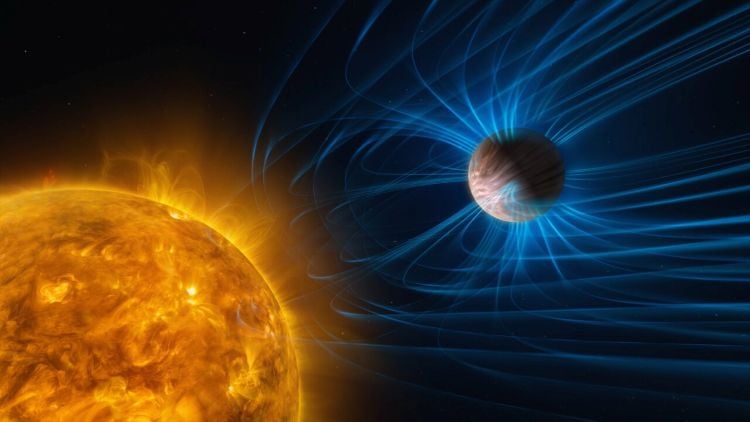
Solar sails work by harnessing solar radiation pressure—the tiny amount of force that a photon imparts when it runs into something. In essence, they sail on sunlight rather than requiring fuel like a traditional chemical or ion rocket. The force from any single photon is minuscule, but a large, lightweight sail can collect that pressure over a broad area and use it to slowly accelerate a spacecraft.
The Beihang University concept centers on a new type of solar sail capable of performing the difficult work of reversing direction. The proposed diffractive solar sail would not produce a sudden burst of thrust. Instead, it would harvest solar radiation pressure over time, allowing the spacecraft to change its orbit without the mass penalty of chemical propellant. That is what makes a retrograde intercept potentially feasible.
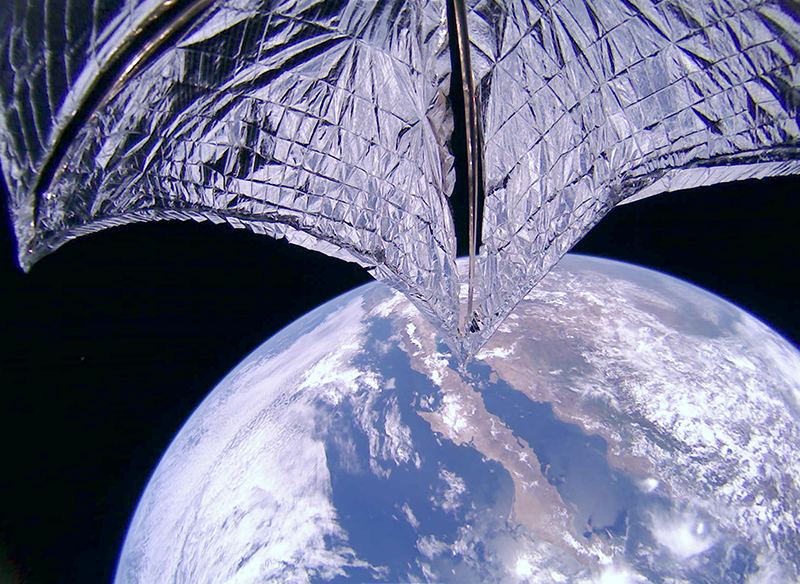
Solar-sail technology has already been tested in space. The Planetary Society’s LightSail 2 deployment, shown in mission imagery associated with the article, demonstrated the kind of sail hardware that such a concept would build upon. A planetary-defense version would need to be far more capable, but the underlying principle is the same: use sunlight to push a spacecraft where a fuel-limited rocket cannot go.
Why early detection remains essential
A 100-kilometer-per-second head-on impact would be an extraordinary deflection tool, but it would not eliminate the need for early warning. The solar sail’s advantage comes from its ability to change trajectory without fuel, yet that advantage depends on time. The sail must deploy, accelerate, and maneuver into a retrograde orbit before the asteroid arrives at the intercept point.
If a hazardous asteroid is discovered only months before impact, even a high-energy impactor may not have enough time to reach it. If it is discovered years or decades in advance, a slow but persistent solar sail could have the time it needs to set up the encounter. That makes asteroid surveys and tracking programs a critical part of the same planetary-defense system.
The strategy also depends on precise knowledge of the target. Mission planners need to know the asteroid’s orbit, size, composition, and spin. Those details determine how the object will respond to an impact and whether a deflection attempt will push it safely away from Earth or simply fragment it in an unpredictable way.
What remains to be proven
The physics of energy transfer is straightforward. The engineering is not. A solar-sail impactor would need to deploy reliably, survive the space environment, navigate accurately, and sustain the necessary trajectory over a long mission. It would also need to reach a retrograde orbit, a maneuver that chemical rockets cannot perform but that solar sails could potentially achieve.
DART has already shown that a kinetic impact can change an asteroid’s motion. LightSail 2 has shown that solar sails can be deployed in space. The Beihang University proposal combines those two lines of evidence into a new planetary-defense concept. The next step would be to test the required sail performance, trajectory control, and intercept timing in a dedicated mission.
None of that makes the concept ready today. It does make it worth studying. If the approach works, it would add a high-energy option to the planetary-defense toolbox—one that could strike an incoming asteroid from the opposite direction rather than chasing it from behind.
The bottom line
The risk of a killer asteroid is low in any given year but not zero. DART proved that humanity can move an asteroid with a kinetic impactor. The Beihang University proposal argues that a diffractive solar sail could enable a head-on strike at roughly 100 kilometers per second, delivering about 230 times the force per kilogram of impactor mass compared with DART. The hard part is reaching retrograde orbit. Chemical rockets cannot carry enough fuel, but solar sails potentially can. If the technology matures and early-warning systems improve, a sunlight-driven impactor could become a powerful new line of defense against a future threat.
This article is based on reporting by Universe Today. Read the original article.
Originally published on universetoday.com