One of the Solar System’s most famous features may be the remains of a destroyed moon
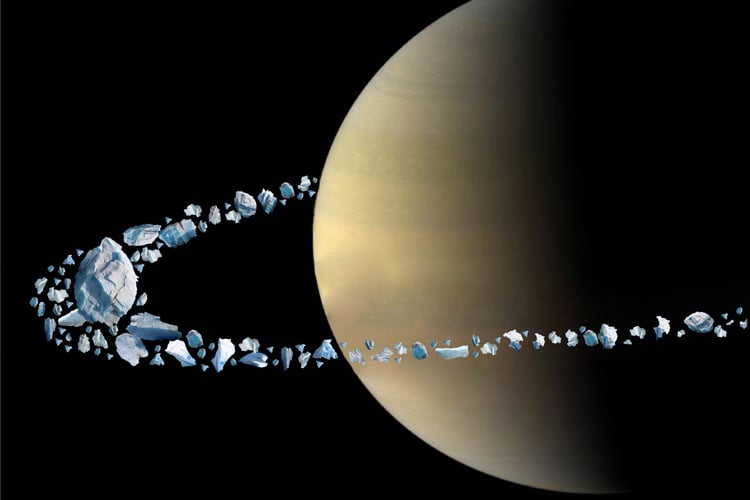
Saturn’s rings are so visually defining that it can be easy to forget they are also a major unresolved scientific problem. Researchers have long debated not only how the rings formed, but also why they appear comparatively young in planetary terms. A new modeling effort presented at the 57th Lunar and Planetary Science Conference argues that one of the leading explanations still holds up: the rings may have been created when an ancient moon, nicknamed Chrysalis, ventured too close to Saturn and was torn apart by gravity.
The idea is compelling because it links several puzzles at once. Scientists estimate that Saturn’s rings formed roughly 100 million years ago, far later than the planet itself. That relatively recent age has encouraged the search for a disruptive event capable of generating a large volume of icy material on the right timescale. A moon breakup inside Saturn’s tidal danger zone remains one of the most plausible mechanisms.
The latest work, according to the supplied report, comes from researchers in the United States and China who used a series of computer models to test the longstanding Chrysalis scenario. Rather than treating the moon as a simple object, the team explored what would happen if a body of substantial size and layered composition moved on an elongated orbit that repeatedly carried it close to Saturn.
The Roche limit is central to the theory
At the core of the model is the Roche limit, the minimum distance at which a smaller body can orbit a larger one without being pulled apart by tidal forces. The exact threshold depends on the composition and internal structure of the smaller object, but the broader principle is straightforward. Get too close to a massive planet and gravity no longer acts uniformly enough to hold the object together.
That makes the Roche limit a natural framework for explaining ring formation. If an icy moon crossed into that region, it could be shredded into debris. Some of that material might then spread into a ring system instead of recombining into a new moon. For Saturn, whose rings are dominated by ice, that possibility has long been especially attractive.
The new modeling work set Chrysalis at about the size of Iapetus, one of Saturn’s major moons, with an estimated diameter of 1,469 kilometers. The hypothetical moon was treated as differentiated, meaning it had internal layers made from water ice and rock rather than being compositionally uniform. That detail matters because the mix of materials influences how the body responds to tidal stress and what kind of debris it leaves behind.
Researchers tested different internal compositions and orbital paths
To explore plausible outcomes, the team modeled Chrysalis using two different ice fractions: 50 percent and 80 percent. Those compositions were chosen to resemble the known makeups of Saturnian moons such as Dione and Iapetus. This is an important constraint because it keeps the exercise tied to objects that already exist in Saturn’s broader satellite family, rather than relying on a moon with highly unusual properties.
The orbital scenario was equally important. In the model, Chrysalis began on an elliptical orbit starting around 200 Saturn radii from the planet and then sweeping inward to roughly 1 to 1.5 Saturn radii at closest approach. That near-pass range corresponds approximately to the Roche limit for icy planetary bodies. In other words, the moon’s path was designed to test the conditions under which tidal destruction would become likely.
The result, as summarized in the source text, is that Chrysalis came too close to Saturn during one of those passes and was ripped apart by the planet’s gravity. That outcome strengthens the case that a catastrophic moon-loss event could account for the origin of the rings without requiring an exotic external trigger.
Why the age of Saturn’s rings remains such a big deal
The estimate that Saturn’s rings are about 100 million years old is one of the most consequential elements in the debate. Saturn itself formed billions of years ago, so a youthful ring system implies either that rings are transient and happen to be visible to us in a relatively brief window, or that some later event refreshed or created them. The Chrysalis hypothesis directly addresses that timing problem by proposing a moon that survived for most of Saturn’s history before eventually entering a fatal orbit.
If correct, that would make the rings a comparatively recent addition to the Solar System’s architecture. It would also mean the familiar view of Saturn from telescopes and spacecraft reflects a dynamic planetary history rather than a primordial one. The planet’s signature feature would be less a permanent identity and more the aftermath of orbital instability.
That is part of what makes this line of research so interesting. Planetary systems can appear stable over immense timescales while still containing pathways to sudden transformation. A moon nudged onto the wrong trajectory can become a debris field. A debris field can become rings. Over time, those rings may themselves evolve, spread, darken, or dissipate.
What the new study does and does not settle
The conference presentation does not close the case on Saturn’s rings, and the source material itself presents the result as a step toward solving the problem rather than a final answer. That is the correct level of caution. Modeling can show that a scenario is plausible and internally consistent, but plausibility is not the same as proof.
Even so, the work appears to strengthen a specific formation pathway by grounding it in realistic moon sizes, layered internal structures, and orbital behavior near the Roche boundary. Instead of asking only whether a moon could in principle be destroyed, the researchers examined how a Chrysalis-like body with Saturnian analogs might behave under those conditions.
That makes the study valuable whether or not Chrysalis existed exactly as modeled. It narrows the argument toward physically credible pathways and away from more speculative explanations. In planetary science, that is often how progress happens: not by instantly solving a mystery, but by ruling in the scenarios that best fit the mechanics.
A familiar planet still has the power to surprise
Saturn’s rings have inspired centuries of observation, yet they continue to raise fundamental questions about timing, structure, and origin. The new Chrysalis modeling reminds us that even the Solar System’s most iconic objects may be products of relatively recent upheaval.
If the hypothesis continues to gain support, Saturn’s brilliant rings may eventually be understood not as an eternal adornment, but as the frozen remains of a lost moon that crossed one boundary too far. That would make one of astronomy’s most recognizable sights also one of its most dramatic planetary memorials.
- Researchers modeled a lost Saturnian moon called Chrysalis as a possible source of the planet’s rings.
- The scenario depends on the moon crossing near Saturn’s Roche limit, where tidal forces can tear icy bodies apart.
- The modeled moon was about the size of Iapetus and contained layers of ice and rock.
- The work adds support to the idea that Saturn’s rings formed roughly 100 million years ago from a catastrophic breakup event.
This article is based on reporting by Universe Today. Read the original article.
Originally published on universetoday.com