A single dark matter idea is being tested against multiple astrophysical mysteries
Dark matter remains one of modern physics’ most persistent unknowns. Astronomers infer its presence from the way galaxies rotate, how mass bends light, and how structure formed across the Universe, yet the underlying particles have still not been directly identified. Now, according to the supplied source text, a team led by UC Riverside physicist Hai-Bo Yu has proposed a model in which self-interacting dark matter could help explain three different observational puzzles at once.
The study, published in Physical Review Letters and titled Core-Collapsed SIDM Halos as the Common Origin of Dense Perturbers in Lenses, Streams, and Satellites, argues that extremely dense clumps formed through self-interactions in dark matter halos may account for signals seen in gravitational lensing, stellar streams, and satellite galaxies. If the idea holds up, it would not amount to direct detection of dark matter, but it would offer a more unified explanation for otherwise disconnected astrophysical anomalies.
What makes self-interacting dark matter different
The standard cosmological picture, often referred to as Lambda Cold Dark Matter or Lambda-CDM, generally treats dark matter as cold and collisionless. In simple terms, that means its particles do not meaningfully interact with one another beyond gravity. The model has been powerful on large scales, helping explain the evolution of cosmic structure, but tensions and unresolved details remain when researchers look closely at smaller-scale phenomena.
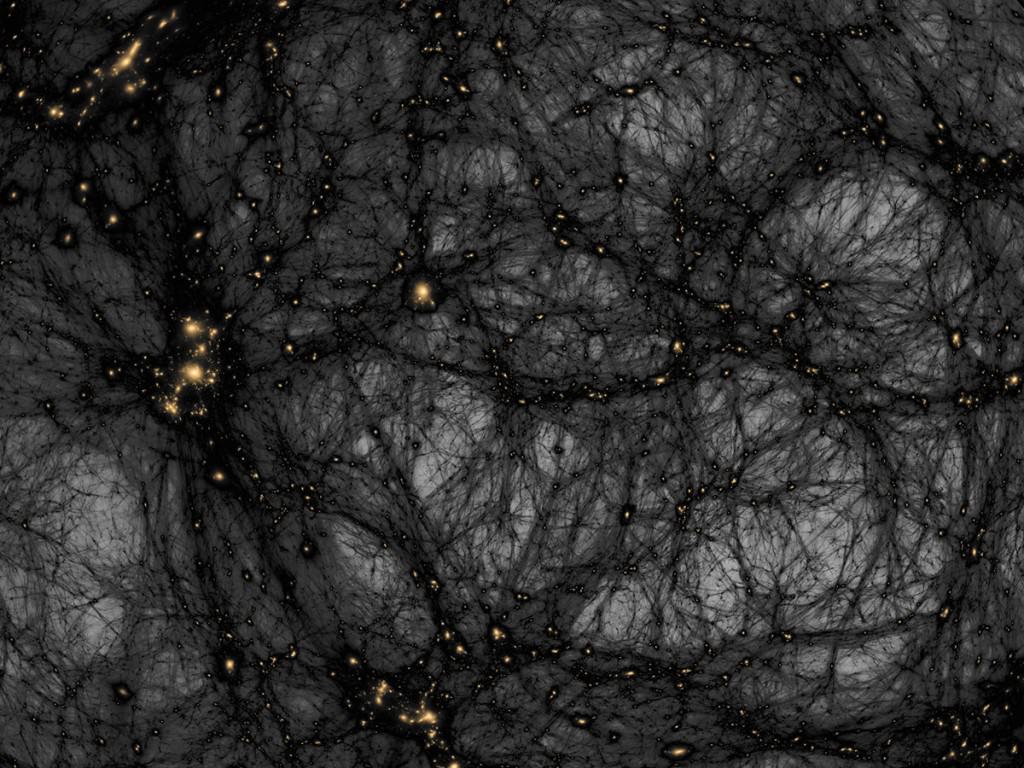
Yu’s proposal centers on self-interacting dark matter, or SIDM. In the supplied source text, this form of dark matter is described as consisting of particles that can collide and exchange energy. Those interactions can lead to what the article calls gravothermal collapse, producing compact dense cores that can reach around a million solar masses. The source uses a useful analogy: unlike a crowd whose members ignore one another, SIDM behaves more like a crowd in which everyone is constantly bumping into each other.
That difference matters because internal interactions can reshape the structure of dark matter halos. Instead of remaining diffuse in the same way as collisionless dark matter, some regions could collapse into dense perturbers capable of leaving measurable gravitational signatures.

Three puzzles, one proposed explanation
The strength of the study is its attempt at unification. Rather than tailoring a separate explanation to each anomaly, the researchers argue that the same class of dense dark matter structures could underlie multiple observations.
The first example cited in the supplied source text is JVAS B1938+666, a well-known gravitational lens system. In such systems, foreground mass bends the light of a background object, often producing arcs or ring-like features. The text says the system contains evidence of an ultra-dense object whose gravitational effect needs explaining. Dense SIDM clumps are proposed as one possible source.
The second example is GD-1, a stellar stream made of old, metal-poor stars. The stream contains gaps and a spur, features that suggest it was disturbed by an unseen massive object. Researchers have long used these scars in stellar streams as possible probes of dark matter substructure. The new study argues that a collapsed SIDM halo could fit that role.
The third class of evidence involves satellite galaxies. Although the supplied extract is truncated before fully detailing this section, it explicitly states that the model is meant to connect dense perturbers in lenses, streams, and satellites. That framing indicates the authors see the same halo-collapse mechanism as relevant across all three environments.
Why this is interesting even without direct detection
Dark matter research often advances by indirect inference rather than direct capture. Since the substance does not emit light in the usual way, scientists rely on its gravitational footprint. What makes the SIDM proposal notable is that it tries to use that footprint more productively. Instead of treating odd observations as isolated exceptions, it asks whether they share a common origin in dark matter microphysics.
If so, that would give theorists a more constrained and potentially more testable framework. A good model does not simply explain one strange case after the fact. It predicts a broader pattern that can be checked in new data. The more independent phenomena a model can explain without becoming arbitrary, the more compelling it becomes.
This does not mean the case is settled. The source text presents the work as a proposal, not a confirmed breakthrough. Dark matter theory has a long history of promising ideas facing further scrutiny when confronted with more detailed simulations or new observations. But the cross-domain ambition of this study is exactly what many physicists look for when evaluating whether a hypothesis deserves sustained attention.

What comes next
The real test of the model will be whether future observations continue to line up with its expectations. Improved lensing measurements, better mapping of stellar streams, and more detailed studies of small satellite systems could all sharpen the picture. If dense perturbers keep appearing where SIDM predicts they should, confidence in the framework would rise. If not, the model would join the long list of dark matter ideas that were suggestive but incomplete.
Even so, this research highlights an important shift in the field. Dark matter investigations are increasingly about structure, behavior, and interaction, not just particle hunting in underground detectors. Astronomical surveys and precision mapping of cosmic systems are becoming laboratories for particle physics by other means.
A cautious but meaningful step in the dark matter debate
The supplied source text does not claim that dark matter has been found. It does not show that self-interacting particles are real. What it does present is a serious attempt to solve three astrophysical mysteries with one theoretical mechanism rooted in known gravitational effects and published in a leading journal.
For a field defined by absence, that is significant. Every credible model that links multiple observations narrows the space of plausible explanations. Yu and colleagues may or may not have identified the right path, but they have added a more integrated option to one of science’s biggest unresolved problems.
In dark matter research, that counts as real progress.
This article is based on reporting by Universe Today. Read the original article.

Originally published on universetoday.com