Discovery of Andromeda XXXVI
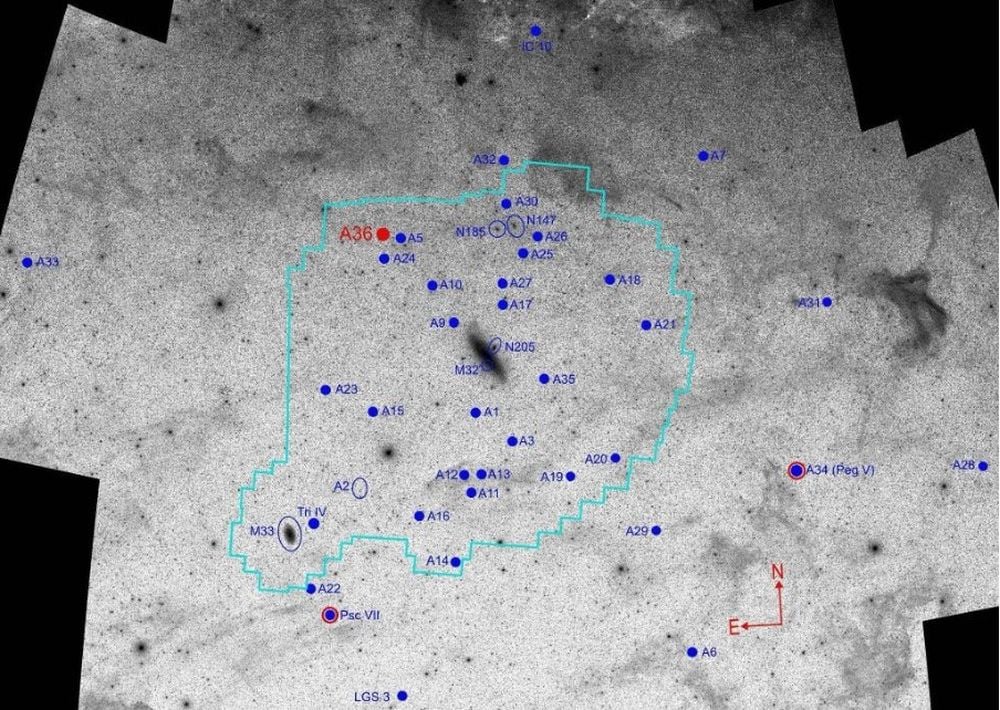
Astronomers have identified a new ultra-faint dwarf galaxy orbiting the Andromeda Galaxy (M31), designated Andromeda XXXVI (And XXXVI). The discovery was made through visual inspection of deep imaging data from the Pan-Andromeda Archaeological Survey, using the OSIRIS+ instrument on the Gran Telescopio Canarias (GTC), a 10.4-meter telescope in Spain's Canary Islands. The research, led by Joanna Sakowska of the Instituto de Astrofísica de Andalucía, has been published in Astronomy & Astrophysics.
Characteristics of And XXXVI
And XXXVI is an ultra-faint dwarf galaxy (UFDG), a class of galaxies characterized by extremely low mass and luminosity. So far, researchers have detected only 46 stars belonging to this galaxy, making it one of the faintest known satellites of Andromeda. UFDGs are the most dark matter-dominated objects known, making them crucial for studying dark matter properties. The galaxy is located about 390,000 light-years from Andromeda and is estimated to be approximately 12.5 billion years old.

Significance for Galaxy Evolution
Ultra-faint dwarf galaxies are key to understanding the growth and evolution of larger galaxies like Andromeda and the Milky Way. They are considered building blocks that merged over cosmic time to form larger structures. The discovery of And XXXVI adds to the faint end of M31's satellite luminosity function, suggesting that a larger population of very faint satellites remains undetected. Astronomers estimate Andromeda hosts about 92 dwarf galaxies, but only about 40 have been confirmed, of which 15 are ultra-faint. And XXXVI becomes the 16th confirmed UFDG around M31.
Observational Challenges
Finding such dim objects is extremely challenging even with powerful telescopes. The OSIRIS instrument on GTC is optimized for observing very faint and distant emission-line objects, enabling this detection. The study highlights that many more ultra-faint dwarfs likely exist, awaiting discovery with next-generation surveys and telescopes.
Implications for Dark Matter Studies
Because UFDGs are dominated by dark matter, they serve as natural laboratories for probing dark matter's nature and distribution. And XXXVI's properties will help refine models of dark matter halos and the hierarchical assembly of galaxies. The research team plans further spectroscopic follow-ups to measure its dynamics and chemical composition.
This article is based on reporting by Universe Today. Read the original article.
Originally published on universetoday.com