Unprecedented Radio Outburst from a Supermassive Black Hole
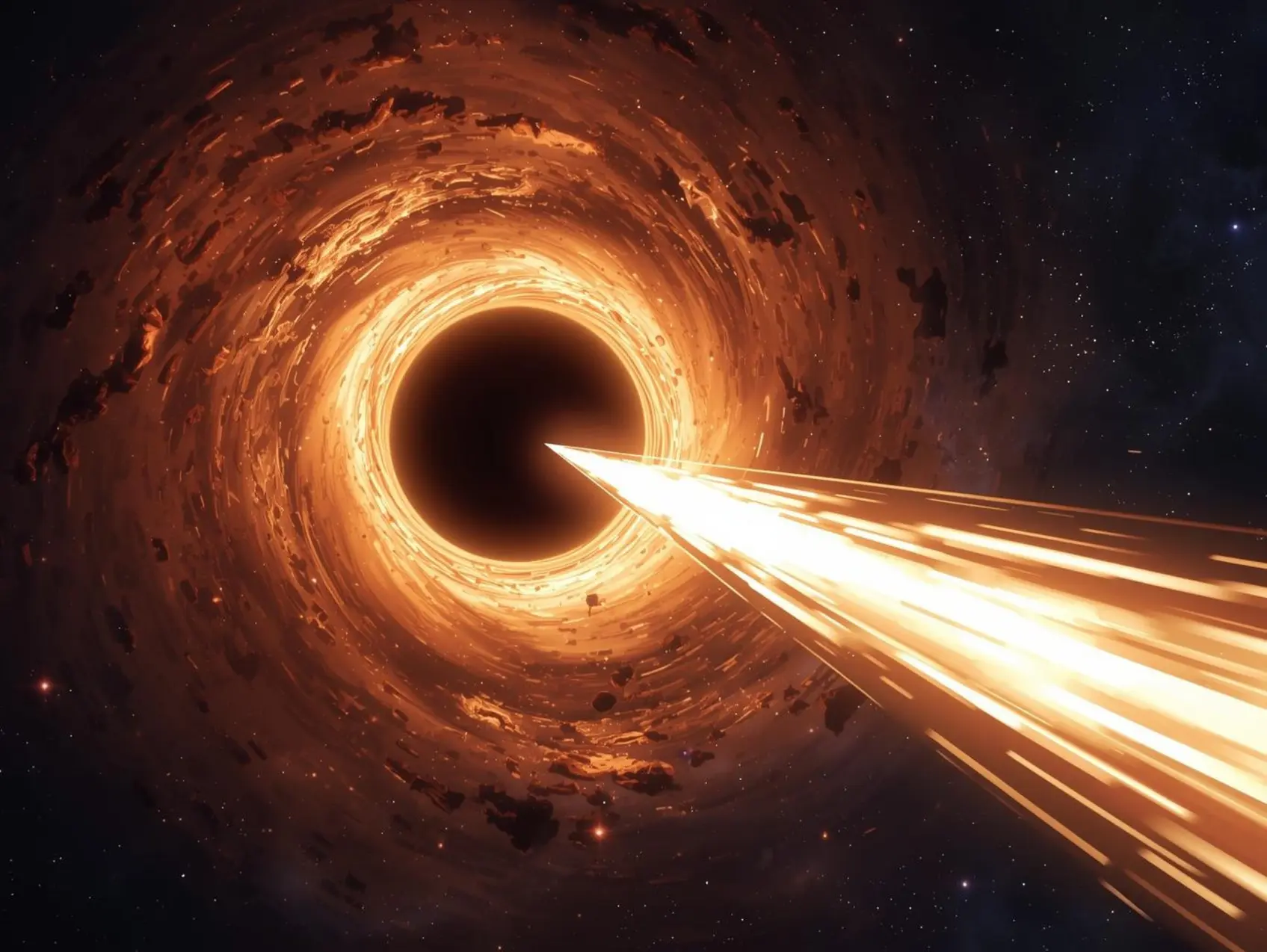
An international team of astronomers led by researchers from the Max Planck Institute for Radio Astronomy (MPIfR) has made a groundbreaking discovery: a supermassive black hole (SMBH) at the center of a spiral galaxy located about 1.8 billion light-years away in the constellation Leo has been emitting exceptionally bright radio waves for eight years. This persistent radio emission, never before observed for such a duration, provides a unique opportunity to study black hole growth and activity that may resemble conditions in the early universe.
The galaxy, designated SDSS J110546.07+145202.4, has been glowing intensely in the radio spectrum due to radiation from its central black hole. While short-lived radio flares from active galactic nuclei (AGN) are common, typically lasting days or weeks, this source has remained bright for years, making it the first known long-duration radio transient of its kind. The findings were published in The Astrophysical Journal.
Characteristics of the Black Hole and Its Accretion Disk
The SMBH at the center of SDSS J110546.07+145202.4 is relatively low in mass compared to other supermassive black holes, but it is growing at an exceptional rate by accreting matter from its surrounding disk. This rapid accretion has triggered a jet that produces the observed radio emission. The team combined new observations with archival data from multiple observatories across the electromagnetic spectrum, including X-ray, optical, radio, and infrared wavelengths, to build a comprehensive picture of the system.
According to Stefanie Komossa, lead author of the study and researcher at MPIfR, “Luminous radio radiation from rapidly growing, lightweight black holes is rare to begin with. Their transition into a long-lasting, radio-bright state has never been observed before.” The reasons for the prolonged accretion and outburst are not yet fully understood, but the event offers a rare glimpse into the physics of black hole growth.

Implications for Understanding the Early Universe
This discovery is particularly significant because it may mimic the conditions of black holes in the early universe, when galaxies and their central black holes were forming and growing rapidly. By studying this nearby example, astronomers can gain insights into the processes that shaped the cosmos billions of years ago. The long-duration radio emission suggests that such events could be more common than previously thought, and future surveys may uncover more examples.
The research team included scientists from institutions around the world, including the Australia Telescope National Facility, the Sydney Institute for Astronomy, the Osservatorio Astrofisico di Torino, and several universities. Their work highlights the importance of multi-wavelength observations in unraveling the mysteries of black hole activity.
Future Observations and Broader Impact
Continued monitoring of SDSS J110546.07+145202.4 will be crucial to understanding the evolution of this outburst. The team plans to use radio telescopes such as the Very Large Array (VLA) and the Atacama Large Millimeter/submillimeter Array (ALMA) to track changes in the jet and accretion disk. These observations could help determine whether the black hole's activity is a one-time event or part of a recurring cycle.
This discovery also underscores the value of archival data. By re-examining old observations, the team was able to identify the onset of the radio brightening and trace its evolution over eight years. Such long-term studies are essential for detecting rare, slow-evolving transients that might otherwise be missed.
As astronomers continue to explore the dynamic universe, events like this provide a window into the extreme environments around black holes. The findings not only advance our understanding of black hole physics but also offer clues about the role of AGN in galaxy evolution.
This article is based on reporting by Universe Today. Read the original article.
Originally published on universetoday.com