The Growing Problem of Satellite Light Pollution
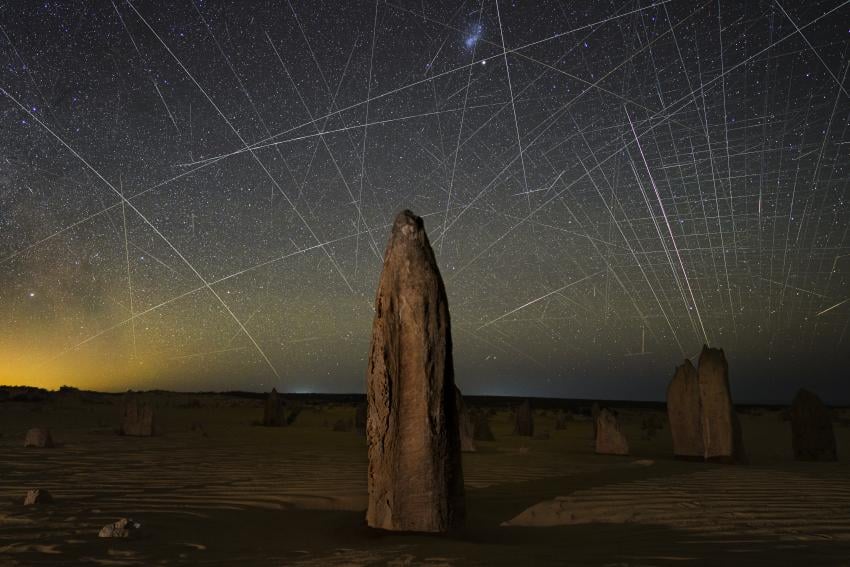
There's no doubt about it: the skies are filling up with satellites that regularly pass overhead, creating light trails that can interfere with stargazing, backyard astronomy, astronomical research, and pose a significant threat to natural ecosystems. The problem stems from the design of the satellites themselves, which include solar arrays that reflect sunlight, creating an artificial, diffuse glow that brightens the night sky and obscures the light of natural objects (the Moon, the planets, and stars). With 1.7 million satellites expected to be launched into orbit in the coming years, things may reach the point where children look up and wonder why the Moon and the few remaining natural objects still visible are not streaking across the night sky.
The presence of satellites in the night sky is something humanity has come to expect ever since the launch of Sputnik 1 in 1958. Sunlight reflected from these satellites can create bright streaks and flares that (at the best of times) can be visually appealing. But with the number of active satellites in Low Earth Orbit (LEO) now approaching 20,000 (and rising rapidly), there are increasing concerns that these streaks could interfere with telescope observations and large-scale surveys of the night sky.
Impact on Astronomical Research
Some examples include the Legacy Survey of Space and Time (LSST) currently underway by the Vera C. Rubin Observatory. Among its many objectives, this ten-year survey will create an inventory of the Solar System, including Near-Earth Asteroids (NEAs), Main Asteroid Belt objects, and many more. Another major objective is to explore the transient optical sky and study objects that move or change in brightness, which will be very difficult with so many streaks and bright spots filling the sky.
The interference is not limited to professional observatories. Amateur astronomers and astrophotographers also report increasing numbers of ruined images due to satellite trails. Furthermore, light pollution from satellites affects natural ecosystems, disrupting the behavior of nocturnal animals and plants that rely on natural darkness.
Introducing the Ultra-Black Coating
To mitigate this problem, a team of researchers from the University of Surrey has developed a new ultra-black coating material for satellites that could drastically reduce the amount of light they reflect. In their study, which recently appeared in the Monthly Notices of the Royal Astronomical Society, the researchers demonstrated how Vantablack® 310, an ultra-black coating developed by a company spun off from the University of Surrey (Surrey NanoSystems), could significantly reduce light pollution from satellites in Low Earth Orbit (LEO). The technology grew out of work involving Professor Ravi Silva, the director of the Advanced Technology Institute (ATI) at the University of Surrey.
How Vantablack Works
Vantablack is a super-black coating made of vertically aligned carbon nanotube arrays that absorb nearly all incident light. Originally developed for space applications to reduce stray light in sensitive instruments, it has been adapted for use on satellite surfaces. The coating can absorb over 99.9% of visible light, dramatically reducing the reflectivity of satellite bodies and solar panels.
Potential Benefits and Challenges
Applying Vantablack to satellites could significantly reduce their brightness, making them less visible from the ground and minimizing interference with astronomical observations. The coating is also durable and can withstand the harsh conditions of space, including extreme temperatures and radiation. However, there are challenges to widespread adoption. The coating process must be carefully controlled to ensure uniform coverage, and the cost of applying the coating to thousands of satellites could be substantial. Additionally, satellite operators may need to balance the benefits of reduced light pollution with other design considerations, such as thermal management and power generation efficiency.
Looking Ahead
The development of ultra-black coatings represents a promising step toward mitigating the impact of satellite constellations on astronomy and the natural environment. As the number of satellites in orbit continues to grow, solutions like Vantablack may become essential for preserving dark skies for future generations. The research team at the University of Surrey is continuing to refine the coating and explore its applications in space. With collaboration from satellite manufacturers and regulatory bodies, this technology could help ensure that the night sky remains a source of wonder and scientific discovery.
This article is based on reporting by Universe Today. Read the original article.
Originally published on universetoday.com