A balloon mission for the universe’s rarest particles
NASA’s Payload for Ultrahigh Energy Observations, or PUEO, is built around an unusual scientific premise: if the particles you want to study are extraordinarily rare and unimaginably energetic, you may need to turn part of a continent into your detector. That is effectively what the mission did by flying high over Antarctica and using the ice sheet below as an immense target volume for radio signals produced when ultrahigh-energy neutrinos interact with the ice.
The mission is part of NASA’s Astrophysics Pioneers Program and recently completed its first flight after launching on Dec. 20, 2025, from the agency’s Long Duration Balloon Facility near McMurdo Station. It remained aloft for 23 days at roughly 120,000 feet before landing about 120 miles from the launch site.
Why neutrinos matter so much
The particles PUEO is chasing are not just difficult to detect; they are scientifically valuable precisely because they are so hard to stop. Ultrahigh-energy neutrinos can travel enormous distances in straight lines without being absorbed, carrying information from some of the most extreme environments in the cosmos. NASA cites supermassive black holes that accrete matter in galactic centers, neutron star mergers, and other powerful cosmic accelerators as likely sources.
Because these particles preserve directional and energetic information across vast distances, they can help researchers investigate where the highest-energy cosmic rays come from and what physical processes produced them. The data may also test physics at energies beyond what human-made accelerators on Earth can reach.
How PUEO listens for invisible events
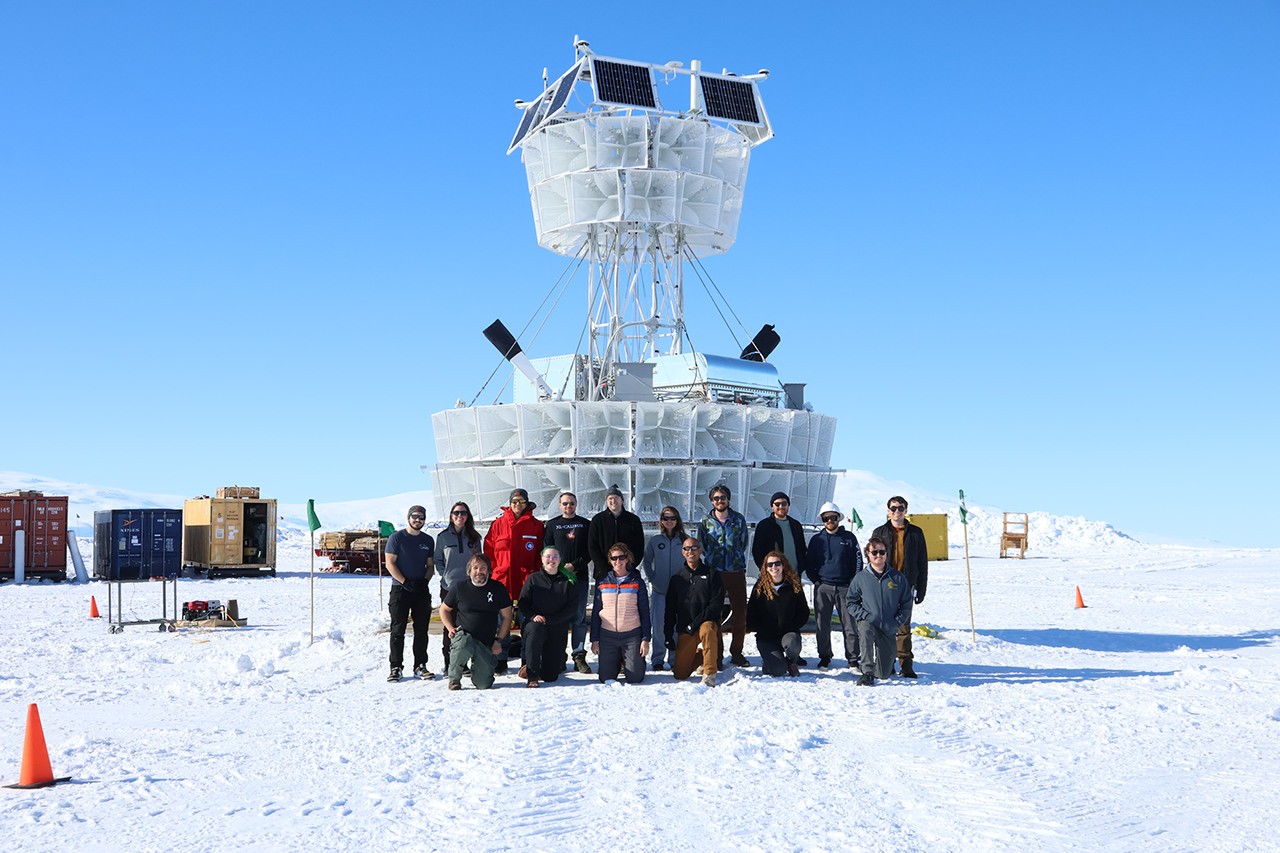
PUEO inherits and extends the concept behind the earlier Antarctic Impulsive Transient Antenna, or ANITA, which flew four successful balloon missions between 2006 and 2016. Like ANITA, PUEO carries an array of radio-frequency antennas, onboard data acquisition systems, and navigation and command hardware. Its job is to detect fleeting radio signatures that resemble the signal expected from neutrino interactions in the ice.
The instrument can also detect radio emissions from high-energy cosmic rays that trigger air showers in Earth’s atmosphere. Those signals may reach the instrument directly or bounce off the ice before detection. That dual capability broadens the mission’s scientific return, letting it contribute both to neutrino hunting and to the study of extreme cosmic-ray events.
Technology advances packed into a constrained platform
NASA emphasizes that PUEO’s sensitivity is the result of technology development and careful optimization within the physical limits of a balloon platform. The mission lowered its detection threshold using interferometric triggering, fit more channels into a tightly constrained instrument volume, and added a low-frequency instrument to characterize air showers.
Those technical details matter because frontier particle astrophysics often advances not through a single dramatic invention, but through multiple incremental gains in sensitivity, bandwidth, signal discrimination, and system integration. A balloon mission has strict mass, power, and volume limits, so any improvement in detection capability carries disproportionate value.
Why Antarctica remains central
Antarctica is not just a dramatic backdrop. It is essential to the measurement strategy. The ice sheet offers both a vast interaction medium and a radio-quiet environment suited to detecting weak transient signals. From high altitude, PUEO can monitor an enormous region at once, giving it a shot at observing events that are too rare for smaller detectors to catch frequently.
The broader significance of the mission is that it demonstrates how space science increasingly blends clever environmental use with advanced instrumentation. PUEO is not orbiting Earth and it is not based in a conventional observatory. Instead, it borrows from both worlds: balloon engineering, cryospheric geography, and particle astrophysics combined into a platform that treats the Antarctic ice as part of the instrument itself.
If the mission’s data deliver, PUEO could sharpen the search for the universe’s most extreme accelerators while helping define the next generation of low-cost, high-impact astrophysics missions.
This article is based on reporting by science.nasa.gov. Read the original article.
Originally published on science.nasa.gov