One Of Artemis’ Most Practical Jobs
NASA’s return-to-the-Moon effort depends on launch vehicles, landers, spacesuits, and mission timelines, but it also depends on something less visible: deciding exactly how astronauts will work once they arrive. A new NASA profile on Jaclyn Kagey puts that operational layer into focus by showing how the Artemis extravehicular activity lead is helping define lunar surface activity for future crews.
Kagey’s role sits near the center of a mission challenge that is easy to underestimate. Artemis astronauts are expected to explore the Moon’s South Pole, a region no human has visited, and do so through tightly planned operations after exiting NASA’s human landing system. That means every task outside the vehicle, from the sequencing of movement to the tools used and the real-time decisions made during a surface excursion, has to be designed in advance and rehearsed extensively.
Turning Exploration Into Procedures
According to NASA’s account, Kagey works closely with scientists and industry partners to define lunar surface activities. That coordination matters because Artemis is not simply repeating Apollo. The missions are being planned around a new geography, new partnerships, and a new expectation that lunar surface work should help prepare for future deep-space exploration.
In practice, that gives Kagey responsibility for turning broad mission goals into executable operations. NASA says she helps define how astronauts will work on the Moon, plans detailed spacewalk timelines, and helps guide real-time operations. Those are the kinds of tasks that convert exploration from aspiration into something crews can actually perform safely and repeatably.
The profile makes clear that Artemis surface planning is not abstract. Crews are expected to step out from a commercial lander designed to move astronauts from lunar orbit to the surface and back again. Once outside, their activity windows, movement patterns, and scientific work all have to be organized under operational constraints that leave little room for improvisation.

Training For The Moon On Earth
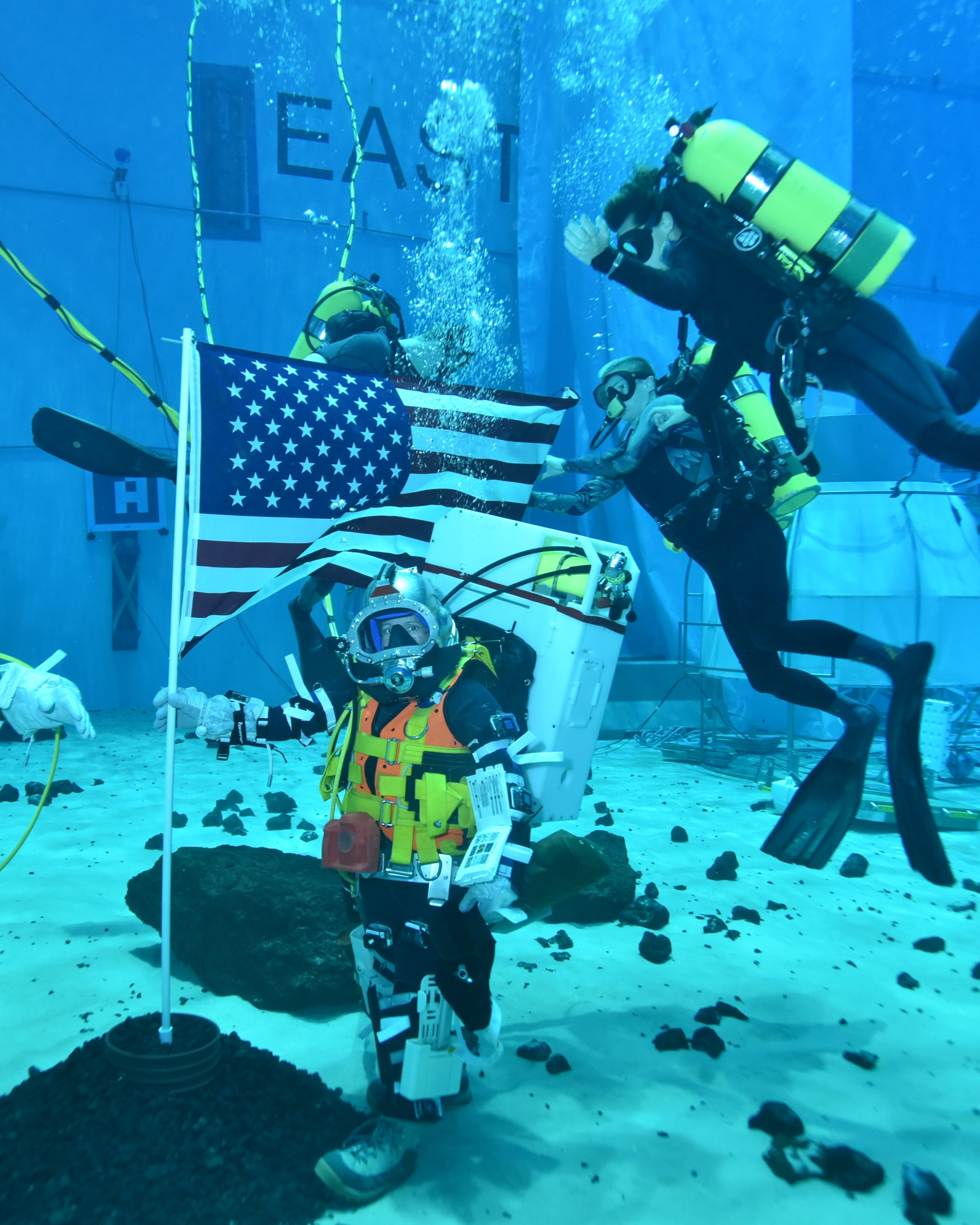
NASA’s description of Kagey’s work also shows how much of lunar preparation happens in analog environments on Earth. She trains in the Neutral Buoyancy Laboratory, where astronauts and flight controllers rehearse spacewalk procedures in simulated microgravity. She also conducts lunar surface operations training in the Rock Yard at Johnson Space Center, where teams test tools and procedures for future Artemis missions.
Those details matter because they show the bridge between engineering and execution. A lunar mission plan is only useful if crews and controllers can run it under realistic conditions before flight. Training environments provide a way to identify procedure flaws, refine timelines, and adapt tools before those problems become mission risks.
A Career Built On Complex Operations
Kagey’s Artemis role is backed by more than 25 years of NASA-related work, according to the agency. Her career path began while studying at Embry-Riddle Aeronautical University, where watching space shuttle launches reinforced her goal of joining the nation’s aerospace effort. She and her husband began their careers as contractors through United Space Alliance.
That background helps explain why NASA highlights her as more than a symbolic profile subject. Artemis surface planning needs people with operational depth, not just conceptual vision. Kagey’s record includes work across several of the agency’s most complex programs, and the profile points to one especially revealing example from the International Space Station.
The Spacewalk That Shows The Skill Set
Kagey recalled a critical ammonia leak aboard the ISS that required an exceptionally fast turnaround. According to NASA, the team had just 36 hours from problem identification to planning, spacesuit preparation, and execution of the repair during U.S. EVA 21. The repair was successful, and Kagey cited the agility and teamwork involved as a defining example of what the team could accomplish under pressure.
That incident helps clarify why her current Artemis role is important. Lunar exploration is often presented through sweeping imagery, but success depends on disciplined operators who can plan rigorously and still adapt quickly when conditions change. A mission to the Moon’s South Pole will carry scientific ambition, but it will also carry the unforgiving reality of field operations far from immediate rescue.
Why This Matters For Artemis
NASA’s profile is ultimately a reminder that returning humans to the Moon is as much about operations as hardware. Artemis requires people who can integrate science priorities, crew procedures, tool development, and mission control execution into a coherent system. Kagey’s job is to help set those standards before astronauts ever leave the lander.
The agency framed her mission in those terms directly: shaping a historic endeavor and helping establish the standard for humanity’s return to the Moon. That is a large claim, but the profile supports it. If Artemis succeeds at the lunar surface, it will be because people like Kagey helped decide not only where astronauts go, but how they work once they get there.
This article is based on reporting by NASA. Read the original article.
Originally published on nasa.gov