A violent signal may help astronomers find hidden black holes
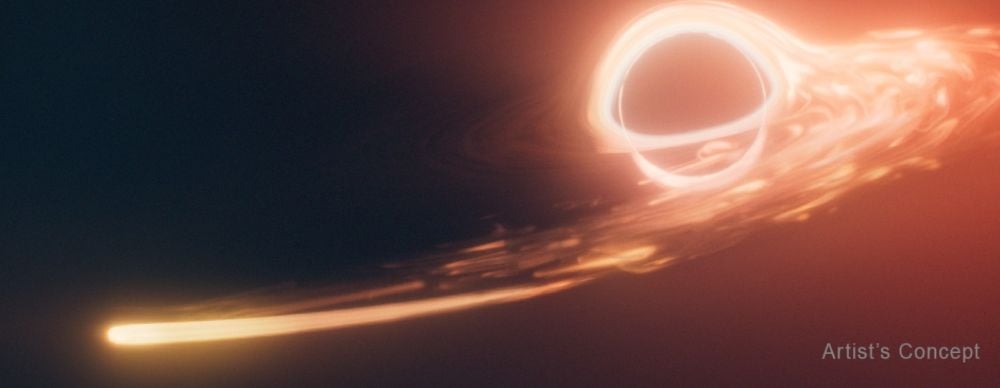
When a star passes too close to a supermassive black hole, the result can be catastrophic. The black hole’s tidal forces stretch the star, tear it apart, and turn the debris into a bright flare that can briefly outshine an entire galaxy. Those outbursts, known as tidal disruption events, or TDEs, are destructive for the star but extremely useful for astronomers.
According to new research highlighted ahead of the Nancy Grace Roman Space Telescope’s launch, these flares could become one of the best tools for tracing how supermassive black holes grew over cosmic time. The study, published in The Astrophysical Journal, forecasts how often major observatories including Roman, LSST, and JWST may detect tidal disruption events, and how those detections could constrain the mass distribution of black holes across the universe.
The central promise is not just counting more spectacular transients. It is finding black holes that are otherwise hard to see, especially lower-mass supermassive black holes in the distant universe.
Why tidal disruption events matter
Many supermassive black holes are difficult to detect directly, particularly if they are not actively feeding. A galaxy may host a central black hole without producing the kind of sustained bright emission that would make it easy to spot. Tidal disruption events offer a workaround. When a black hole tears apart a passing star, the shredded material forms a hot, luminous ring of infalling gas. That flare acts like a beacon.
For astrophysicists, the importance of TDEs lies in the mass range they probe. The source material notes that these events are especially associated with lower-mass supermassive black holes, roughly from about 100,000 to 100 million solar masses or less. At higher masses, a black hole may swallow a star so quickly that the dramatic flare is diminished or absent.
That makes TDEs unusually valuable for studying a population that is central to long-running questions about black hole origins. Lower-mass black holes at higher redshift are particularly informative because they retain clues about early seeding and growth processes. Yet they are also among the hardest objects to characterize with existing methods.
Roman’s role in a larger observing strategy
The upcoming Nancy Grace Roman Space Telescope is expected to expand the TDE sample significantly. Roman is designed to survey large areas of the sky with high sensitivity, an important combination for finding rare transients across long distances. If the forecasts are correct, the telescope could detect many more of these star-shredding events across cosmic history than astronomers can currently assemble.
That broad reach matters because isolated detections do not settle the larger formation question. Researchers want a statistical view of how black hole masses are distributed at different epochs. A larger sample of TDEs spread across redshift would provide exactly that kind of dataset.
The new paper, led by Johns Hopkins University graduate student Mitchell Karmen, focuses on estimating event rates for Roman and other observatories. The researchers argue that measuring the mass distribution of supermassive black holes over cosmic time is especially difficult for the low-mass population beyond redshift 1. That is also the regime where different black hole seeding models may diverge most clearly.
In practical terms, Roman could help transform TDEs from intriguing one-off discoveries into a systematic probe of black hole demographics.
What black hole “seeding” means
One of the major unsolved problems in astrophysics is how supermassive black holes became so massive, so early. Some growth models propose relatively small “seed” black holes left behind by the first generations of stars, which then grew by accreting gas and merging with other black holes. Other models allow for more massive seeds forming through different collapse pathways.
Observing today’s largest black holes does not easily distinguish among those scenarios, because billions of years of growth can erase the signatures of their beginnings. Lower-mass black holes seen at earlier cosmic times are more useful. They are closer to the formative stages where the models make different predictions.
That is why TDEs are so appealing. They may reveal dormant or faint black holes that do not announce themselves through other channels. If astronomers can assemble a large sample of such events across cosmic time, they gain a new way to infer how many lower-mass black holes existed at different epochs and how quickly they grew.
Why this is not just about spectacle
Tidal disruption events already attract attention because they are among the most dramatic things black holes do. But their scientific value goes beyond the visual drama. Each event can carry information about the black hole’s mass range, the surrounding environment, and the frequency with which stars interact with the galactic center.
When those events are collected into large surveys, the picture becomes much more powerful. Astronomers can start turning flare counts into population constraints. That is the jump the new study is pointing toward: from individual transient astronomy to a census tool for black hole evolution.
The paper also places Roman in a broader ecosystem with LSST and JWST. Each observatory brings different strengths, whether in wide-field discovery, time-domain coverage, or deeper follow-up. Together, they could help build a richer map of where and when these events occur.
What the forecasts could change
If Roman detects the predicted number of TDEs, the telescope could sharpen measurements of the supermassive black hole mass function in a range that is currently hard to access. That would give theorists firmer observational ground for evaluating models of early black hole formation.
It could also help clarify how rapidly black holes assembled relative to their host galaxies. Black hole growth is deeply tied to galaxy evolution, but the timing and causal direction of that relationship remain under study. Finding more lower-mass black holes across redshift would add evidence to that debate.
There is also a methodological shift embedded in this work. Instead of relying only on continuously active galactic nuclei to study black holes, astronomers may increasingly depend on transient events that briefly light up otherwise hidden systems. Roman is especially well suited to that style of time-domain cosmology.

Caution, but real opportunity
The findings described here are forecasts, not a list of detections already in hand. Predicted event rates depend on assumptions about black hole populations, stellar dynamics, and observational sensitivity. Actual results may differ once Roman begins operations.
Even so, forecasting studies are important because they shape survey strategy before the data starts arriving. They help determine cadence, prioritization, and the kind of follow-up needed to turn raw detections into robust physical conclusions. In that sense, this work is part of the telescope’s scientific groundwork.
The source text presents Roman as a mission poised to find many more tidal disruption events than are currently available. If that happens, astronomers could gain one of their clearest windows yet into the quieter, lower-mass black holes that have remained difficult to count.
A way to watch black holes grow indirectly
Black holes themselves emit no light. Much of black hole astronomy therefore depends on indirect evidence: the motion of nearby stars, the behavior of surrounding gas, or the radiation produced as matter falls inward. Tidal disruption events add another route. They turn a brief act of stellar destruction into a measurement opportunity.
For the study of cosmic history, that may be enough to make Roman one of the most consequential black hole missions of its era. By watching stars get torn apart in distant galaxies, the telescope could help answer a much larger question: how the universe built its giant black holes in the first place.
This article is based on reporting by Universe Today. Read the original article.
Originally published on universetoday.com