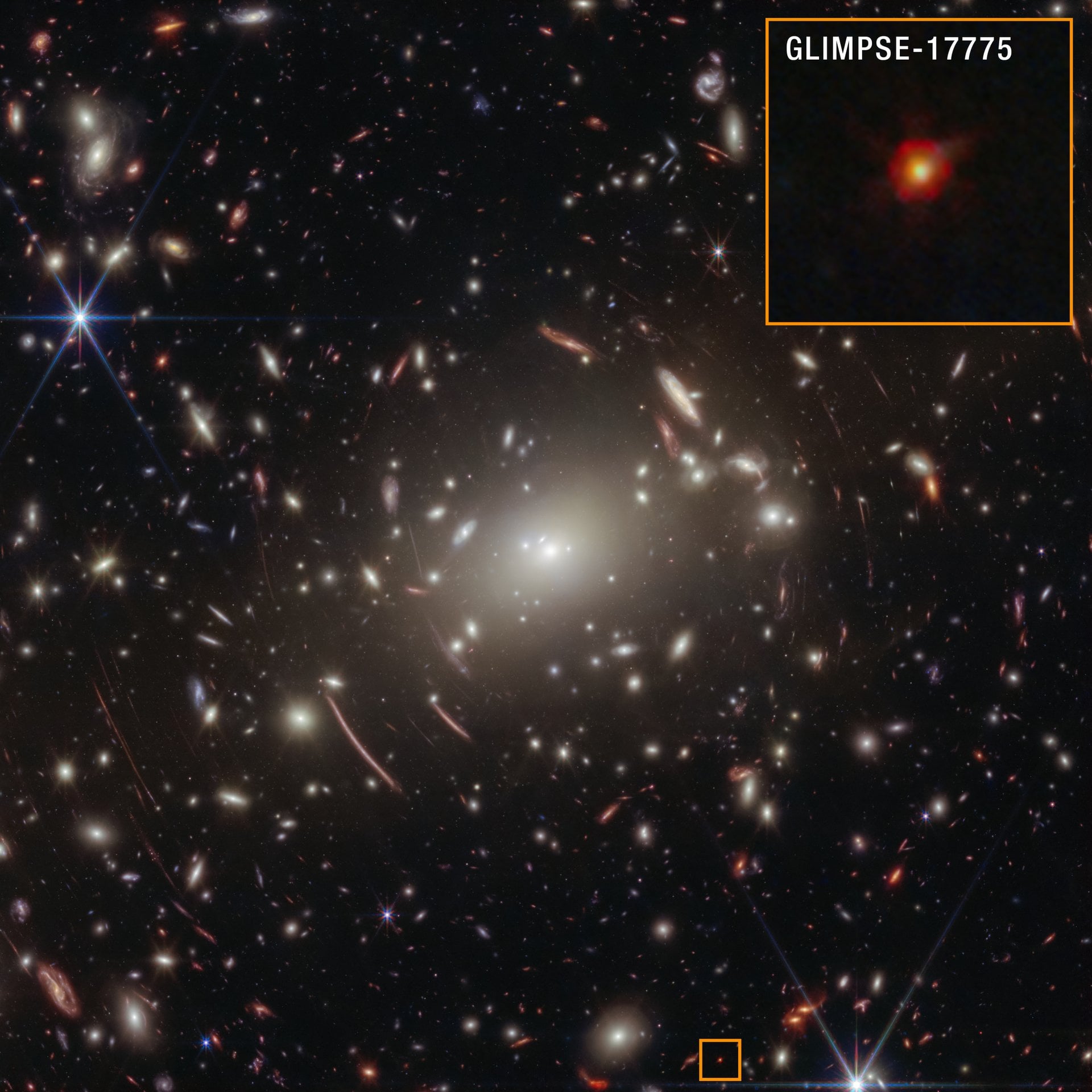
One strange object may explain a long-running Webb puzzle
Since 2022, astronomers using the James Webb Space Telescope have been grappling with one of the early mission's strangest discoveries: tiny, intensely red objects scattered across the young universe. These “little red dots” appeared around 600 million years after the Big Bang, looked unexpectedly bright, and quickly became a problem for researchers trying to explain how such objects could form so early.
Now, according to a report on new observations of a source called GLIMPSE-17775, at least some of those dots may not be oddball galaxies after all. Instead, they may be what the article describes as “black hole stars,” a misleading name for a far more interesting arrangement: a rapidly growing black hole wrapped in a dense shroud of gas that absorbs harsh radiation and re-emits it as redder light.
Why GLIMPSE-17775 matters
The importance of GLIMPSE-17775 lies in the quality of the data. A team led by Vasily Kokorev at the University of Texas at Austin obtained what the report calls the deepest spectrum yet recorded from a little red dot. Webb extracted more than 40 separate spectral lines from the object, providing the richest chemical and physical fingerprint ever gathered for one of these sources.
That level of detail was possible because of an unusually favorable alignment. GLIMPSE-17775 sits behind the massive galaxy cluster Abell S1063, whose gravity acts as a natural magnifying lens. Webb observed the target for 30 hours, but gravitational lensing effectively boosted that view to the equivalent of 80 hours, turning a faint target into something researchers could study in far greater depth.
A black hole hiding in plain sight
The “black hole star” idea does not describe a true star. In the scenario outlined in the report, a central black hole is consuming gas at a furious pace while a thick surrounding envelope of gas absorbs the intense radiation generated by that feeding process. Instead of allowing that energy to escape directly, the shroud reprocesses it into softer, redder light, making the object appear less violent and more star-like from a great distance.
That mechanism offers a neat solution to the little red dots problem. It explains how the objects can look small, red, and surprisingly bright without requiring astronomers to assume that normal galaxy growth models were drastically wrong. The light is not necessarily coming from a conventional stellar population; it may be coming from a heavily obscured black hole system.
The spectrum strengthened the case
The spectrum of GLIMPSE-17775 reportedly contained more than 40 lines, and many of them independently pointed toward a black hole interpretation. That matters because astronomers have spent three years debating multiple explanations for the little red dots, including whether some were simply unusual galaxies. A single observation with many separate indicators is more persuasive than a result that rests on one ambiguous feature.
It does not mean every little red dot in the early universe is the same kind of object. But it does give researchers a much firmer template for at least one major class within the population.

Why the result reaches beyond one object
The little red dots became such a high-profile puzzle because they seemed abundant and bright enough to challenge expectations about the early universe. If a substantial fraction of them are really growing black holes hidden in gas, the implications are broad. It would reshape how astronomers count early galaxies, how they interpret the buildup of supermassive black holes, and how they reconstruct the first few hundred million years of cosmic history.
The result also shows how much leverage Webb gains when paired with gravitational lensing. Even for a telescope designed to probe the distant universe, some of the most revealing targets are still extremely faint. Nature's own magnifying glass can make the difference between a tantalizing blur and a spectrum rich enough to break a deadlock.
A puzzle may be narrowing, not disappearing
Researchers are unlikely to declare the case closed on the basis of one object, however compelling it appears. The little red dots are a population, not a single source, and populations can contain multiple physical types. Some may be dominated by buried black holes, others may reflect different stages of galaxy formation, and still others may combine properties that blur the categories astronomers are used to applying.
Still, GLIMPSE-17775 looks like a turning point. After years in which the little red dots seemed to threaten simple explanations, astronomers now have a deeply studied example that points to a concrete physical model rather than a mystery for mystery's sake.

Webb's early-universe surprises continue
In that sense, the story of GLIMPSE-17775 is also a story about how Webb is changing astronomy. The telescope is not just seeing farther than its predecessors. It is forcing researchers to classify objects they had never clearly observed before and to build explanations that match the universe as it actually appears, not just as theory expected it to appear. For the little red dots, that process may finally be producing an answer.
This article is based on reporting by Universe Today. Read the original article.
Originally published on universetoday.com