Astrobiology is broadening from life-hunting to planetary self-understanding
Astrobiology is often framed as the search for life elsewhere. But a central argument emerging from the Origins 2026 conference in Paris is that the field may be just as important for understanding Earth itself. Reporting from Universe Today highlights a view shared by researchers at the meeting: rocky exoplanets orbiting other stars can act as comparative cases that reveal how planets form, evolve and sometimes remain habitable.
That shift in emphasis matters because Earth science still faces major blind spots, especially when it comes to the deepest parts of our planet’s history. The farther scientists look back, the harder it becomes to reconstruct which processes were most important in shaping climate, atmosphere and surface conditions. The exoplanet census offers a different route. Instead of depending only on incomplete geological traces from one world, researchers can compare many rocky planets at different ages and around different stars.
Lisa Kaltenegger, director of the Carl Sagan Institute at Cornell University, made that case at the conference, according to the report. The 45 rocky exoplanets identified so far in habitable zones are not simply a tally of possible life-bearing worlds. They are data points for planetary evolution. Each one potentially adds evidence about how atmospheres emerge, how stellar radiation affects surfaces and whether conditions associated with liquid water can persist over time.
Why habitable zones are only the beginning
The source text underscores an important distinction that is sometimes lost in public discussion. A planet lying in a habitable zone does not automatically mean it is habitable. A habitable zone describes an orbital region where liquid water could, in principle, exist on a planet’s surface. It says nothing definitive about the actual chemistry, atmosphere, geology or magnetic environment of that world.
That caution is especially relevant because a large share of the known candidate worlds orbit red M-dwarf stars. These stars are common, and the report notes that about 20 percent of them are thought to host rocky planets in their habitable zones. For astronomers, that makes them a natural starting point. For astrobiologists, however, abundance does not resolve the harder question of whether such planets can hold onto stable, life-friendly environments over long periods.
The opportunity is still immense. If scientists can measure the atmospheres and thermal properties of enough rocky planets around stars of different ages, they may be able to reconstruct a broader theory of planetary development. In that framework, Earth becomes one example within a much larger dataset rather than the only fully characterized case.

The Trappist-1 priority and the telescope bottleneck
One reason this comparative science is advancing slowly is simple: observing time is scarce. Kaltenegger noted, as summarized in the article, that NASA’s James Webb Space Telescope cannot be dedicated exclusively to exoplanets. Webb is a general-purpose observatory serving many areas of astrophysics, from black holes to distant galaxies.
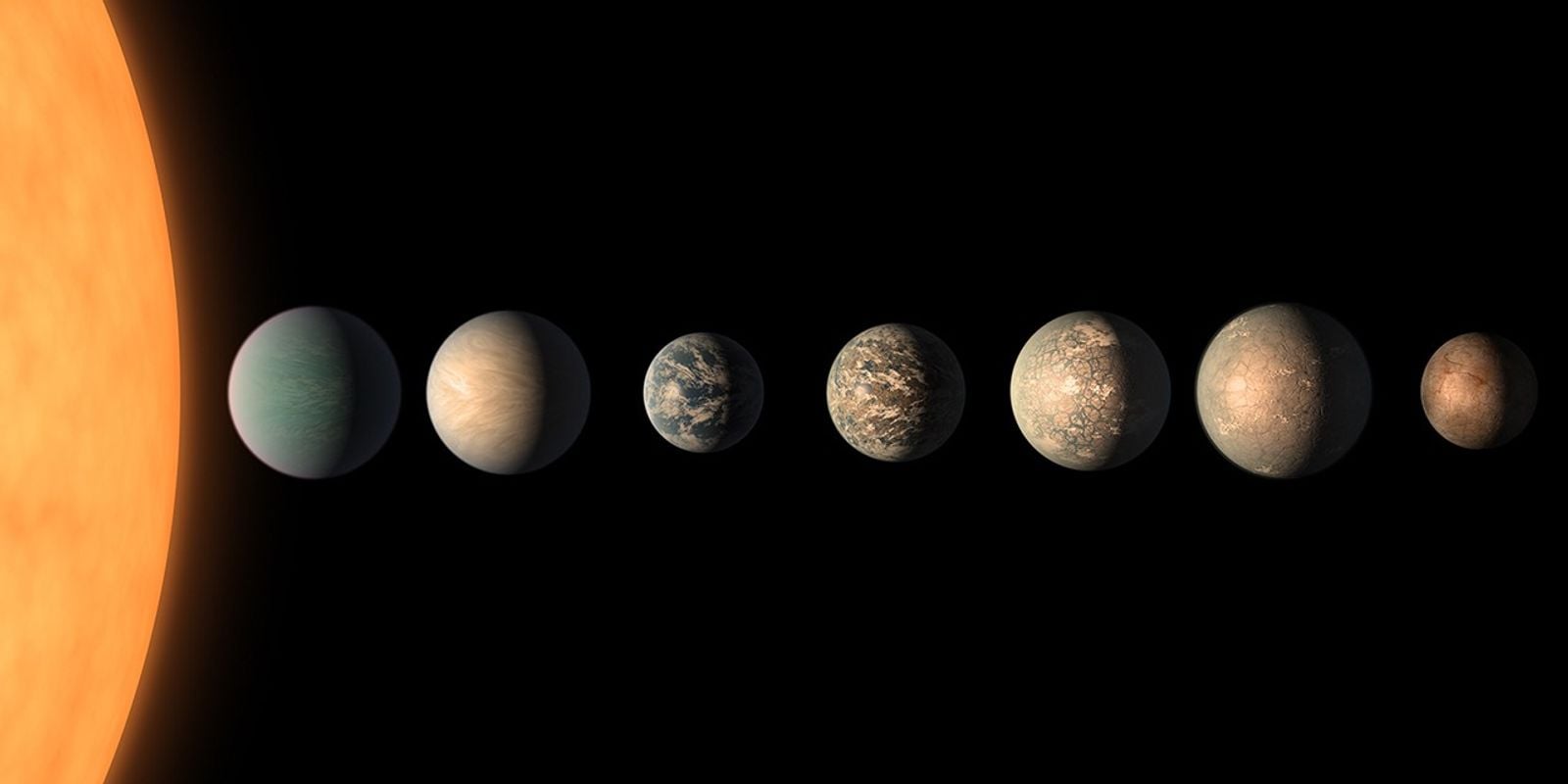
That resource constraint has pushed the exoplanet community to prioritize a small number of especially promising targets. Near the top of the list is Trappist-1, the compact planetary system roughly 40 light-years away in Aquarius. It contains seven Earth-sized planets, with three commonly regarded as potentially habitable candidates. Because the system packs multiple rocky worlds around a cool red dwarf, it offers an unusually efficient laboratory for comparative study.
By focusing limited Webb time on Trappist-1, researchers hope to extract atmospheric clues that are otherwise out of reach. Even non-detections would be meaningful. If some of the planets appear airless, chemically hostile or strongly altered by their star, that helps constrain models of what habitability around red dwarfs really looks like. If one or more worlds show signs of more durable atmospheres, that would sharpen the case for broader follow-up with future observatories.
Earth’s past, Earth’s future
The deeper scientific appeal of astrobiology lies in the way it links distant worlds back to our own. Earth’s geological record is rich but incomplete, especially over billions of years. Key transitions in atmospheric chemistry, surface temperature and biological interaction remain difficult to disentangle. Exoplanets at different stages of development could provide natural experiments that Earth can no longer preserve in full.
That does not mean exoplanets function as direct replicas of Earth’s past. Every planetary system has its own architecture and stellar environment. But patterns across many systems could still reveal which processes are common and which are exceptional. For example, researchers may learn more about how young stars reshape planetary atmospheres, how rocky planets cool, or how long temperate conditions tend to last around different stellar types.
This approach also opens a way to think about Earth’s future. If astronomers can observe rocky planets around older stars, they may gain hints about long-term climate stability and late-stage atmospheric evolution. In that sense, astrobiology is not just about asking whether life exists elsewhere. It is about locating Earth within a longer planetary timeline.

An interdisciplinary field trying to grow up
The conference discussion described in the source also points to a structural challenge. Astrobiology depends on coordination across astronomy, biology, chemistry, geology and solar or stellar physics, yet those communities do not always communicate smoothly. That lack of cross-talk can slow progress because habitability is not a single-discipline problem. It emerges from interactions among stars, atmospheres, interiors, surfaces and, potentially, biology itself.
Origins 2026 appears to have served as a reminder that the field needs shared language as much as new instruments. If planetary characterization is going to illuminate Earth’s past and future, researchers will need frameworks that let evidence travel cleanly between specialties. A spectral observation from a telescope matters differently when interpreted alongside climate chemistry, geophysics and evolutionary constraints.
That is why the current moment in astrobiology is significant. The field is moving beyond headline questions about finding “another Earth” and toward a more mature scientific program: using rocky exoplanets to test how planets work. The search for life remains the long-term prize, but the nearer-term payoff may be a better theory of planetary habitability itself.
Key points
- Researchers at Origins 2026 argued that rocky exoplanets can help explain Earth’s deep history and long-term evolution.
- Planets in habitable zones are not automatically habitable, making atmospheric characterization essential.
- Limited James Webb observing time has made the Trappist-1 system a major comparative target.
This article is based on reporting by Universe Today. Read the original article.
Originally published on universetoday.com