Chang'e-6 opens a new window on the Moon's far side
Samples returned by China's Chang'e-6 mission are giving planetary scientists something they have lacked for decades: direct laboratory material from the Moon's far side. According to a new study highlighted by Universe Today, those grains of regolith are doing more than filling a geographic gap in lunar science. They are helping researchers reconstruct how the Earth-Moon system has interacted with the solar wind over billions of years.
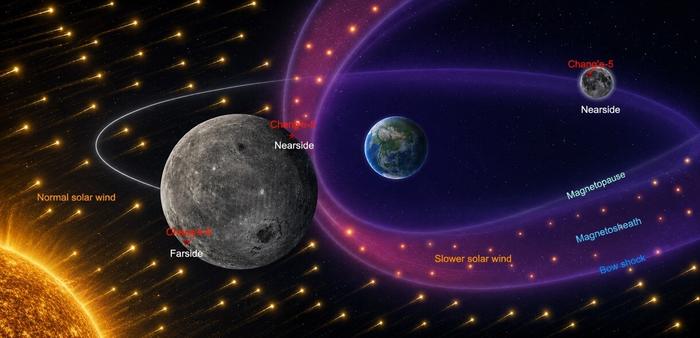
The central finding is that the Moon's far side appears to have experienced a different long-term solar-wind environment than the near side, and that Earth itself is a key reason why. A team from the Institute of Geology and Geophysics at the Chinese Academy of Sciences used noble-gas isotope measurements from Chang'e-6 samples to examine how solar wind particles were implanted into far-side lunar soil. Their interpretation is that Earth's magnetosphere has altered the bombardment pattern between the two hemispheres, leaving distinct chemical records in the lunar regolith.
That matters because the Moon has no global atmosphere and no planet-wide magnetosphere of its own. Solar wind particles can strike the surface directly and become trapped in the topmost dust and rock. Over immense spans of time, that process turns lunar regolith into a natural archive of space weather. Until now, researchers could only study that archive directly on the near side, where Apollo and other missions obtained samples. Chang'e-6 changes that by providing material from the South Pole-Aitken basin on the far side.
Why the far side can tell a different story
The new work centers on noble gases including helium, neon, argon, krypton, and xenon. These elements are especially useful because they can preserve evidence of solar wind implantation. In the Chang'e-6 material, the researchers found distinctive isotopic signatures, especially in neon, that indicate the far side recorded bombardment under different conditions than the near side.
The broad idea is physically intuitive. As the Moon orbits Earth, the near side can at times be influenced by Earth's magnetosphere in ways the far side is not, and vice versa. Over geologic time, those changing positions can affect the energy and speed of incoming charged particles. The result is not simply a uniform dusting of solar wind across a static world. Instead, the Moon's two hemispheres can preserve contrasting records of exposure, protection, and particle implantation.
That contrast gives scientists a new comparative baseline. With only near-side samples, it was difficult to separate local geology from system-wide space-weather effects. Far-side material allows researchers to test whether differences in volatile content and isotopic composition reflect regional lunar history, long-term orbital geometry, the shielding effects of Earth, or some combination of all three.
The Chang'e-6 return is particularly important because the South Pole-Aitken basin is one of the oldest and largest impact structures in the solar system. Material from that region may preserve evidence from ancient episodes of lunar and solar-system evolution. If those grains also carry a long-term record of solar wind behavior, they become valuable not just for Moon science, but for understanding how the Sun's activity interacted with rocky bodies over deep time.
What the study adds to Earth-Moon system science
The study's significance extends beyond the Moon itself. Earth's atmosphere and magnetosphere shield our planet from most incoming solar-wind particles, which is why direct surface records of that bombardment are limited here. The Moon, by contrast, acts as an exposed recorder. Reading that record can reveal how solar particles behaved in the past and how Earth's magnetic environment shaped conditions in nearby space.
In that sense, the Chang'e-6 samples may help scientists study a three-body relationship: the Sun as the particle source, the Earth as a magnetic shield, and the Moon as a long-lived archive. That framing turns lunar regolith into a proxy for system history. Rather than just asking what happened on the Moon, researchers can ask what the Moon remembers about the Earth and the Sun.
It also sharpens a long-running scientific contrast between the Moon's near side and far side. The two hemispheres already differ in crustal thickness, volcanic history, terrain, and appearance. The near side is marked by broad maria, while the far side is more heavily cratered. The new evidence suggests they may also differ in how the space environment has chemically imprinted itself into the surface.
That makes future sample science even more consequential. If far-side regolith preserves a systematically different volatile and isotopic record, laboratories can revisit assumptions built mainly from Apollo-era materials. Some conclusions may hold up cleanly; others may need to be refined now that the sample set is no longer one-sided.
Why this mission may matter for future exploration
The findings also arrive as interest in lunar exploration expands. Governments and private companies are treating the Moon not only as a scientific destination but as a proving ground for long-term operations beyond low Earth orbit. Understanding how solar wind interacts with different lunar regions has practical value for that future. It can inform how engineers think about surface exposure, volatile behavior, and the chemical evolution of regolith in places where equipment or crews may eventually operate.
For now, the biggest immediate value is scientific. Chang'e-6 has delivered a new class of evidence, and the first results suggest that the far side is not merely a geographic opposite of the near side. It is a distinct environmental archive.
That is a meaningful step for lunar science. The Moon has always been one of the best-preserved witnesses to solar-system history because it lacks the erosion, tectonics, and atmospheric recycling that erase old records on Earth. With direct far-side samples finally in hand, scientists can begin comparing two hemispheres that spent billions of years under related but not identical conditions.
If those early interpretations continue to hold, the Moon will become even more useful as a recorder of ancient space weather and Earth-Moon dynamics. Chang'e-6, in that view, is not just a sample-return mission. It is the start of a more complete lunar archive, one that may help explain how our planet's magnetic shield has shaped the neighborhood around it for eons.
This article is based on reporting by Universe Today. Read the original article.
Originally published on universetoday.com