A New Idea for One of JWST’s Most Puzzling Discoveries
The James Webb Space Telescope has already changed astronomy’s picture of the early universe, but some of its most intriguing findings remain hard to classify. Among them are the so-called little red dots, compact luminous sources that appeared in large numbers in deep observations of the young cosmos. Astronomers have debated what these objects are since their emergence in Webb data was first reported in 2024. Proposed explanations have included active galactic nuclei, primordial galaxies, and even supermassive primordial stars.
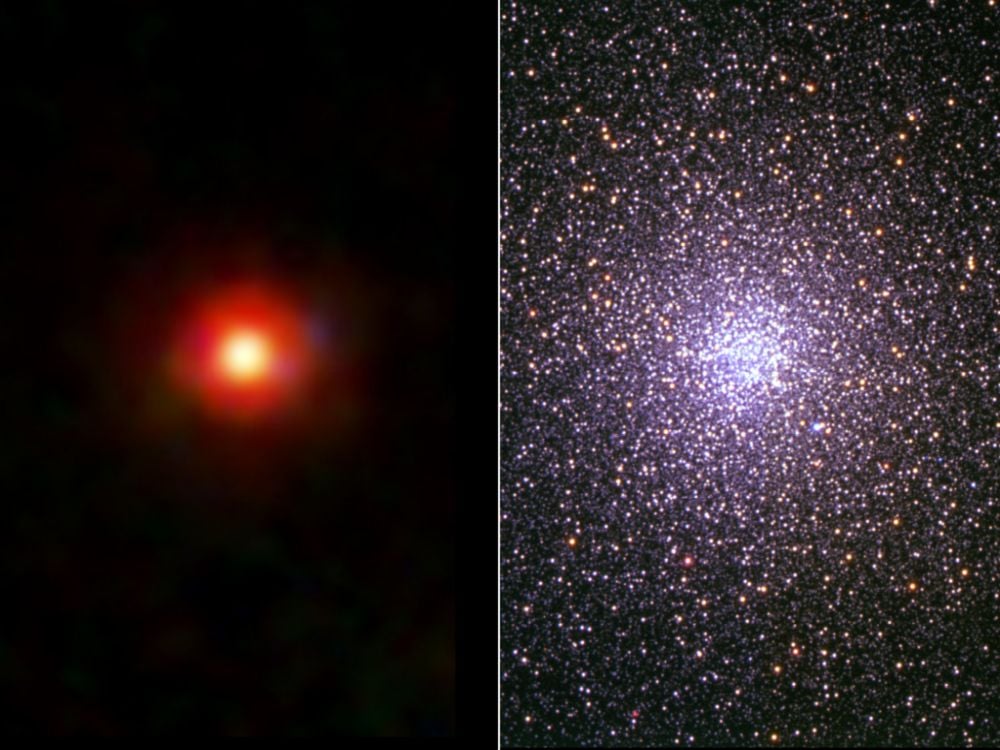
Now a new study argues that at least some of those little red dots may instead be globular clusters in formation. The work, published in The Astrophysical Journal Letters, proposes that two separate astronomical puzzles could be linked by a single explanation: the nature of Webb’s little red dots, and the origin of globular clusters, the densely packed star systems found around galaxies such as the Milky Way.
The idea is attractive because it connects an extremely distant, early-universe population with an ancient, nearby one. If correct, the proposal would mean astronomers may already be seeing the birth stage of systems that later survive for billions of years in galactic halos.
Why Little Red Dots Have Been So Difficult to Explain
The study describes little red dots as enigmatic high-redshift discoveries. They appeared between roughly 13.2 billion and 12.2 billion years ago, placing them in a very early cosmic era. According to the source text, large numbers of these objects emerged about 600 million years after the Big Bang and then declined rapidly by around 1.5 billion years after the Big Bang.
That timing matters. It suggests little red dots are tied to a relatively brief but important phase of cosmic history rather than representing a generic class of objects that remained common throughout later epochs. Their compactness and brightness have made them stand out, but those same traits have made them hard to interpret with confidence.
Several candidate explanations have remained on the table because the observations can be read in more than one way. Some models treat the objects as signs of black-hole activity in galactic nuclei. Others cast them as unusual stellar systems or primordial galaxies. The new paper does not claim those alternatives are impossible in all cases. Instead, it explores whether globular cluster formation can plausibly account for at least part of the population.

How the Globular Cluster Explanation Works
Globular clusters are not mysterious in the same sense as little red dots. Astronomers know them as gravitationally bound collections of stars, sometimes containing several million members. Their stars are generally old and metal-poor, and in many galaxies they rank among the oldest surviving structures. The Milky Way alone contains at least 150 of them in its halo.
What makes the new interpretation compelling is not that mature globular clusters resemble little red dots today. They do not. The argument is that astronomers are observing the two classes at radically different stages of life. Nearby globular clusters are ancient relics that have had billions of years to evolve. Webb’s little red dots, by contrast, are being seen in the act of formation, when their stellar populations and light output would look very different.
The researchers used modeling to test that connection. In the source material, study co-author Danielle Berg emphasizes the role of time in shaping appearance, noting that local globular clusters are observed only after they have aged for billions of years. That framing is central to the paper’s logic: differences in appearance do not necessarily rule out a shared identity when the systems are separated by most of cosmic history.
The paper’s title, “Little Red Dots as Globular Clusters in Formation,” makes clear that the authors are advancing a concrete formation scenario rather than offering a loose analogy. In effect, the work suggests Webb may have uncovered a direct observational window into how some of the universe’s oldest star clusters first assembled.
Why This Matters Beyond Naming an Object
Resolving the nature of little red dots would matter on its own, but the broader significance lies in what it could reveal about early structure formation. Globular clusters are widespread. Almost all galaxies have them. Yet their formation history remains incompletely understood. If little red dots are indeed globular clusters caught in birth, astronomers gain a way to study that process directly rather than reconstructing it only from ancient survivors in the nearby universe.
That would also help explain why the objects appear in abundance during a narrow window and then fade from prominence. A formation-driven population should be tied to a specific phase, not distributed evenly across cosmic time. The rise and decline described in the source text are therefore an important qualitative fit for the hypothesis.
There is also a methodological payoff. Webb has repeatedly found compact, bright early-universe sources that challenge expectations. Each time astronomers can connect an unfamiliar distant signal to a better-understood class of local objects, they improve the framework for interpreting deep-field observations. That does not eliminate uncertainty, but it turns a catalog of anomalies into a more coherent story about how galaxies and stellar systems assembled.

What Comes Next
The new study is a modeling result, not a final verdict. The source text presents the hypothesis as a serious possibility, not as settled fact. That distinction is important. Little red dots have drawn multiple interpretations precisely because the available evidence can support competing explanations. Further observations and comparisons will be needed to determine how many of these sources, if any, are best explained as globular clusters in formation.
Still, the proposal stands out because it offers an economical answer to two long-running questions at once. Instead of treating little red dots as a wholly new category and globular clusters as a separate historical problem, it asks whether one population could evolve into the other. For a field flooded with new data and unresolved classes of objects, that kind of unifying explanation carries weight.
If later work supports the idea, Webb’s little red dots may come to be seen not as exotic curiosities alone, but as snapshots of an origin story astronomers have long wanted to witness: the formation of some of the oldest star clusters in the universe.
This article is based on reporting by Universe Today. Read the original article.
Originally published on universetoday.com