NASA turns a rare eclipse into a moving observatory
NASA is preparing an unusually mobile science campaign for the total solar eclipse on August 12, 2026, using a high-altitude research jet and scientific balloons to study both the Sun’s corona and how a sudden loss of sunlight changes Earth’s atmosphere. The eclipse path will cross Greenland, Iceland, and Spain, offering researchers a brief but valuable window into processes that are hard to observe under normal conditions.
Total solar eclipses are short, geographically narrow events, but they create one of the few opportunities for researchers on Earth to directly examine the corona, the Sun’s faint outer atmosphere, in ways that conventional observations cannot fully match. NASA says the temporary darkening of the sky also creates a natural experiment for atmospheric science, making the 2026 event useful well beyond eclipse photography or public outreach.
That dual focus is what makes this campaign stand out. One part of the effort is directed outward, toward the structure and behavior of the corona. The other is directed back at Earth, asking how the atmosphere reacts when incoming solar radiation abruptly drops along the eclipse track. NASA’s plan uses different airborne platforms to chase both questions at once.
A WB-57 jet will chase the Moon’s shadow
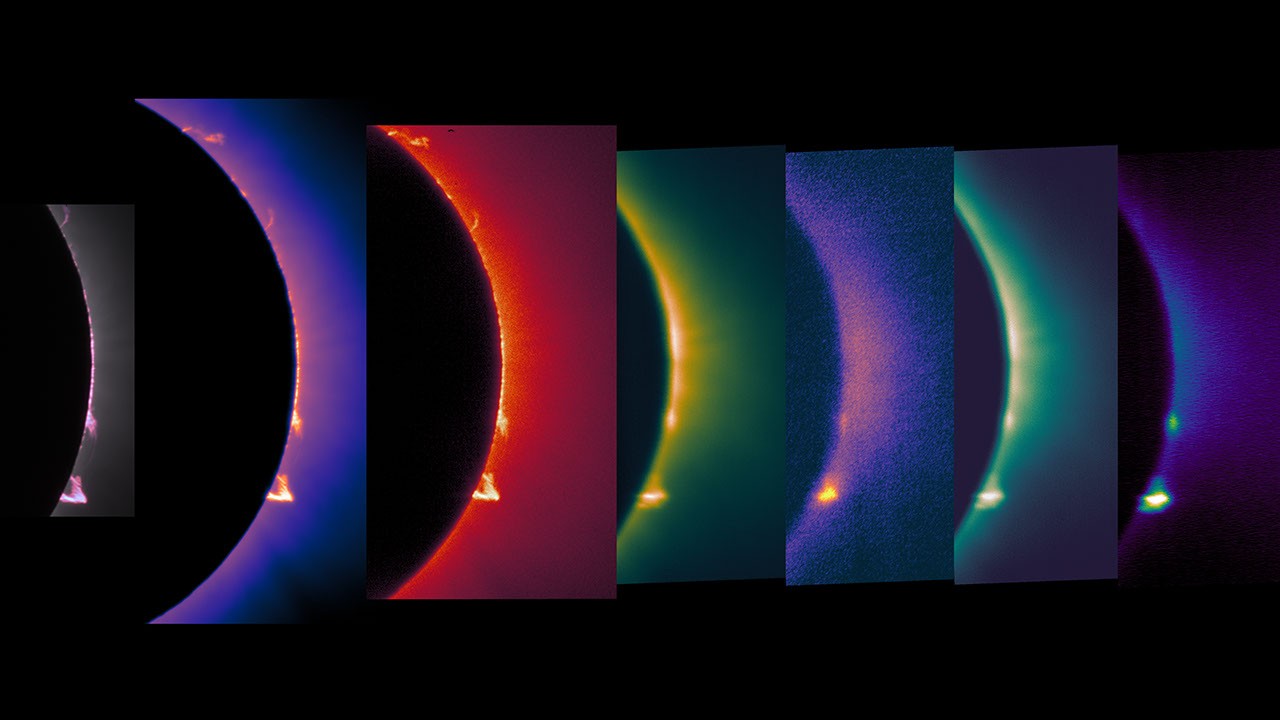
At the center of the solar observation effort is NASA’s WB-57 high-altitude research aircraft. Mounted in the aircraft’s nose cone is a suite of four cameras developed as part of an instrument from the NASA Scientifically Calibrated In-Flight Imagery, or SCIFLI, team at Langley Research Center. During the eclipse, those cameras will collect high-resolution images of the corona in several wavelengths of visible and infrared light.
NASA says the camera system will capture at least 20 images per second. That cadence is meant to help scientists record structures, outflows, and rapid changes in the corona during the period of totality. The goal is not only to collect striking imagery, but to extract physical clues about how the Sun behaves in its outer layers.
Researchers hope the data will improve understanding in several areas. NASA says the images may help scientists learn more about the formation of prominences, which are solar material suspended above the Sun’s surface. The observations are also intended to shed light on the corona itself, including why it is heated to nearly a million degrees. Another question involves the relationship between material in the corona and the solar wind, the stream of particles that flows outward from the Sun through the solar system.
These are not narrow academic issues. The Sun affects satellites, astronauts, and systems on and around Earth. NASA’s eclipse program manager Kelly Korreck said the moment offers a way to advance understanding of that influence from a unique observational perspective available only during totality.
Why flying matters
The key advantage of the WB-57 is not just altitude. It is mobility. On the ground, NASA says the longest view of the corona during this eclipse will be two minutes and 18 seconds. By flying along the eclipse path at roughly 460 miles per hour, the jet can stay within the Moon’s shadow longer and stretch the observing time to nearly three minutes.
That extra time may sound modest, but in eclipse science it is significant. Totality is the critical interval when the Moon fully blocks the bright solar disk and allows the much fainter corona to become visible. Every additional second gives researchers more frames, more wavelength coverage, and more opportunity to capture fast-changing structures that might otherwise go unseen.
The aircraft’s 50,000-foot operating altitude adds another advantage by placing the observations above clouds that could easily ruin a ground-based viewing attempt. For eclipse research, mobility and altitude combine to reduce two of the biggest constraints: limited duration and uncertain weather.
NASA previously flew the same camera system on a WB-57 during the April 8, 2024 total solar eclipse. The agency says those earlier flights captured images of the corona and solar prominences in multiple wavelengths of visible and infrared light. Reusing the system in 2026 gives the team continuity, allowing it to build on previous observations rather than starting from scratch.
Balloons will watch the atmosphere respond
The eclipse campaign is not limited to solar physics. NASA also says scientific balloons will be used to investigate atmospheric changes associated with the temporary dimming of daylight. That part of the work reflects a central fact about total eclipses: they are not only astronomical events but also abrupt environmental shifts that ripple through the air above us.
While the supplied report does not detail every balloon instrument or measurement objective, the framing is clear. As the Moon’s shadow moves overhead, the atmosphere experiences a sudden, localized change in heating. That makes the eclipse a useful test case for understanding how atmospheric conditions respond to short-term solar interruptions.
This kind of observation helps connect heliophysics with Earth system science. A total eclipse becomes, in effect, a naturally scheduled perturbation experiment. Scientists know where the shadow will travel and approximately how conditions will change, which allows them to organize measurements before, during, and after the event. Balloons are well suited for that work because they can sample the atmosphere directly in ways that complement ground stations and airborne imaging.
A targeted science opportunity, not just a spectacle
Total solar eclipses often enter public consciousness as dramatic skywatching events, but NASA’s campaign underscores how much disciplined science can be packed into a few minutes of darkness. The agency is using the event to examine solar structures at high speed and in multiple wavelengths, while also treating the eclipse as a controlled atmospheric disturbance over a defined geographic corridor.
The August 12 track across Greenland, Iceland, and Spain also shapes the international character of the observations. Because totality occurs across multiple regions, researchers can coordinate viewing and measurement strategies in different locations. The airborne approach adds resilience to that plan, especially where local cloud cover could otherwise disrupt surface-based work.
There is also a broader strategic point in how NASA is framing the mission. The agency is linking eclipse science directly to practical concerns about the Sun’s influence on everyday life, satellites, and human activity in space. That makes the campaign more than a specialized observing exercise. It becomes part of a larger effort to understand the environment generated by our nearest star and how that environment affects technological systems.
For the public, the eclipse will still be a spectacle. For NASA, it is a tightly timed research opportunity with little margin for error and potentially high scientific return. A WB-57 racing the Moon’s shadow and balloons probing the atmosphere are tools built for exactly that kind of moment: brief, rare, and scientifically rich.
If the campaign succeeds, it will provide new observations of the corona, extended airborne totality data, and fresh measurements of atmospheric response under eclipse conditions. Those are distinct outcomes, but they are linked by the same core idea. A few minutes of darkness can still reveal a great deal about both the Sun above and the planet below.
This article is based on reporting by science.nasa.gov. Read the original article.
Originally published on science.nasa.gov