Completed VLA survey gives astronomy a new radio baseline
Radio astronomy has gained a powerful new reference map. The National Radio Astronomy Observatory’s Very Large Array Sky Survey, or VLASS, has now been completed, giving researchers what source material describes as the highest-resolution radio survey ever taken.
The achievement matters because modern astronomy increasingly depends on matching observations across wavelengths. Optical and infrared surveys have advanced rapidly in both scale and detail, but radio data has not always lined up with them at comparable resolution. VLASS changes that balance by delivering a radio view of the sky detailed enough to be combined more directly with contemporary optical and infrared maps.
For scientists searching for transient events, tracking black holes, studying star formation, or comparing the structure of galaxies across different kinds of light, that alignment could open a far broader discovery space.
What VLASS accomplished
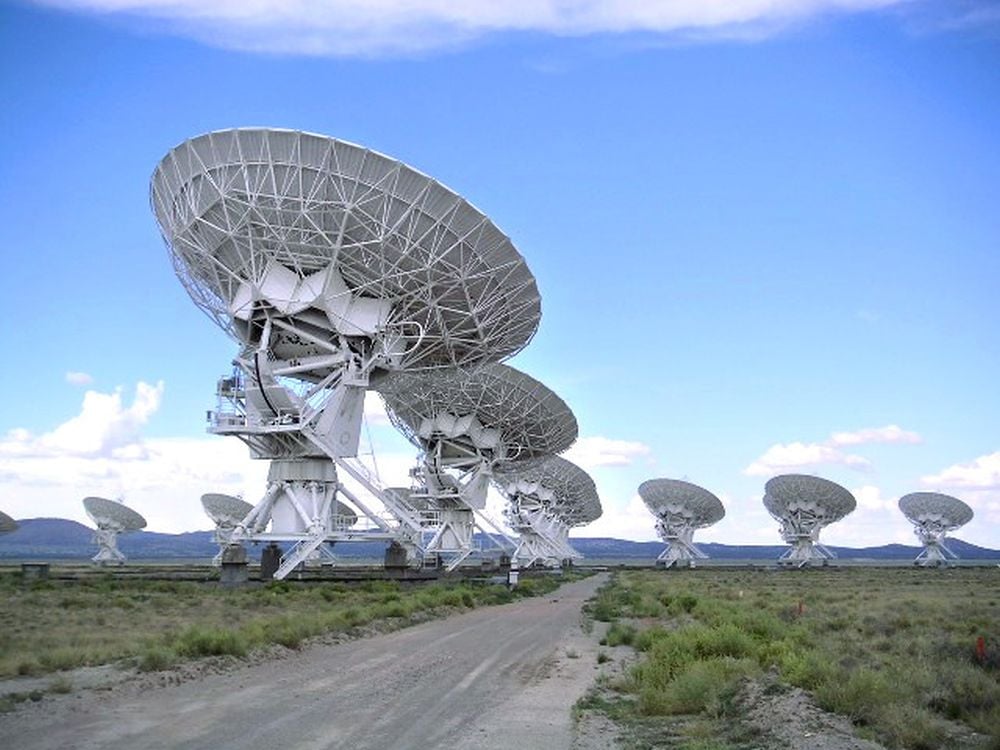
The survey was carried out using the Karl G. Jansky Very Large Array in New Mexico, an interferometric radio observatory made up of 28 dishes, each 25 meters across. The antennas can be repositioned on rails, allowing the array to be reconfigured for different observational goals, including sharper angular resolution or improved sensitivity to extended structures.
VLASS was completed in February 2026 after covering 80% of the sky in three separate epochs. That multi-epoch design is important because it allows astronomers to detect transients and changes over time rather than producing only a single static snapshot. The result is not just a large survey, but a dynamic one built to capture variability.
The project generated roughly 2 petabytes of data, making it the largest survey the VLA has ever conducted. Scale alone would be notable, but the more significant point is the combination of scale and sharpness. According to the source material, VLASS now provides a radio map whose resolution matches modern optical and infrared surveys, something earlier generations of radio sky mapping could not deliver at the same level.

Why matching other surveys matters
Astronomy has become a multiwavelength science. A galaxy, supermassive black hole, jet, supernova remnant, or protoplanetary disk can look fundamentally different depending on whether it is observed in visible light, infrared, X-rays, or radio frequencies. The more precisely those observations can be aligned, the easier it becomes to identify which structures correspond to one another and to build a fuller physical picture of what is happening.
Amy Kimball, VLASS Head of Operations, described the survey as a radio map of the sky that matches the resolution of modern optical and infrared surveys, opening the door to “truly multiwavelength discoveries” at a level of detail that was not previously possible.
That is the strategic importance of VLASS. It is not simply another catalog of radio sources. It becomes infrastructure for future research, a base layer that other observatories and future surveys can build on. When a transient source appears elsewhere in the electromagnetic spectrum, astronomers can compare it against a high-resolution radio reference. When a radio source is identified first, it can be cross-matched more cleanly with optical and infrared data.
An upgrade that meets a broader shift in astronomy
The source material notes that the VLA has completed other surveys before, but VLASS emerged in part because astronomy itself changed. A 2020 paper describing the survey’s science case argued that major optical and near-infrared programs had dramatically expanded what survey science could do. Large-format detectors in those fields made it possible to combine greater depth with frequent re-observation over wide areas of sky.
That shift created pressure for radio astronomy to keep pace. Without a similarly capable radio survey, some of the most interesting multiwavelength comparisons would remain limited by mismatched detail. VLASS responds directly to that need, effectively modernizing radio survey capability so it can operate on the same playing field as newer optical and infrared efforts.
The VLA itself was well suited for the job after upgrades in recent years. Its flexible configuration, long scientific track record, and improved capabilities made it possible to take on a program large enough to map most of the sky while still preserving the resolution needed to make the results broadly useful.

What researchers can do with the new map
The VLA has already contributed to studies of protoplanetary disks, black holes, and gas motion near the center of the Milky Way. A survey like VLASS expands that utility by creating a large-scale context for targeted observations. Instead of beginning with isolated radio measurements, astronomers can place many objects into a detailed all-sky framework.
The three-epoch structure should be especially valuable for time-domain astronomy. Because the sky was revisited, researchers can search for sources that brighten, fade, or appear unexpectedly. That adds a temporal layer to the survey and increases its value for tracking active galactic nuclei, explosive events, and other variable radio phenomena.
Just as important, VLASS can help researchers decide where to point more specialized instruments next. A high-resolution survey often serves as a discovery engine and triage system: it identifies unusual targets, reveals new structure, and narrows follow-up priorities for deeper study.
A foundational dataset for the next phase of discovery
Big surveys do not always produce a single headline-grabbing discovery at the moment they are completed. Their significance often lies in how many later discoveries they enable. VLASS appears to fit that pattern. By finishing an 80%-of-sky, multi-epoch, high-resolution radio map and producing an unprecedented volume of data, the VLA has created a durable resource for the astronomy community.
The larger story is that radio astronomy is becoming more interoperable with the rest of observational science. As telescopes across the spectrum continue to improve, the ability to compare their views cleanly becomes more valuable. VLASS gives radio astronomy a much stronger seat at that table, and the discoveries that follow may arrive across many subfields rather than from one corner of space.
What makes VLASS significant
- The survey covered 80% of the sky in three observing epochs.
- It produced about 2 petabytes of data, the largest survey in VLA history.
- Its resolution is described as matching modern optical and infrared surveys.
- The multi-epoch design allows astronomers to detect transients and variability.
- The dataset is expected to support more detailed multiwavelength research across astronomy.
This article is based on reporting by Universe Today. Read the original article.

Originally published on universetoday.com