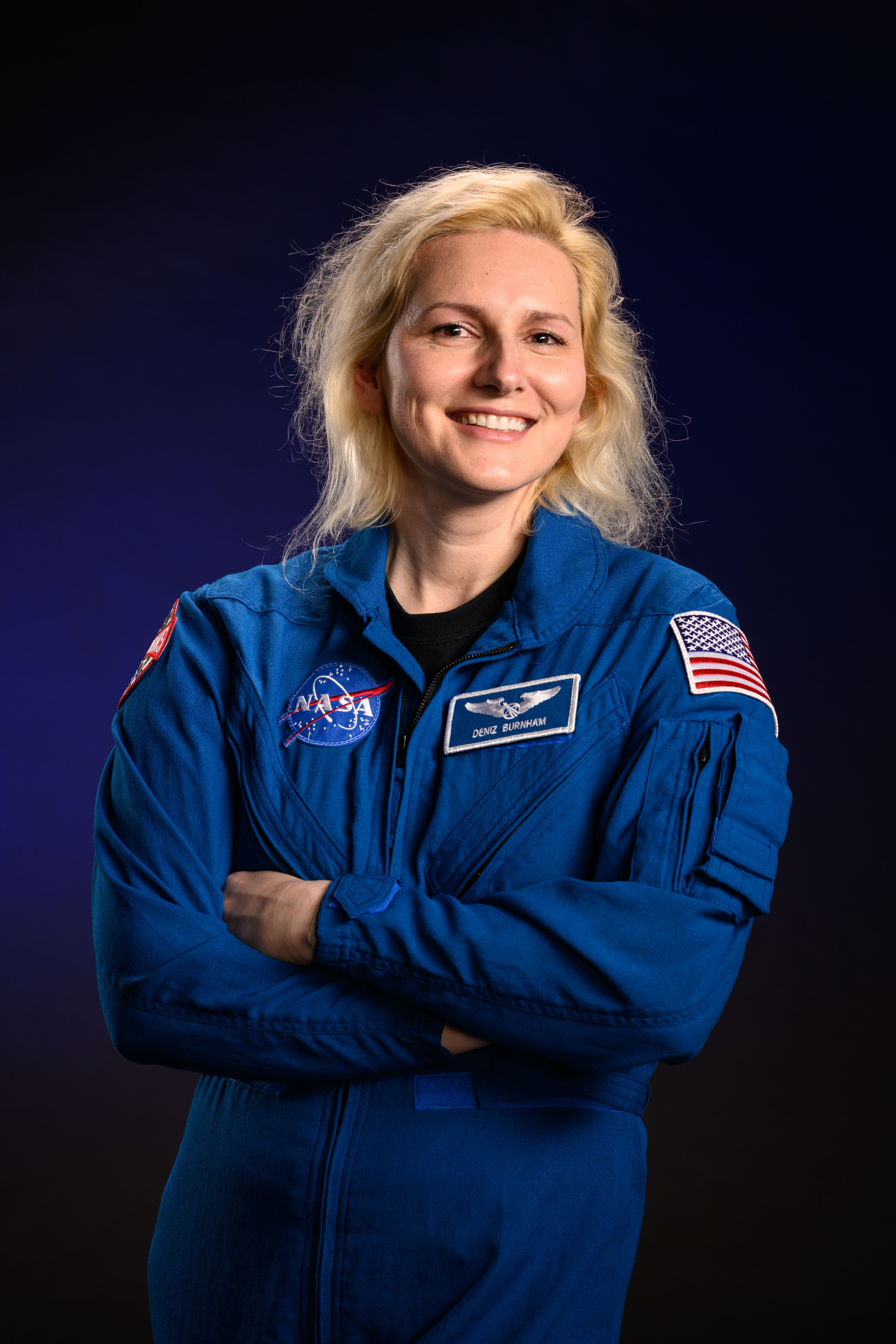
NASA Assigns Deniz Burnham to Her First Space Station Mission
NASA has assigned astronaut Deniz Burnham to her first mission to the International Space Station, placing her on Expedition 76 as a flight engineer for a launch targeted in March 2027. Burnham will fly aboard the Roscosmos Soyuz MS-30 spacecraft alongside cosmonauts Dmitri Petelin and Konstantin Borisov, with liftoff planned from the Baikonur Cosmodrome in Kazakhstan.
The crew is expected to spend about seven months aboard the orbital laboratory. During that time, Burnham will take part in scientific investigations and technology demonstrations that NASA says are intended both to support future exploration of the Moon and Mars and to generate benefits for people on Earth.
The assignment is significant on a personal level for Burnham, who was selected as part of NASA’s 2021 astronaut class and graduated in 2024, and on an institutional level for NASA, which continues to rely on the International Space Station as a proving ground for long-duration human spaceflight. Even a brief assignment announcement tells a larger story about how the agency develops astronaut talent, sustains international operations in low Earth orbit, and ties station research to its longer-term exploration plans.
From Astronaut Selection to First Flight
Burnham’s path to this mission has unfolded over several years. NASA selected her in 2021 as a member of the agency’s 23rd astronaut class. She completed training and graduated in 2024, moving from candidate status into the pool of astronauts eligible for flight assignments.
Now, with Expedition 76, she is making the transition from training to operational spaceflight. First assignments to the space station are major milestones for astronauts because they convert years of classroom work, systems training, survival preparation, engineering study, and team integration into a mission with clear responsibilities and a fixed launch timeline.
That progression also reflects NASA’s broader astronaut pipeline. The agency recruits people with technical depth, operational discipline, and experience in demanding environments, then prepares them for a mission set that combines science, engineering, maintenance, international coordination, and emergency readiness. Burnham’s background fits that model closely.
An Engineering and Operations Background
According to NASA, Burnham earned a bachelor’s degree in chemical engineering from the University of California, San Diego, and a master’s degree in mechanical engineering from the University of Southern California. Before becoming an astronaut, she spent more than a decade managing onsite drilling operations on oil rigs across North America.
That experience suggests deep familiarity with high-consequence industrial systems, logistical complexity, and field leadership under pressure. Those are useful traits for station crews, who must operate in a tightly constrained technical environment where small failures can have outsized effects.
Burnham also served in the U.S. Navy Reserves as an engineering duty officer. In addition, NASA describes her as a licensed private pilot with ratings for airplane single engine land and sea, instrument airplane, and rotorcraft-helicopter. Taken together, those qualifications point to a career shaped by applied engineering, operational decision-making, and disciplined systems work rather than purely academic specialization.
NASA’s short biography also notes that Burnham was born at Incirlik Air Base in Adana, Turkey, and moved frequently while growing up in a military family. She was living in Wasilla, Alaska, when she was selected as an astronaut. The agency further notes that she had previously interned at NASA’s Ames Research Center in California’s Silicon Valley, giving her an earlier connection to the organization she now represents in orbit.
What Burnham Will Do on Expedition 76
NASA says Burnham will serve as an Expedition 76 flight engineer. While the announcement does not provide a detailed activity list, it states that she will conduct scientific investigations and technology demonstrations aboard the station.
Those experiments and demonstrations are part of the station’s longstanding role as both laboratory and testbed. Research in microgravity allows scientists and engineers to study phenomena that are difficult or impossible to reproduce under Earth’s gravity conditions. The station also gives space agencies a place to evaluate equipment, operational procedures, and human-performance questions that matter for longer missions beyond low Earth orbit.
NASA ties Burnham’s mission explicitly to future exploration. The agency says the work will help prepare humans for missions to the Moon and Mars while also benefiting people on Earth. That dual framing has become central to how NASA presents station operations: near-term research value coupled with long-term exploration readiness.
The Space Station’s Continuing Role
For more than 25 years, people have lived and worked continuously aboard the International Space Station, according to NASA. That continuity is one of the agency’s central arguments for the station’s importance. Rather than functioning only as a symbolic outpost, the ISS has become a long-duration operational environment where crews can build a cumulative record of human performance, maintenance demands, scientific output, and international coordination.
The station also remains an important bridge between present-day low Earth orbit activity and NASA’s Artemis-era ambitions. NASA says the ISS helps the agency understand and overcome the challenges of human spaceflight, expand commercial opportunities in low Earth orbit, and build the foundation for longer-duration missions to the Moon and Mars.
In practical terms, that means station missions like Burnham’s are not isolated assignments. They are part of a continuous campaign in which each increment of crew time supports research, operations, and experience that can inform future exploration architectures. The seven months Burnham is expected to spend on orbit will contribute to that larger body of work.
International Cooperation Still Defines ISS Missions
Burnham’s flight assignment also underscores the station’s international character. She will launch on a Roscosmos Soyuz spacecraft with two Russian crewmates, Dmitri Petelin and Konstantin Borisov, from Baikonur in Kazakhstan. The announcement is a reminder that ISS missions are still structured through multinational operational partnerships, with crew roles and transportation arrangements crossing agency lines.
That matters because the station remains one of the world’s most visible examples of sustained cooperation in human spaceflight. Crew assignments, vehicle use, and expedition planning all depend on coordination across institutions and national programs. Burnham’s first mission fits squarely within that framework.
For NASA, the announcement is also a personnel marker: one of its newer astronauts is moving into active flight operations on a mission with defined international partners, a specified launch vehicle, and a clear expedition role. For Burnham, it is the transition from preparation to spaceflight. For the agency, it is another step in keeping the ISS crew pipeline moving while using today’s missions to support tomorrow’s exploration goals.
With launch targeted for March 2027, there is still time before Burnham begins her first stay aboard the station. But the assignment already signals NASA’s confidence in her training and readiness. It also shows how the station continues to serve multiple purposes at once: a laboratory, an operational outpost, a training ground for exploration, and a platform where the next generation of astronauts begins its flight careers.
This article is based on reporting by NASA. Read the original article.

Originally published on nasa.gov