Quiet early galaxies may have been shut down by their own winds
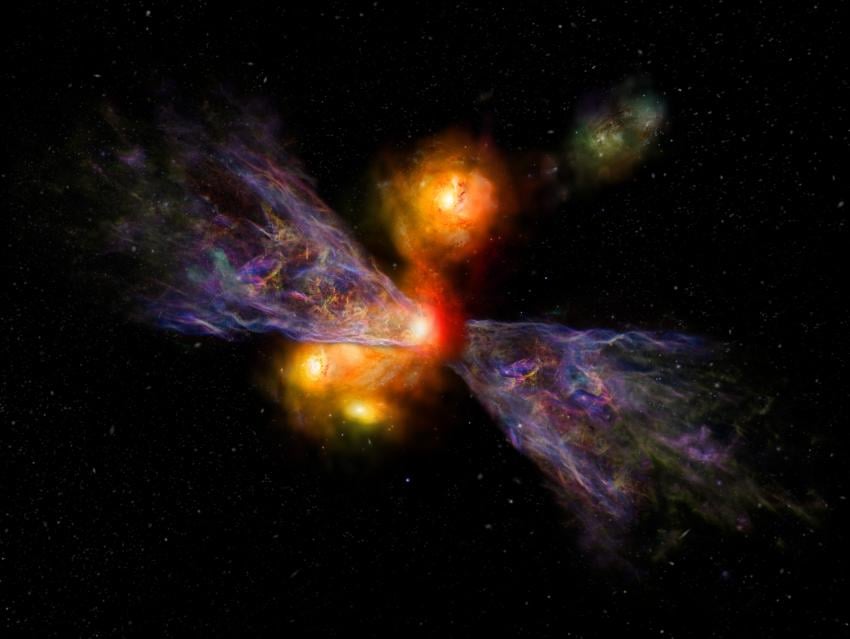
Astronomers studying the young universe have been trying to explain a puzzling class of objects: massive galaxies that formed early, burned through a period of intense star creation, and then went unexpectedly quiet. A report highlighted by Universe Today points to a clearer answer. Observations of a distant galaxy called CRISTAL-02 suggest that powerful gas outflows, likely triggered during galaxy collisions, can blow away the raw material needed for new stars and effectively shut a galaxy down.
The finding addresses one of the more surprising results from the James Webb Space Telescope era. Webb has revealed massive quiescent galaxies when the universe was only about 1 billion to 2 billion years old, a period when galaxy building was still in full swing. Those galaxies are not literally dead, but they have little ongoing star formation compared with the brighter, busier systems around them. The central question has been what caused such young galaxies to stop making stars so quickly.
The answer proposed here is both physical and dramatic: the galaxies may have expelled their own future. When galaxies interact and merge, the encounter can trigger enormous bursts of star formation. But the same violent phase can also drive gas outward in vast winds. Once enough cold gas is pushed away, the galaxy loses the fuel required to keep building stars, leaving behind a massive but comparatively quiet system.
CRISTAL-02 offers a direct clue
The case centers on CRISTAL-02, a galaxy observed with both the James Webb Space Telescope and the Atacama Large Millimeter/submillimeter Array, or ALMA. Together, the instruments offer a useful combination. Webb can study the distant universe in infrared light, where the stretched light from early galaxies is easiest to detect, while ALMA can trace cold gas and related structures that are central to star formation.
According to the report, CRISTAL-02 shows a huge plume of cold gas extending away from the galaxy. That structure is almost as long as the galaxy itself, making it a striking sign that material is being driven outward rather than staying in place to form the next generation of stars. For astronomers trying to understand why some early galaxies went quiescent, this kind of direct evidence is especially valuable. It links the shutdown not just to theory or simulation, but to an observed physical mechanism.
The interpretation also fits the broader environment of the early universe. During that era, galaxies were smaller, denser, and more prone to interactions. Collisions and mergers were common parts of cosmic growth. Those events helped assemble larger galaxies over time, but they also produced chaotic internal conditions. If a merger-driven starburst can generate enough energy and feedback to expel cold gas, then galaxy growth and galaxy shutdown become part of the same process rather than opposite outcomes.
Why JWST made the puzzle sharper
The James Webb Space Telescope did not create the idea of quiescent galaxies, but it made the problem harder to ignore. In recent years, Webb has uncovered massive, apparently quiet galaxies at unexpectedly early cosmic times. Their existence stood out because standard expectations held that this period should be dominated by rapid growth, active star formation, and repeated assembly through mergers.
Some astronomers explored more exotic explanations for the mismatch. The report notes that proposals have included early dark energy activity that might have allowed some galaxies to grow quickly and then die young. At the same time, other work has suggested that certain early galaxies may have appeared more massive than they really were because black holes made them look brighter and larger.
That context matters because it shows how unsettled the field has been. The challenge has not just been explaining one odd observation, but reconciling multiple categories of evidence about galaxy mass, brightness, and star-forming activity in the first few billion years of cosmic history. The CRISTAL-02 result does not necessarily solve every version of that problem, but it provides a concrete, testable mechanism for at least some of these quiet galaxies.
In that sense, the finding narrows the debate. Instead of asking only whether early quiescent galaxies exist and whether their masses were overestimated, astronomers can increasingly ask how often strong gas outflows occur, what kinds of mergers produce them, and how efficiently those winds remove the star-forming reservoir.
Starbursts and shutdowns may be two phases of one event
The picture emerging from CRISTAL-02 is not one of gradual exhaustion. It is more abrupt. A merger can first compress gas and ignite a burst of star formation, making the galaxy briefly more active. But that same episode may also power feedback strong enough to drive gas away. The result is a galaxy that forms stars intensely, then rapidly loses the means to continue.
That sequence helps explain why early quiescent galaxies still show evidence of past star formation. They are not systems that failed to grow. They grew fast. Their quiet state came after an earlier, more violent phase. In practical terms, the difference matters because it changes the question from “Why did these galaxies never become active?” to “What ended their activity so early?”
The observed cold-gas plume provides a plausible answer. Star formation depends on dense, cool gas clouds collapsing under gravity. Remove enough of that gas, and a galaxy can remain structurally intact while becoming much less productive. Over time it may continue to evolve through later interactions, but the explosive first phase of stellar growth is over.
That mechanism also fits with the way astronomers increasingly think about feedback in galaxy evolution more broadly. Whether from intense star formation, black hole activity, or both, feedback processes can regulate how quickly galaxies convert gas into stars. In the early universe, where conditions were more extreme, that regulation may have been especially forceful.

A more dynamic early universe
The larger implication is that the early universe may have been even more dynamic than expected. The same collisions that built galaxies could also help quench them. Growth and suppression were not separate stories unfolding in different places. They may have been tightly linked phases in the life cycle of the same objects.
For observers, that makes systems like CRISTAL-02 valuable benchmarks. They offer a chance to compare theoretical models with actual gas structures in distant galaxies. Future observations should help determine whether giant cold-gas plumes are common among early quiescent galaxies or whether CRISTAL-02 represents a more selective pathway to shutdown.
Either way, the result strengthens the idea that some of the universe’s earliest quiet giants were shaped by violent internal and external forces rather than by slow fading alone. The raw material for stars did not simply run out. In at least some cases, it appears to have been pushed out.
That is a consequential shift in explanation. If confirmed across more objects, it would turn merger-driven winds into a key part of the story of how the first massive galaxies formed, flared, and then fell silent while the universe was still young.
This article is based on reporting by Universe Today. Read the original article.
Originally published on universetoday.com