Webb offers a possible evolutionary path for one of the early universe’s strangest objects
Since 2022, astronomers working with NASA’s James Webb Space Telescope have been trying to explain a newly noticed population of distant objects known as little red dots, or LRDs. They appear as compact, reddish sources in the young universe and have become one of the telescope’s more intriguing puzzles. A new study highlighted by NASA on July 29 proposes that these objects may not represent a permanently distinct class of galaxy at all. Instead, they may mark a temporary stage in the growth of highly active supermassive black holes.
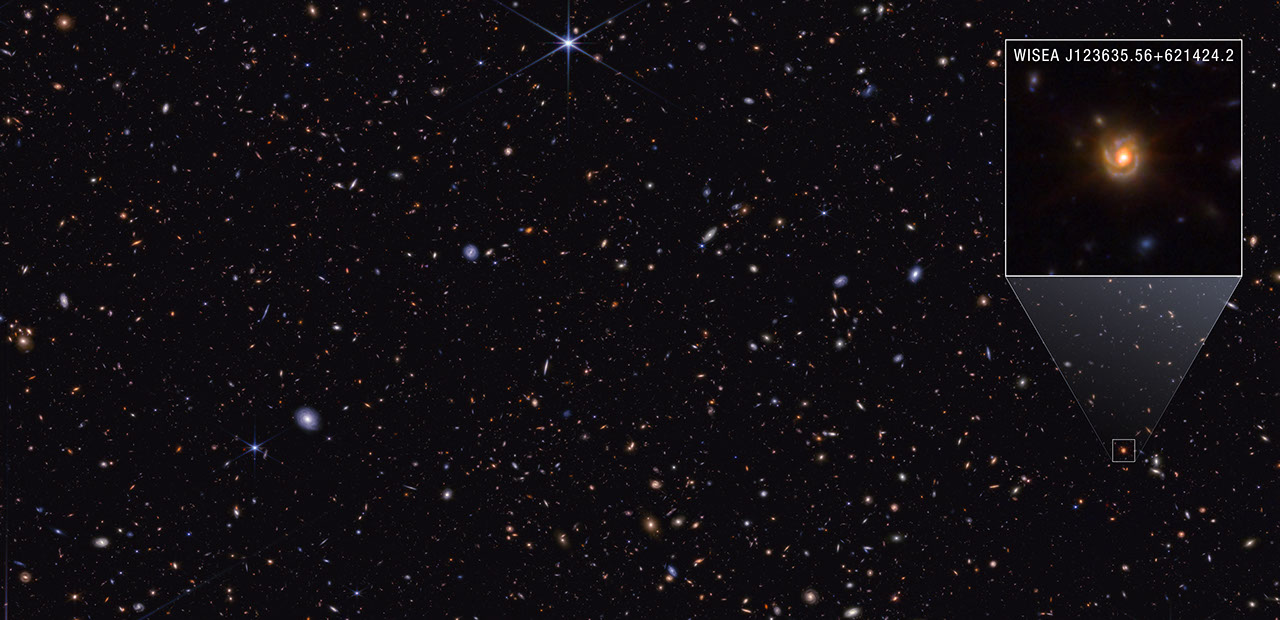
The work centers on a spiral galaxy formally known as WISEA J123635.56+621424.2 and nicknamed the “Saguaro.” Researchers say the object helps outline one pathway little red dots could follow as the universe matures. In that view, at least some LRDs are active galactic nuclei seen under conditions that make them look unusual compared with nearby examples. Their apparent abundance in the early universe, followed by a sharp drop at lower redshifts, would then reflect a phase that does not last very long on cosmic timescales.
That matters because little red dots have been difficult to fit into standard expectations. One popular theory has been that they are powered by supermassive black holes, but the source text notes they do not neatly resemble active galactic nuclei observed closer to home. At the same time, they were common at high redshift and then became much rarer as the universe aged. That mismatch between early prevalence and later scarcity raised a basic question: what do these objects become?
Why little red dots have attracted so much attention
Webb’s sensitivity to the distant universe has made it especially good at finding compact, faint, and ancient sources. Little red dots stood out because they seemed to cluster in an era when galaxies and black holes were still assembling, yet they did not behave exactly like familiar categories. Their color, compact appearance, and distribution hinted that astronomers might be seeing a short-lived but important stage in early cosmic evolution.
The NASA summary frames the new study as an attempt to move from simple description to an evolutionary explanation. Rather than asking only what little red dots are at the moment they are observed, the researchers are asking how they change over time. The Saguaro galaxy becomes useful here because it appears to connect Webb’s early-universe discoveries to a later, more developed system that may preserve evidence of the same underlying process.
If that interpretation holds up, little red dots could help researchers understand how black holes grew rapidly in the first chapters of cosmic history. The source text says the team’s proposed pathway suggests LRDs may be a temporary phase of highly active supermassive black holes. In practical terms, that means Webb may be catching black holes during a period when their activity and surrounding material make them easier to see as compact red sources, before later evolution changes their appearance.

A puzzle about visibility, not just identity
An important idea in the NASA summary is that little red dots may look like a unique population partly because of observational effects. The source text says the researchers argue these dots are affected by observational biases. That is a significant distinction. It implies astronomers may not be discovering an entirely separate branch of cosmic objects so much as seeing a familiar phenomenon under unusual early-universe conditions and with particular observational constraints.
That kind of argument is common in astronomy, where objects can appear radically different depending on distance, orientation, intervening material, and the wavelengths used to observe them. For little red dots, the challenge has been to separate what is intrinsically strange from what only appears strange because Webb is observing very distant systems in a formative era of the universe.
The new study does not close the case, but it does offer a more structured framework. Instead of leaving LRDs as an isolated mystery, it places them in a developmental sequence. That is useful for future observing campaigns, because astronomers can now test whether more galaxies show the same kinds of traits that link compact early red sources to later active systems.
Why the “Saguaro” galaxy matters
The Saguaro is central because it gives researchers a concrete object through which to study this transition. NASA’s summary says the team built on previous research and used the galaxy to propose one pathway for how LRDs evolve as the universe ages. In effect, the galaxy acts as a bridge between the unusual red dots Webb found at high redshift and a more interpretable system that may preserve clues to their later development.
That does not mean every little red dot follows the same route. The wording in the source is careful: the team proposed one pathway, not the pathway. That leaves room for the possibility that the LRD label includes more than one physical scenario. Even so, identifying one credible evolutionary track is a meaningful advance because it narrows the field of possibilities and ties the mystery to a broader problem in galaxy and black hole growth.
The study was led by Pierluigi Rinaldi, formerly of the University of Arizona’s Steward Observatory and now at the Space Telescope Science Institute in Baltimore. NASA says the paper was published July 29 in The Astrophysical Journal, giving the work the added weight of a formal research publication rather than a preliminary claim.

What comes next
The immediate consequence of the study is not that astronomers have solved little red dots once and for all. The better reading is that Webb data are starting to support a coherent narrative. The objects may represent a transient episode in which supermassive black holes are highly active and appear in ways that differ from nearby active nuclei. Their disappearance at lower redshift would then be less mysterious: the phase ends, and the systems evolve into something easier to classify.
That kind of result is exactly where a flagship observatory such as Webb can have outsized impact. It is not only finding unexpected phenomena, but also generating the follow-up evidence needed to place those phenomena into cosmic history. For little red dots, the next step will be to see whether additional observations strengthen the proposed family tree, reveal competing pathways, or show that the category itself contains multiple populations now grouped under one convenient label.
For now, the study gives astronomers something they have lacked since the first discoveries in 2022: a plausible answer to what happens after the little red dot phase ends. If that answer is right, one of Webb’s most puzzling discoveries may turn out to be a fleeting but revealing snapshot of black holes growing up in the early universe.
This article is based on reporting by science.nasa.gov. Read the original article.
Originally published on science.nasa.gov