JWST points to a volatile atmosphere on one of the best-known lava worlds
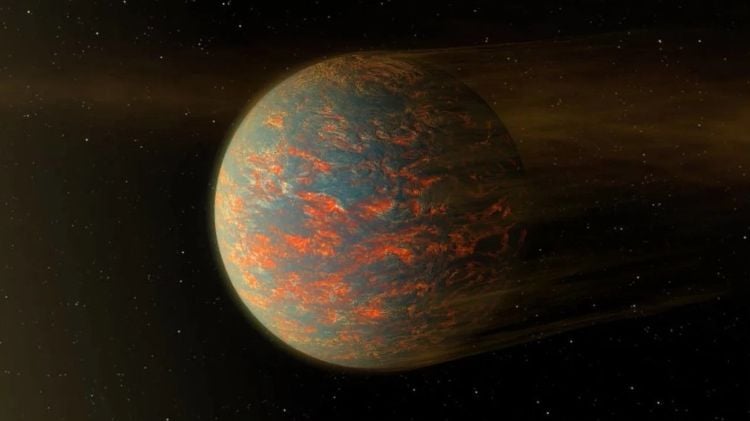
Fresh observations from NASA’s James Webb Space Telescope are giving researchers a sharper view of 55 Cancri e, a super-Earth about 41 light-years from Earth that orbits so close to its star that scientists think its surface may be partially molten. The new analysis suggests the planet’s atmosphere is not only present, but likely hydrogen-rich and potentially active, with signs that outgassing and temporary cloud formation may be reshaping conditions over time.
The findings, reported in a study submitted to Nature Astronomy, add to a growing effort to understand so-called lava planets: rocky worlds heated to extremes by their stars. These planets are among the most hostile environments known, but they also offer a rare natural laboratory for studying how atmospheres behave when surfaces are hot enough to melt and exchange material directly with the air above them.
In the case of 55 Cancri e, the basic numbers already made it unusual. The planet has about 1.88 times Earth’s radius and roughly eight times Earth’s mass. It circles a Sun-like star once every 0.7 days and is thought to be tidally locked, meaning one side likely faces the star continuously. That tight orbit is central to the new interpretation: researchers hypothesize that the intense stellar heating is enough to melt surface materials and drive atmospheric chemistry unlike anything seen in the Solar System’s rocky planets.
Five eclipse observations changed the picture
Researchers used JWST to observe five eclipses of 55 Cancri e and compare the data with long-standing models for lava-planet formation and evolution. Earlier expectations had favored atmospheres rich in carbon monoxide and carbon dioxide. The new observations still support significant carbon monoxide, but they point to a more complicated mix than standard models suggested.
According to the report, the atmosphere is likely made up of large amounts of carbon monoxide, smaller amounts of carbon dioxide, and substantial hydrogen. That last ingredient is especially notable. A hydrogen-rich atmosphere on an intensely heated rocky planet implies the interior chemistry may be more reduced than some models assumed, tying what astronomers can detect above the surface to what may be happening inside a global or near-global magma environment.
The study argues that secondary atmospheres on rocky planets are set by interior composition and later outgassing. In practical terms, that means atmospheric measurements can act as indirect probes of the planet’s interior state. Here, the preference for hydrogen-rich models suggests relatively low oxygen fugacity, a geochemical indicator that the planet’s interior may favor hydrogen relative to oxygen-bearing compounds.
That is important because it moves 55 Cancri e beyond being merely an exotic object with extreme temperatures. It becomes a test case for connecting atmospheric signatures, magma chemistry, and planetary evolution on worlds that are neither gas giants nor Earth-like terrestrial planets.

Why the atmosphere may be changing in real time
One of the more intriguing details in the source report is that the five eclipse observations did not line up perfectly. The researchers say the mixed data could indicate active outgassing or clouds produced by that outgassing. In this scenario, material released from the hot surface or interior forms clouds that briefly cool the planet’s surface until renewed outgassing disperses them.
If that interpretation holds up, 55 Cancri e may be one of the clearest examples yet of an exoplanet whose atmosphere is being actively replenished and altered on short timescales. Rather than a static envelope of gas, the planet could have a cycling system in which surface heat, atmospheric composition, and transient clouds interact continuously.
That matters for more than just this one object. Astronomers are trying to determine which rocky exoplanets can hold atmospheres at all under intense irradiation, and how those atmospheres evolve. A world like 55 Cancri e sits at the far edge of that question. If it can sustain a dynamic atmosphere while orbiting so close to its star, then models of atmospheric survival, replenishment, and composition on ultra-hot rocky planets may need refinement.
What this means for exoplanet science
55 Cancri e has long attracted attention because it is relatively nearby and unusually accessible for repeated study. That makes it a prime target for observatories trying to move from simple detection of exoplanets to detailed characterization of their atmospheres and interiors. JWST’s ability to gather multiple eclipse datasets is a major reason scientists can now make more specific claims about what gases may be present and how variable the system might be.
The broader significance is methodological as much as scientific. Exoplanet researchers increasingly rely on atmosphere measurements to infer processes they cannot observe directly, including volcanic activity, interior composition, and heat transport. On a planet as extreme as 55 Cancri e, those inferences are difficult and model-dependent. Even so, the new results show that the field is progressing from broad classification toward physically grounded interpretations.
There are still limits. The study has been submitted for publication, not yet described as fully published, and the reported interpretation depends on how the eclipse data compare with competing atmospheric models. But even with those caveats, the result is meaningful: a nearby lava planet once framed mostly as an extreme curiosity now looks like a dynamic world with a chemically informative atmosphere.
That makes 55 Cancri e more than a cautionary tale about planetary overheating. It is becoming a benchmark for how astronomers study rocky exoplanets pushed to physical extremes, and for how telescopes like JWST can translate tiny shifts in light into a working picture of alien geology and atmospheric change.
This article is based on reporting by Universe Today. Read the original article.
Originally published on universetoday.com