A Century-Long Search Near One of the Sky’s Brightest Stars
Astronomers have announced the clearest image yet of a long-suspected companion to Betelgeuse, the red supergiant that marks Orion’s shoulder. The detection, made with the European Southern Observatory’s Very Large Telescope in Chile using data collected in 2024, appears to confirm that the famous star is not alone.
The newly identified object is being referred to as Betelgeuse B and carries the nickname Siwarha. For researchers, the result closes out a search that has stretched across decades of observation and speculation. Betelgeuse is one of the best-known stars in the night sky, yet its extreme brightness and pulsations have made it surprisingly difficult to study in full detail, especially when it comes to spotting any much fainter neighbor nearby.
Miguel Montargès, who led the observing team, described the result as the conclusion of a century-long quest. That sense of closure reflects how persistent the mystery has been. Astronomers have long suspected that variations in Betelgeuse’s behavior might be influenced by a hidden companion, but direct proof remained elusive.
Why Betelgeuse is so hard to probe
Betelgeuse sits roughly 400 to 550 light-years from Earth and is an unusually massive and young star by stellar standards. It contains about 14 times the mass of the Sun and is thought to be no more than 10 million years old. Because it evolved rapidly, it has already entered the red supergiant phase, becoming enormous, bright, and astrophysically important.
Its future also makes it famous. Betelgeuse is expected to explode as a supernova sometime within the next 100,000 years, which is relatively soon on cosmic timescales. That fate, combined with its visibility and size, has made it a frequent target for telescopes on Earth and in space.
But those same traits complicate the search for companions. Betelgeuse is so bright that it can wash out nearby objects, especially ones packed close to it in the sky. Its own brightness also changes, and the star pulsates, making it difficult to pin down its exact size and surrounding environment over time. A faint companion could easily hide inside the glare.
The image that changed the picture
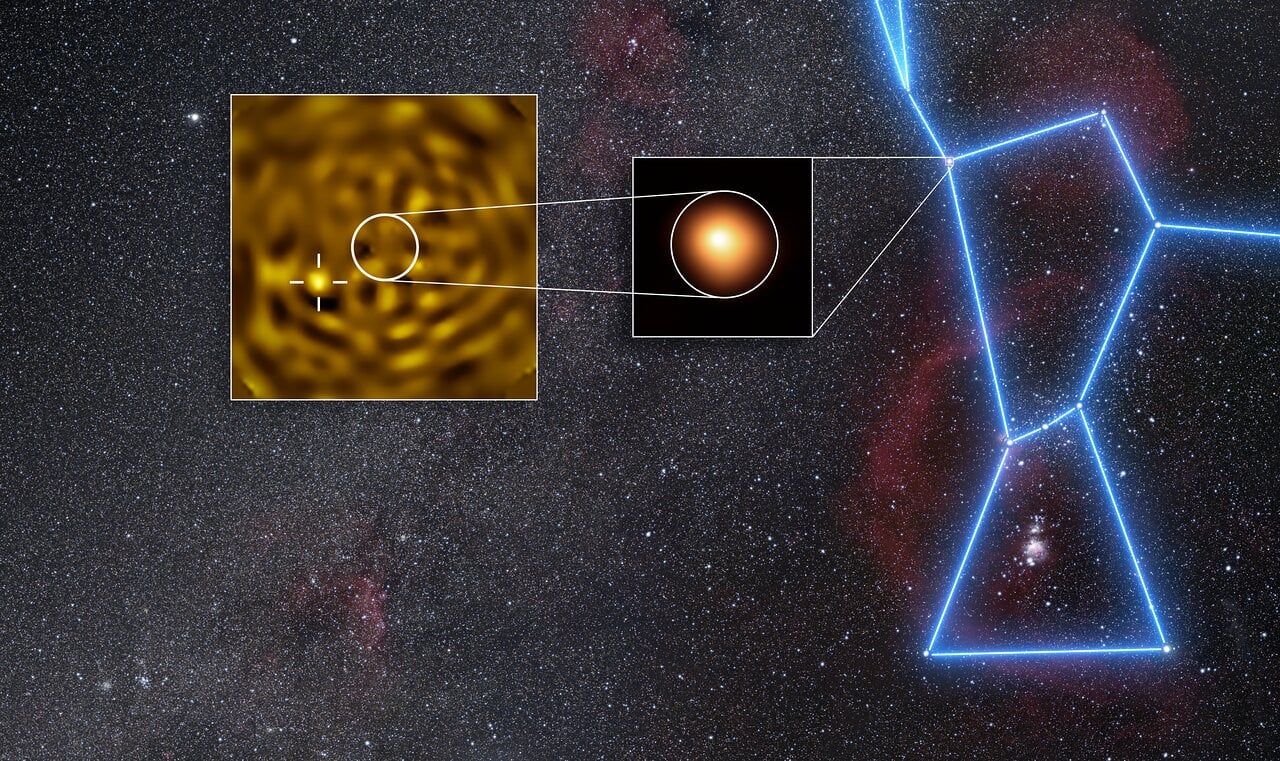
The breakthrough came from observations made when the companion was predicted to be at its greatest apparent separation from Betelgeuse as seen from Earth. Using the SPHERE instrument on ESO’s Very Large Telescope, astronomers examined data from December 2024 and removed Betelgeuse’s overwhelming light from the image. What remained was a source consistent with the expected position of the hidden star.
The source appears in contrast to an earlier 2019 image focused on Betelgeuse itself. By comparing the two, the team argues that the newly revealed point is the clearest evidence yet for Betelgeuse B. The timing was important: if the companion had been closer in projection to the main star, the glare problem would have been much worse.
That observational strategy highlights how modern astronomy often advances not only through more powerful instruments, but through more precise predictions about when and where a target will be most detectable. In this case, the team appears to have caught the system at exactly the right moment.
What astronomers think Betelgeuse B is
Based on the observations, Betelgeuse B may be around two to three times the mass of the Sun. That estimate is notable because Montargès said the object appears more massive than expected. If confirmed, that could help explain why earlier predictions underestimated the likelihood of a direct detection.
The companion’s existence could also clarify long-running questions about Betelgeuse’s brightness variations and local environment. Companion stars can influence mass loss, surrounding gas, and orbital dynamics. For a red supergiant already known for unusual behavior, even a moderately massive neighbor could matter.
At the same time, the new image is not the final word on the system. Direct imaging provides a strong observational anchor, but understanding the orbit, mass, and interaction between the two stars will require more follow-up work. Astronomers will want to refine how often the pair can be observed cleanly and how the companion’s motion fits earlier indirect evidence.
Why this result matters beyond one star
The announcement is important not simply because Betelgeuse is famous, but because it demonstrates how difficult stellar systems can yield to patient, high-resolution observation. A bright nearby supergiant might sound easy to study, yet Betelgeuse has repeatedly shown that prominent objects can still hide basic secrets.
The result also adds a new layer to a star that already commands unusual public attention. Betelgeuse drew intense scrutiny during its dramatic dimming episode several years ago, when observers wondered whether it might be approaching explosion. Subsequent work tied that event to surface activity and dust, not an imminent supernova. Now the star is back in headlines for a different reason: its apparent family structure.
For astronomers, the detection offers a cleaner framework for future modeling of Betelgeuse’s evolution. A confirmed companion can affect how researchers interpret brightness changes, circumstellar material, and the geometry of matter around the star. In other words, Betelgeuse may be a slightly less solitary and slightly more complex object than many models assumed.
That complexity is part of the appeal. Even after decades of close attention, one of the most recognizable stars in the sky still had a hidden companion waiting in the glare. The new image does not make Betelgeuse any less mysterious, but it does make the mystery more specific, and that is often how real progress in astronomy begins.
This article is based on reporting by Universe Today. Read the original article.
Originally published on universetoday.com