A Simulation Becomes an Observation
Astronomers have spent decades modeling how planets assemble themselves inside the rotating disks of gas and dust that surround young stars. Those models predicted that a growing planet should stir up the material around it, creating visible swirls of moving gas. Until now, no one had ever photographed that process directly. That changed with an international research effort that has delivered the first direct image of a planet forming inside a swirling envelope of gas and dust — a body known as a protoplanet.
The work, published in The Astrophysical Journal Letters, centers on a pair of young planets orbiting a star roughly 430 light-years from Earth. The observations were made using the Atacama Large Millimeter/submillimeter Array (ALMA), the observatory perched in northern Chile that has become a workhorse for studying the cold gas and dust of planet-forming disks.
"We clearly see both planets shaping their environment," said Dr. Myriam Benisty, Director of the Max Planck Institute for Astronomy in Germany and the lead author of the study.
A Pair of Young Worlds in One Disk
The target system hosts two confirmed protoplanets, both of which have now been directly imaged. Together they offer an unusually complete view of how multiple planets can carve up a single disk of material.
The Outer World: WISPIT 2b
- Located approximately 57 astronomical units (AU) from its host star — well beyond the distance at which Jupiter sits in our own solar system.
- Estimated to be about five times as massive as Jupiter.
- Imaged directly by ALMA and described as the first directly imaged protoplanet.
- Its discovery was announced in August 2025.
Around this outer planet, the new ALMA data reveal swirls of gas in motion — the long-anticipated signature of a planet interacting with the disk it is still feeding from.
The Inner World: WISPIT 2c
- Orbits interior to WISPIT 2b at a distance of about 15 AU from the star.
- Estimated to be between 8 and 12 Jupiter masses.
- Its discovery was announced in March 2026, shortly after the announcement of its outer companion.
Taken together, the two objects show a system in which distinct planets occupy distinct regions of the same disk and leave very different marks on their surroundings.
Reading the Colours of Moving Gas
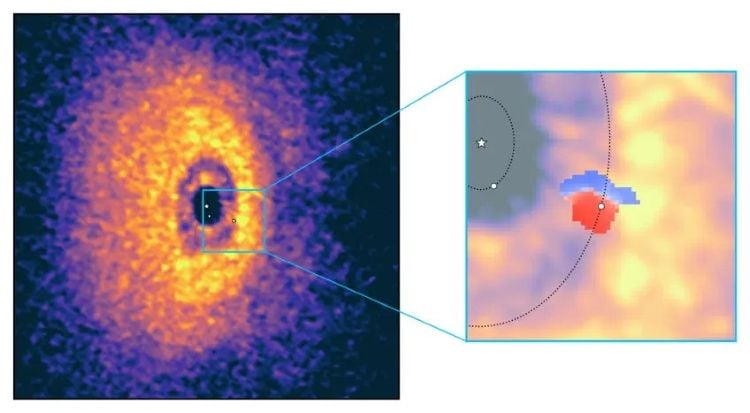
ALMA does not produce a simple photograph in the way an optical telescope does. Instead, the image of this system encodes motion. Gas that is travelling toward the observer is rendered in blue, while gas moving away is rendered in red. The resulting picture of WISPIT 2b is therefore not just a portrait of a young planet, but a map of the gas streaming around it.
That mapping is what makes the result significant. Simulations of disk–planet interactions have long predicted that a sufficiently massive body should create spiral-like disturbances in the surrounding material. The new ALMA image shows exactly that kind of structure around WISPIT 2b.
"WISPIT 2c has carved a cavity, and WISPIT 2b a gap," Benisty explained. "Around WISPIT 2b, we find swirls of gas that had been predicted by simulations of disk-planet interactions, but never actually seen before. Now there is an image of them!"
Why a Cavity Is Not a Gap
The distinction between the two features in this system matters for understanding how planets continue to grow. A cavity represents a complete clearing of gas and dust — the disk material is essentially gone. A gap, by contrast, signals only a reduction in the density of disk material. Enough gas and dust remain within a gap for a protoplanet to keep accreting material and adding to its mass.
That means WISPIT 2b is likely still under construction, embedded in the residual material of its gap, while WISPIT 2c has swept its neighbourhood far more thoroughly. The comparison gives researchers a rare chance to observe two planets at different points in the same overall process within a single system.

How Planets Are Born
The broader picture of planet formation begins with a massive ball of gas and dust that swirls and eventually flattens into a disk. Within that disk, rocky material ranging from pebbles to kilometre-scale objects clumps together in a process called accretion. Those growing bodies continue to orbit within the larger disk. Closer to the star, conditions favour the formation of rocky planets, while farther out, planets collect the gas, ice, and dust that the star is unable to evaporate.
Every stage of that sequence has been studied primarily through theory and computer modelling. Direct observations of a planet still embedded in its birth material are extremely difficult, which is why the WISPIT system stands out.
What the Image Means for the Search for Life
Planet formation and evolution are the driving forces behind where — and how — we might find life beyond Earth. Understanding how planets acquire their mass, where they settle in a system, and how they interact with the material around them shapes expectations about which worlds could eventually become habitable.
An image that confirms decades of simulation is more than an aesthetic milestone. It validates the theoretical framework researchers use to interpret disk observations across the galaxy, and it strengthens confidence in predictions about systems that remain too distant or too faint to resolve.
The Road Ahead
The result also raises new questions. How long do such gas swirls persist around a growing protoplanet? Does the same signature appear around planets of different masses and at different orbital distances? With two planets visible in one disk — one sitting in a gap, the other having carved a cavity — the WISPIT system provides a natural laboratory for pursuing those questions.
For now, the headline is simple: a process that existed only in simulations has been photographed. The gas moving toward us glows blue; the gas moving away glows red; and somewhere in between, a planet roughly five times the mass of Jupiter is still being built.
This article is based on reporting by Universe Today. Read the original article.
Originally published on universetoday.com