The Navy is asking industry to rethink how an anti-submarine torpedo gets to the fight
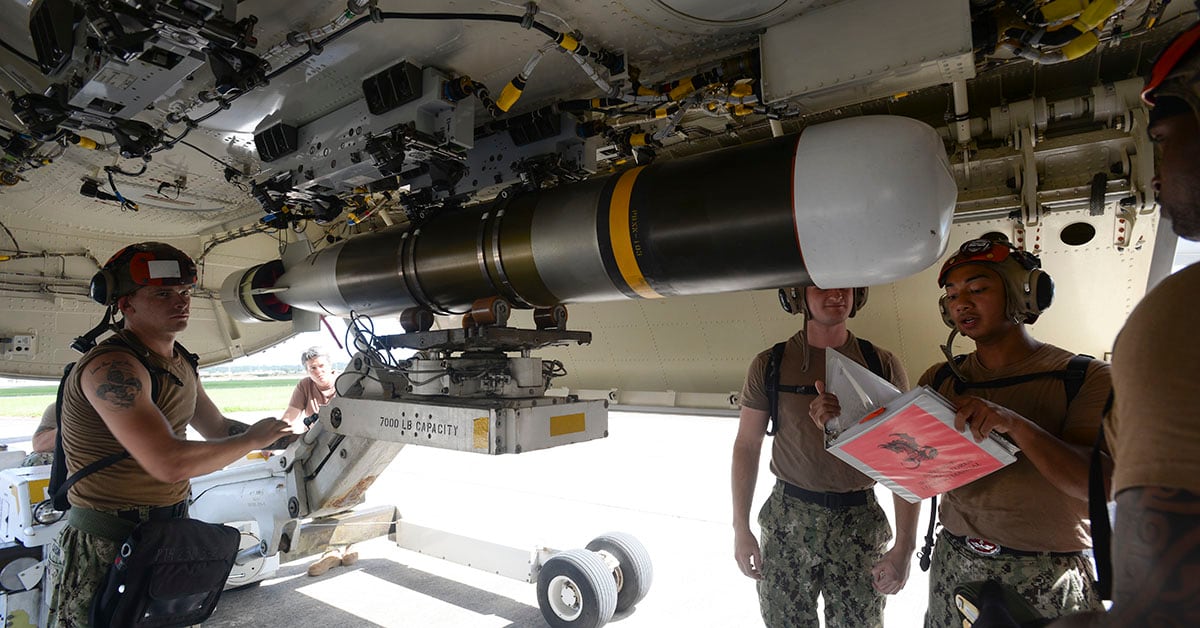
The U.S. Navy has opened the door to a new class of air-launched anti-submarine weapon, one that would spend more of its mission gliding through the air and less of it moving through the water. In a new request for information, the service says it is exploring the Silent Anvil Air-Launched Torpedo, or SAA-LT, as either a new torpedo purpose-built for airborne launch or as a glide kit that can be attached to an existing torpedo.
The concept matters because anti-submarine warfare has long been constrained by physics. Aircraft can search large areas quickly, but once a torpedo enters the water its useful range and endurance become more limited. A weapon that can travel farther through the air before splashing down could expand how aircraft and drones prosecute submarine contacts, while also giving crews more standoff distance.
According to the request, the Navy wants Silent Anvil to work across a broader range of manned and unmanned aircraft than existing systems. That puts the effort in line with a larger Pentagon push to distribute missions across more platforms, especially uncrewed ones, without giving up useful payloads or compatible hardware.
Two designs, one operational goal
The Navy described two possible approaches. One is a compact torpedo that launches from an aircraft or drone, glides to the target area, enters the water, and then acoustically homes in on a submarine. The other is a glide kit for an existing torpedo, echoing the logic of previous guidance packages that turned conventional weapons into more flexible stand-off systems.
Defense News compared the idea to the High Altitude Anti-Submarine Warfare Weapon Capability, which already adds a glide kit to Mark 54 torpedoes for launch from P-8 Poseidon patrol aircraft. Silent Anvil appears to extend that concept by seeking compatibility with a wider set of aircraft and by emphasizing compact size and carriage flexibility.
The form-factor targets in the request are notable. The Navy says the weapon should be similar in size to the GBU-39 Small Diameter Bomb, with a weight of no more than 268 pounds, a length of no more than 70 inches, and a diameter up to 7.5 inches. That is a strong signal that the service is trying to make the weapon easier to carry internally or externally on multiple aircraft, including platforms that cannot handle larger torpedoes.
Compatibility with the standard BRU-61/A bomb rack is another clue. Rather than demanding a niche mounting arrangement, the Navy is anchoring the concept in widely used aircraft hardware. If that carries through to a program of record, Silent Anvil could fit more naturally into existing airborne loadout planning.
Why the glide phase is central
The request does not spell out a desired range, but it explicitly asks industry for input on the maximum standoff glide range achievable. That omission is important. Instead of dictating a fixed threshold, the Navy appears to be surveying what industry believes is technically and operationally realistic.
The performance envelope in the request is broad. Silent Anvil would need to account for launch speeds of Mach 0.25, 0.50, and 0.85, and for launch altitudes ranging from just 10 feet to as high as 60,000 feet. That upper-end altitude exceeds the operating ceiling of the P-8 and points toward high-altitude unmanned systems as possible hosts, including aircraft in the class of the MQ-4C Triton.
The Navy also says the weapon should maximize aerial flight endurance while minimizing time spent in the water, limiting immersion to the minimum needed for mission success. That sentence captures the design logic of the whole project. Air travel is fast and relatively energy-efficient over long distances. Water is where the torpedo must do its final work, but it is also where drag, battery limits, and detection concerns become more significant.
For the glide-kit option, the Navy included water-entry parameters of 45 to 90 degrees and 40 to 120 feet per second. That suggests the service is thinking carefully about the transition from airborne glide to survivable splashdown, a technically demanding phase for any weapon that must preserve sensors, structure, and guidance integrity before switching into underwater homing.
A response to a changing submarine problem
The timing is not accidental. Defense News frames the effort against China’s expanding and increasingly sophisticated submarine fleet, including large and long-range robotic submarines. Whether the Navy ultimately adopts an all-new torpedo or an add-on kit, the operational problem is clear: aircraft and drones need more flexible ways to attack undersea targets without having to get as close, and commanders want more platform options for doing that job.
That broader platform ambition may be the most consequential part of the notice. If anti-submarine weapons can be sized and packaged for more aircraft, then the Navy can widen the network of assets able to hold submarines at risk. In practical terms, that could help patrol aircraft, drones, and potentially other aviation platforms contribute to the same mission set with less dependence on a narrow list of specialized systems.
The effort also fits alongside other Navy work on long-range anti-submarine weapons. Defense News notes the service is developing a Long Range Antisubmarine Warfare weapon for rocket-launched torpedoes fired from surface ships. Silent Anvil addresses the airborne side of the equation, but both efforts point in the same direction: extending reach and compressing the time between detection and attack.
What happens next
The current step is still exploratory. The Navy is seeking responses from contractors by Sept. 29, and the timeline in the request calls for a prototype within 18 months after an agreement award. If a demonstration succeeds, that would be followed by 180 all-up-round prototypes within three years.
That schedule does not guarantee procurement, but it does show the Navy is not treating the idea as a distant science project. It is asking industry to think in terms of producible hardware, integration constraints, and flight performance across a realistic set of launch conditions.
For defense companies, Silent Anvil is a familiar kind of invitation: prove that an emerging operational concept can be made compact, compatible, and affordable enough to spread across the force. For the Navy, the attraction is straightforward. A torpedo that spends more of its journey in the air could give commanders more reach, more launch options, and more ways to pressure submarines in increasingly contested waters.
- The Navy is considering either a new glide-launched torpedo or a glide kit for an existing weapon.
- The design target is roughly the size and weight class of a Small Diameter Bomb.
- The service wants compatibility across manned and unmanned aircraft, with broad launch-speed and altitude bands.
- Industry responses are due Sept. 29, with a prototype goal set for 18 months after award.
This article is based on reporting by Defense News. Read the original article.
Originally published on defensenews.com