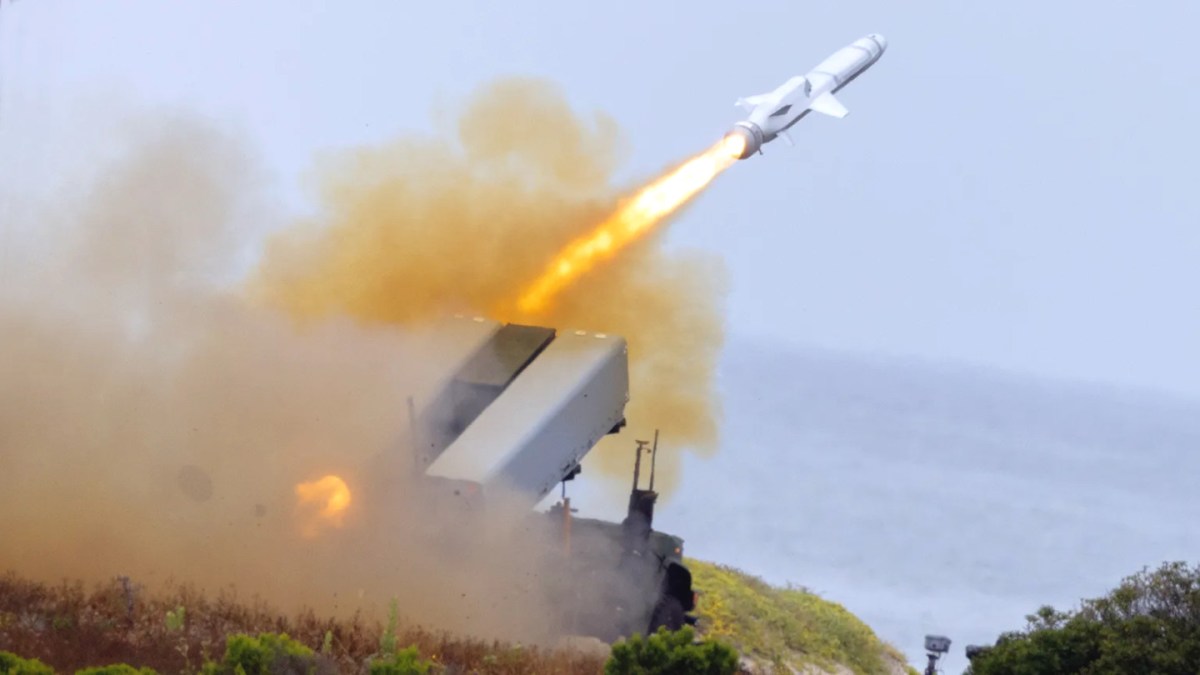
The U.S. Marine Corps is exploring ways to more than double the range of its ground-launched Naval Strike Missile, a change that could substantially expand the area Marine missile batteries can hold at risk.
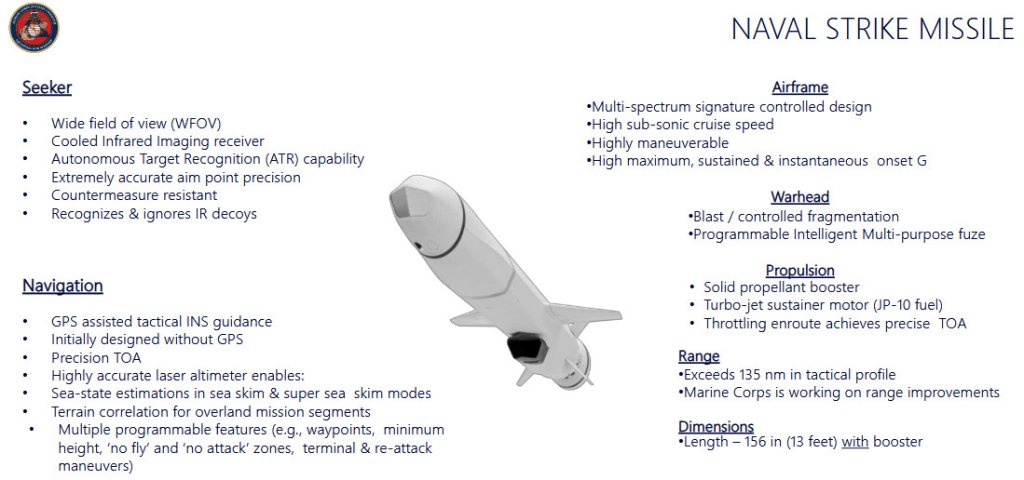
A Marine Corps spokesperson told The War Zone that the missile’s range is 135 nautical miles and that the service is examining opportunities to push it beyond twice that distance. Missiles able to reach 270 nautical miles or more would give deployed units a markedly wider reach against warships and ground targets.
Extending the reach of expeditionary forces
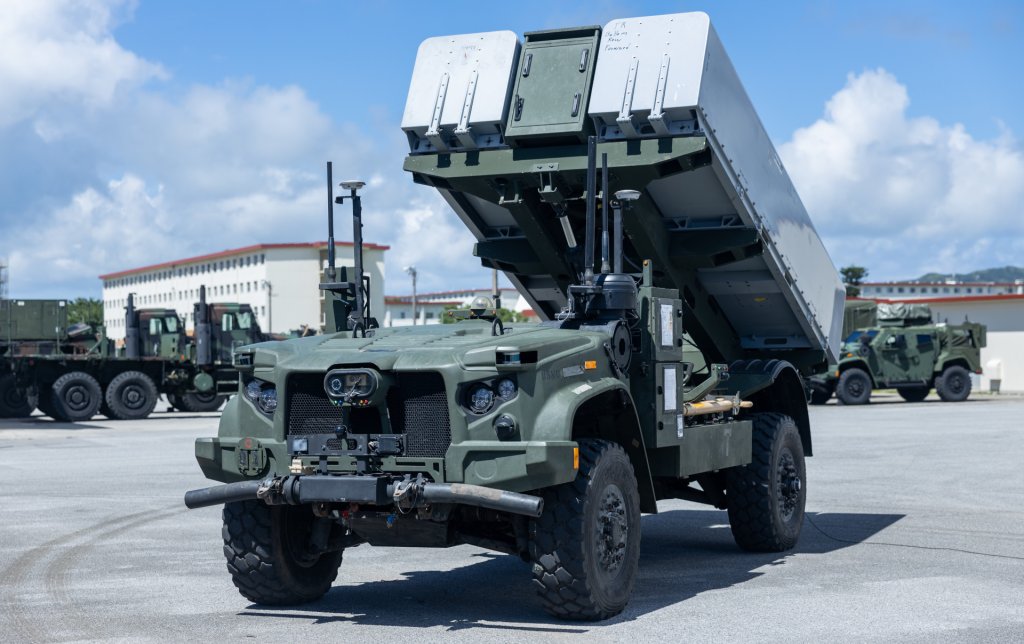
The Naval Strike Missile, or NSM, is already central to the Marine Corps’ Navy-Marine Expeditionary Ship Interdiction System, known as NMESIS. The system combines the missile with the Remotely Operated Ground Unit Expeditionary-Fires platform, an uncrewed launcher vehicle based on the 4×4 Joint Light Tactical Vehicle.
Each ROGUE-Fires launcher can carry up to two NSMs in ready-to-fire canisters. That pairing gives the Corps a ground-based, mobile means of fielding anti-ship missiles rather than relying solely on ships or aircraft for maritime strike.
The range figure cited by the Corps reflects an increase already associated with the Block 1A version of the missile, introduced in the early 2020s. Earlier versions, developed by Norway’s Kongsberg in partnership with Raytheon in the United States, were said to have a range of about 100 nautical miles. The Corps has also previously said the existing missile can fly beyond 135 nautical miles depending on its flight profile to the target.
Why the range matters
Range is not merely a technical specification for a coastal-defense weapon. It shapes where launchers can operate, how far they can remain from a target area, and the size of the zone in which they can threaten opposing ships or land targets.
More than doubling the stated range would increase the area a Marine battery could cover by more than four times, according to the source report. That expansion could give commanders more options in a campaign where forces are distributed across islands or other dispersed locations.
The potential gain is particularly relevant to the Corps’ evolving expeditionary and distributed concepts of operations. These concepts emphasize the ability to move, disperse and operate from smaller or less concentrated positions. A longer-range missile could allow Marine units to contribute to maritime denial while operating farther from the targets they are intended to hold at risk.
In an island-hopping campaign, that additional reach could be valuable because geography determines both where forces can deploy and which sea lanes or approaches they can influence. A missile battery with a longer reach can affect a wider set of routes without having to position itself as close to the intended target area.
NMESIS and the Naval Strike Missile
NMESIS is built around a relatively compact launcher concept. The ROGUE-Fires platform is uncrewed and based on the Joint Light Tactical Vehicle, while the missiles are transported and fired from canisters. The arrangement is intended to give the Marine Corps a mobile ground-launched anti-ship capability.
NSM is not exclusive to Marine service. The U.S. Navy employs the missile primarily on Independence-class Littoral Combat Ships and plans eventually to arm Freedom-class ships with it as well. One Arleigh Burke-class destroyer has also been equipped with NSM on an experimental basis.
Beyond the United States, the missile is in growing service internationally in ship-launched and ground-based forms. That existing ecosystem matters because it places the Corps’ interest in an extended-range version within a broader family of missile applications, rather than a completely separate weapon concept.
An exploration, not a declared fielding plan
The Corps’ statement is an indication that it is looking at options; the supplied information does not establish a final design, development schedule, test program or procurement decision for an extended-range NSM. Nor does it specify the technical approach that could be used to obtain the additional reach.
That distinction is important. The service has confirmed its interest in more than doubling the missile’s range, but the details that would determine how such a capability is developed and fielded have not been provided in the source material.
Still, the objective itself is clear. A missile capable of reaching 270 nautical miles or more from a ground launcher would broaden the Marines’ ability to threaten maritime and land targets from dispersed positions. It would also reinforce the role of NMESIS as a tool for bringing land-based Marine units into naval and maritime operations.
For the Marine Corps, the question is therefore larger than adding distance to an existing missile. It is about how a mobile force on land can shape events at sea across a wider area. The exploration of an extended-range NSM signals that the answer may depend increasingly on reach, mobility and the ability to distribute missile batteries across the operational landscape.
This article is based on reporting by twz.com. Read the original article.
Originally published on twz.com