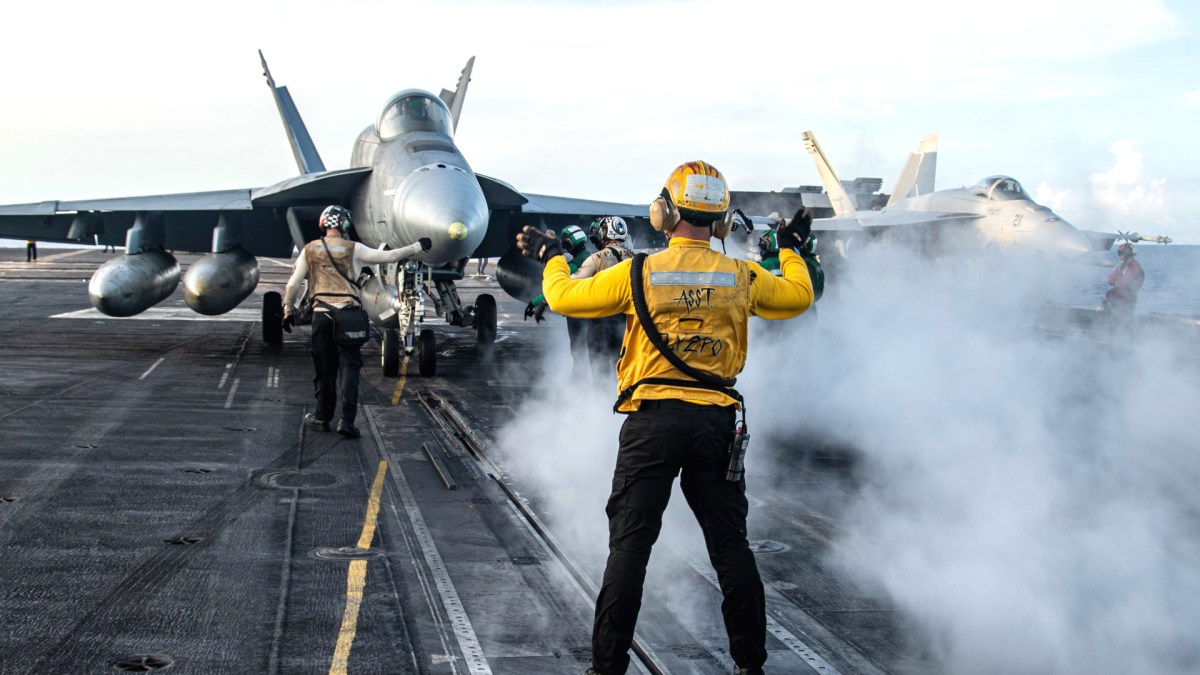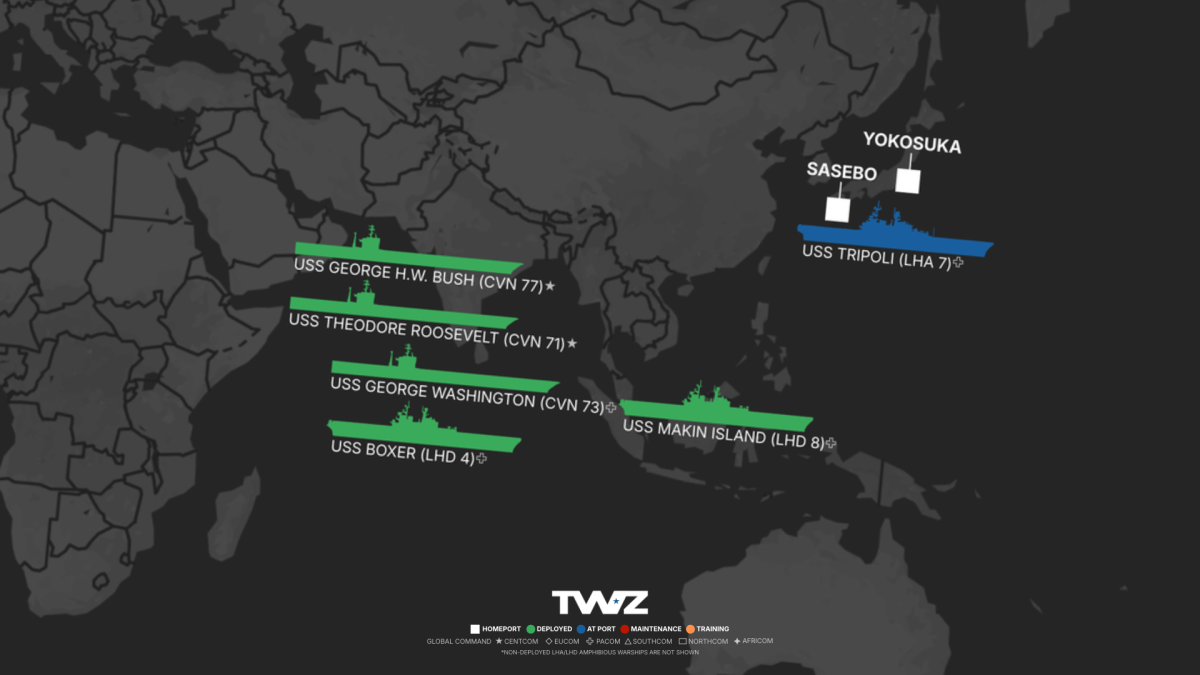
The USS Theodore Roosevelt carrier strike group has entered the U.S. Central Command area of responsibility, beginning a relief of the USS George Washington in the Middle East. The handoff briefly put three American aircraft carriers in the region, according to The War Zone’s Nov. 21 carrier tracker, before the George Washington departed.
The transition leaves two U.S. carriers in the area and, by the tracker’s account, does not change the overall carrier-force posture there. The Roosevelt’s arrival is therefore best understood as a rotational replacement rather than an immediate expansion of the carrier presence.
A brief three-carrier overlap
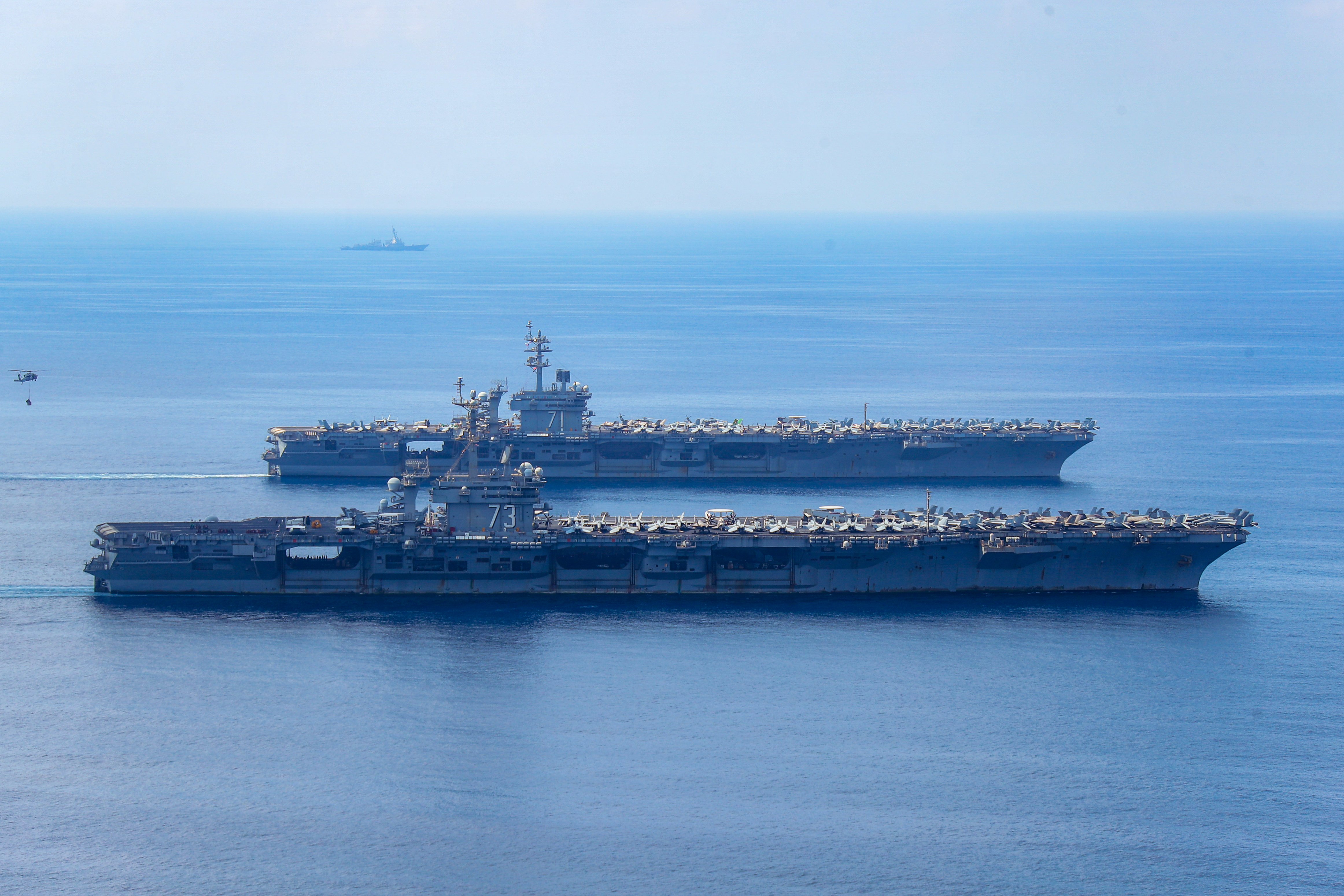
Theodore Roosevelt was pictured sailing with George Washington in the Arabian Sea during the week. USS George H.W. Bush was also on station, producing the short-lived overlap of three carriers. The source said the overlap was anticipated and that George Washington had left the region by the time of its report.
George Washington was most recently operating at an undisclosed location off India and had likely started its return journey to Yokosuka, Japan. Theodore Roosevelt’s entry into the CENTCOM area supplies the replacement needed to keep two carriers assigned to the theater after the departure.
Carrier rotations are operationally significant even when the final number of ships stays the same. A carrier strike group is not simply a single large warship. It comprises the carrier and accompanying naval forces, and the movement of an incoming group must be coordinated with the departure and disposition of an outgoing force. In this case, the overlap allowed the transition to occur while preserving the stated regional posture.
Roosevelt’s transit
Theodore Roosevelt departed Singapore on Nov. 8 after a short visit to Changi Naval Base. It then transited the Strait of Malacca and entered the CENTCOM area of responsibility on or around Nov. 15, the tracker reported.
Guided-missile cruiser USS Chosin and guided-missile destroyer USS Decatur accompanied the carrier through the strait. Another destroyer, USS Paul Hamilton, was steaming east in the South China Sea. The final identified element of the group, destroyer USS Carl M. Levin, had been operating separately in the theater since October.
That distribution underscores that a strike group’s ships do not necessarily move as a single visible formation at all times. The source identifies an accompanying cruiser and destroyer for the strait transit while also describing other destroyers in different locations or operating independently. It does not establish the current position of every ship, but it provides a snapshot of how the group’s elements were arranged during the deployment.
Posture remains at two carriers
The key operational outcome is the continued presence of two carriers in the CENTCOM area after George Washington’s departure. Theodore Roosevelt has taken over the regional role while George H.W. Bush remains on station, according to the report. The source characterizes this as an unchanged carrier force posture.
That distinction is important when reading reports of a three-carrier presence. A temporary overlap can reflect the practical requirements of relief and transit rather than a lasting decision to add another carrier to the region. The tracker explicitly frames the three-carrier count as short-lived and ties it to the arrival of Roosevelt and the exit of George Washington.
The report also notes wider movements among deployed naval forces. The final elements of the Abraham Lincoln carrier strike group, which had deployed for almost a year, were said to be home after what the source called historic deployments. Amphibious assault ship USS Boxer had moved out of the Middle East, while USS Makin Island, described as its expected replacement, was in Singapore.
Pressure on the carrier fleet
The movements come as the Navy faces a separate fleet-capacity issue. The acting secretary of the Navy told senators that the service will face five years with nine aircraft carriers rather than the 11 required by law, according to the report. The source does not detail the cause of that projected shortfall or how it will affect individual deployment schedules.
Still, the statement places the Roosevelt–George Washington transition in a larger context. Maintaining a two-carrier presence in a major theater depends on a fleet that must also meet commitments elsewhere and cycle ships through deployment, maintenance, and home-port operations. Rotations are a routine part of that process, but the projected number of available carriers makes each one more consequential.
For now, the available picture is clear: Theodore Roosevelt has entered the CENTCOM area, George Washington has departed toward its Japan home port, and two U.S. carriers remain in the Middle East. The brief three-carrier overlap has ended, but the relief operation has preserved the regional carrier posture described in the tracker.
This article is based on reporting by twz.com. Read the original article.
Originally published on twz.com