Before an F-15E Strike Eagle returns to an operational squadron after deep maintenance, it must prove that its repaired and upgraded systems work in the air. At Robins Air Force Base in Georgia, that task falls in part to the Air Force Reserve Command's 339th Flight Test Squadron, which conducts rigorous airborne checks on aircraft that have emerged from program depot maintenance.
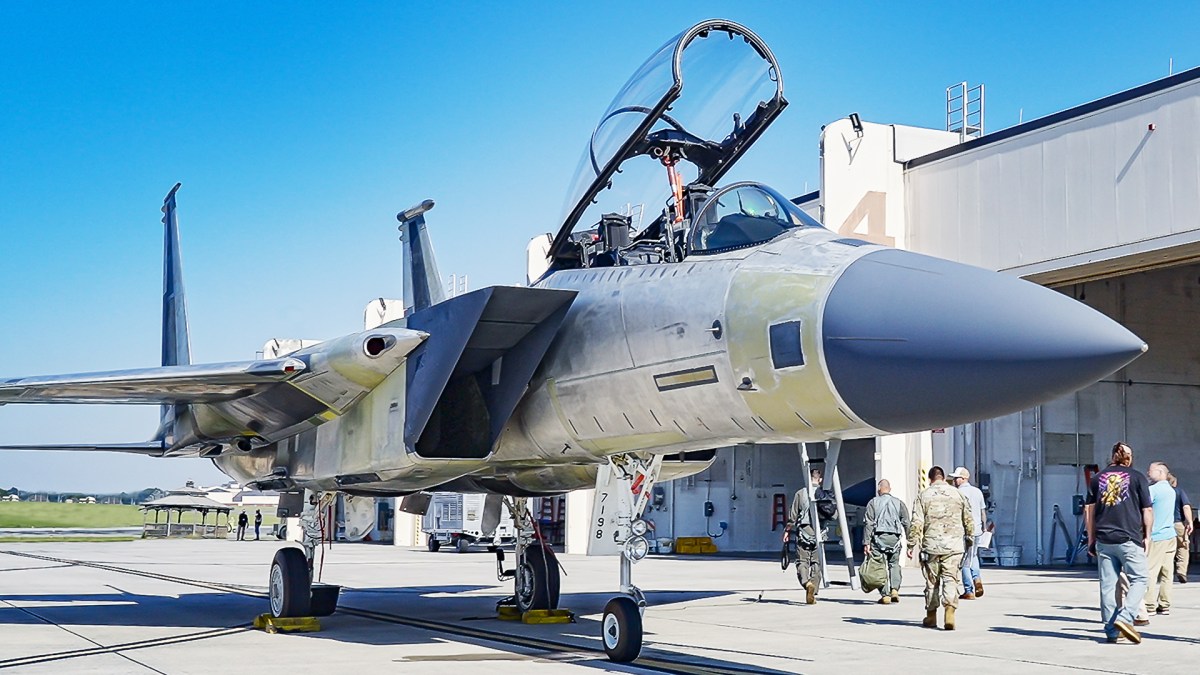
Some of the jets are particularly conspicuous during this phase. They retain bare-metal surfaces before repainting and may fly without external hardpoints, fuel tanks, or, in some cases, even the gun. The configuration has earned them the informal description “Silver Eagles.” With less external equipment attached, these F-15s are unusually clean aerodynamically and are described as the highest-performing F-15s on the planet in that configuration.
Maintenance that reaches the airframe’s foundations
The Warner Robins Air Logistics Complex has performed program depot maintenance, known as PDM, on F-15 aircraft since 1975. The complex also carries out deep maintenance for the C-5M Galaxy, C-17 Globemaster and C-130 Hercules fleets, but its F-15 work remains a critical element of sustaining the Air Force's Eagle force.
Roughly every seven years, an F-15 comes to Warner Robins for PDM. In the large maintenance hangars, the aircraft is stripped down so workers can inspect the airframe thoroughly, repair it where necessary and incorporate upgrades. That level of work is different from routine squadron maintenance: it provides an opportunity to examine the aircraft's structure and systems at a far deeper level before returning the jet to service.
The remaining F-15C/D fleet is now limited to two squadrons and has been managed in a way that retains airframes not requiring PDM. As a result, the depot work at Robins is focused on F-15E Strike Eagles. Newer F-15EX aircraft are expected to begin cycling through the facility in coming years.

Why flight testing follows depot work
Finishing the work in a hangar is not the end of the process. Before a refurbished F-15E is painted and sent back to its operational unit, it is handed to the flight-test team for a series of checks in the air. The purpose is to validate the aircraft after its maintenance and upgrades in the environment where it must ultimately operate.
The 339th Flight Test Squadron's work is therefore a bridge between depot maintenance and combat-unit service. Ground inspections and functional checks are essential, but airborne testing provides another layer of assurance that the jet performs properly once its engines are running, its systems are operating together and the aircraft is exposed to flight conditions.
The assignment also puts flight-test crews in aircraft that can look markedly different from the fully equipped Strike Eagles familiar at operational bases. A jet that has not yet received its paint and is flying without its usual external stores presents the bare outline of the aircraft, its metallic surfaces revealing the stage it occupies in the maintenance cycle.
A temporary “rocket ship” configuration
Removing external hardpoints and tanks reduces drag and weight. In the cases described at Robins, some aircraft are also without their gun. The result is a stripped-down configuration that accentuates the performance of the F-15E airframe. These are not special new variants; they are operational aircraft in a temporary condition created by the depot-maintenance and test sequence.
That distinction is important. The “Silver Eagle” nickname describes an appearance and configuration associated with this process, not a separate procurement program. The aircraft are still Strike Eagles moving through the sustainment pipeline. Once they have passed the required checks, they are painted and returned to their squadrons.
Yet the configuration gives flight-test personnel a rare view of the aircraft without the equipment normally seen under its wings and fuselage. It also underscores how much of an operational fighter's day-to-day form is shaped by mission equipment, fuel carriage and weapons-related hardware rather than the basic airframe alone.
Sustaining an aging combat fleet
The F-15E has been a central part of the U.S. Air Force's combat-aircraft inventory for decades. Its continued availability depends not just on operations and unit-level maintenance, but on the industrial work performed at depots such as Warner Robins. Program depot maintenance is the mechanism through which airframes are inspected, repaired and updated at intervals measured in years.
That makes the subsequent flight-test sorties more than a technical formality. They are part of the process that returns a complex combat aircraft to the force after extensive intervention. The maintenance team, the logistics complex and the test squadron each handle a different stage of that cycle.
As the F-15E fleet continues to undergo depot work and the F-15EX begins to enter the same long-term sustainment ecosystem, Robins will remain a notable point in the Eagle's service life. The bare-metal jets that emerge from its hangars may be temporary sights, but they offer a clear view of the testing and maintenance infrastructure required to keep frontline aircraft flying.
This article is based on reporting by twz.com. Read the original article.
Originally published on twz.com