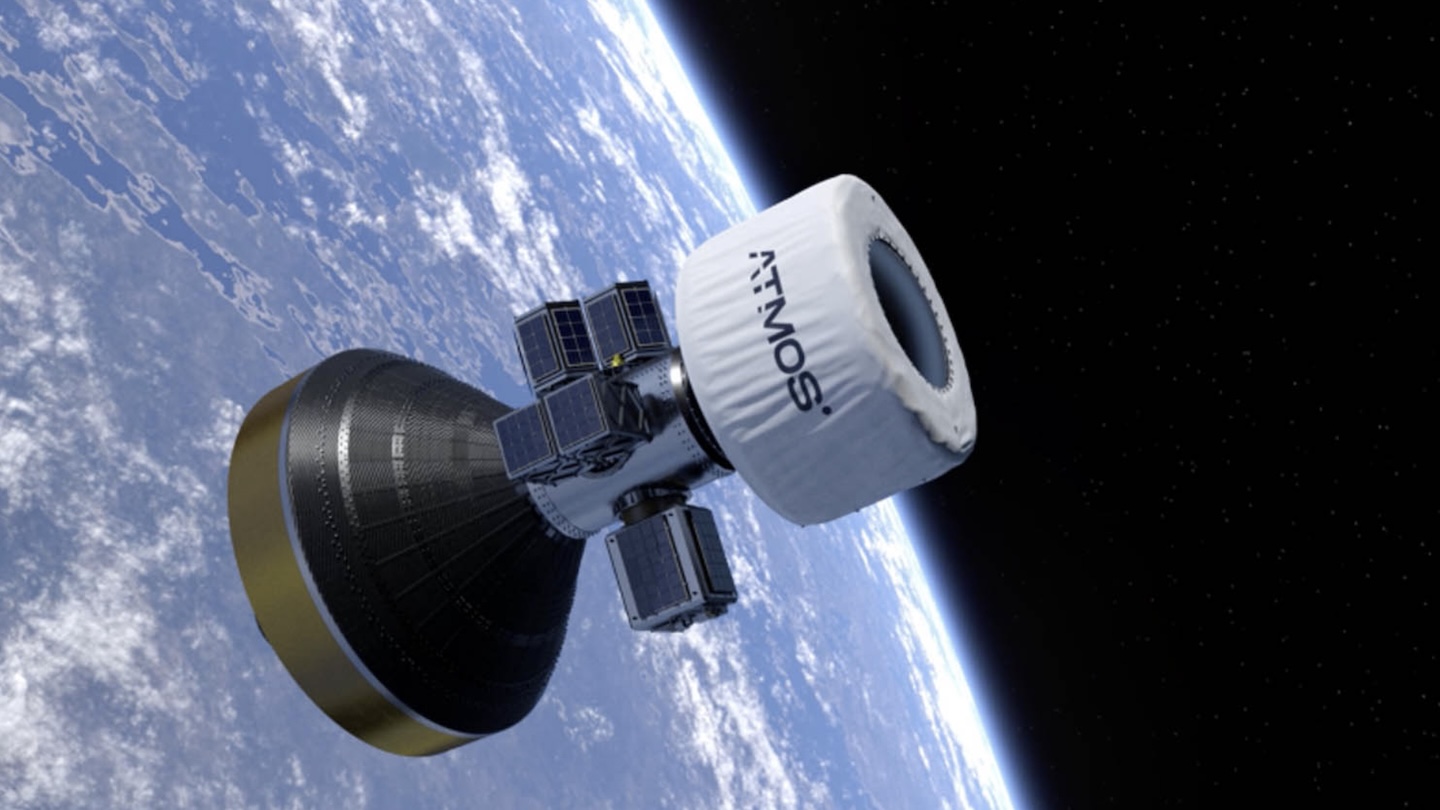
European missile maker MBDA and German startup Atmos Space Cargo have agreed to study whether military payloads could be delivered from Earth orbit using orbital transport and reentry vehicles. The cooperation is an early feasibility effort, not a deployment program, but it brings a politically charged military concept into a formal industrial assessment.
The companies said their agreement will examine a potential precision orbital deep-strike capability. The initial work will focus on system architecture, technical feasibility, payload integration and possible technology demonstrations.
Atmos would contribute its experience in orbital transportation and atmospheric reentry, while MBDA would bring expertise in defense systems and military payloads. MBDA, owned by Airbus, BAE Systems and Leonardo, is Europe’s largest missile maker.
An exploratory agreement, not an operational weapon
The announced cooperation does not commit either company or a government customer to fielding weapons in space. Atmos said that specific developments and future projects remain subject to further evaluation and separate agreements. It also said any eventual deployment or use would depend on applicable law and decisions by responsible governmental and military authorities.
That framing is significant. The companies are not claiming to have an operational system, a selected payload or an approved mission. Their work begins with the technical and architectural questions that would have to be answered before a concept could move toward a demonstration.
Those questions include how a military payload could be integrated with an orbital transport system, how it would return through the atmosphere, and how a broader system could be designed around that sequence. Reentry is a central element because the proposed capability would rely on vehicles that can carry a payload in orbit and then return it toward Earth.
The deterrence argument
Atmos chief executive Sebastian Klaus has argued that Europe needs an orbital deterrent to address what he describes as a gap in deep precision strike. In March, he made the case for a conventional system capable of being deployed from orbit and striking a legitimate military target anywhere on Earth within 60 minutes.
In a statement on the new agreement, Klaus described the objective as deterrence: strengthening European allies’ ability to prevent aggression by making their capacity to defend themselves more credible. He characterized orbital transport and return as a new layer of strategic infrastructure.
MBDA and Atmos said they are assessing how existing defense technology and newer orbital technology could be combined to strengthen Europe’s conventional deterrence. The emphasis on conventional capability distinguishes the idea, as described by the firms, from nuclear weapons. But it does not make the questions around escalation, governance and military necessity any less consequential.
Why reentry technology is central
Atmos specializes in orbital transportation and reentry technology. Its work is relevant to the proposed concept because placing an object in orbit is only one part of a system intended to deliver something back through Earth’s atmosphere. A usable capability would need a reliable way to carry a payload, survive reentry and integrate with military systems.
MBDA’s role would be different but complementary. The company brings defense-system and military-payload expertise to an assessment that will look at how such payloads could fit within an orbital and reentry architecture. The partners have not disclosed a particular payload, launch arrangement, demonstration timetable or operational customer.
The agreement therefore sits at the intersection of two technological domains that are often developed separately: space transportation and weapons-system integration. Its practical value will depend on whether the partners can identify a credible technical path and whether governments decide that such a capability is lawful, strategically useful and worth pursuing.

A new European defense question
Europe’s renewed focus on long-range conventional deterrence has created interest in capabilities that can operate across greater distances and respond rapidly. The MBDA-Atmos study introduces orbit as one possible layer in that discussion.
Yet orbital deep strike is not simply a matter of speed. The concept would raise difficult issues around command authority, target legitimacy, rules for operating from orbit, and the risks of treating space infrastructure as part of a conventional strike architecture. The companies acknowledge the importance of government and military decisions by making any future deployment conditional on those authorities.
For now, the partnership is best understood as an industrial study of a potential capability. Its near-term outputs are expected to be designs, feasibility work, payload-integration assessments and potentially technology demonstrations. Whether any of that becomes a procurement program will be decided later, outside the scope of the agreement announced this week.
What to watch next
The next signals will be more concrete than the initial announcement: whether the companies identify a technical demonstration, whether a government backs further work, and how the proposed system is defined in terms of payloads, launch and return operations. Those details would clarify whether the effort remains a strategic concept or begins to mature into a specific defense program.
For MBDA and Atmos, the immediate goal is to test the premise that orbital transportation and atmospheric reentry can be paired with established military technology. The outcome could influence a wider European debate over how space systems fit into conventional deterrence. It could also show how far that debate is willing to move from studying rapid access to orbit toward studying the use of orbit as part of a strike capability.
This article is based on reporting by Defense News. Read the original article.
Originally published on defensenews.com