China may field space-based directed-energy systems capable of threatening satellites in higher orbits by the late 2020s, according to a newly released unclassified assessment from the US Defense Intelligence Agency. The assessment places the possibility within a wider picture of expanding counterspace capabilities and intensifying military competition beyond Earth’s atmosphere.
The report, Challenges to Security in Space, says the People’s Liberation Army likely views directed-energy weapons as particularly useful counterspace tools because they can produce both reversible and nonreversible effects against satellites. It does not specify whether any prospective Chinese orbital system would use lasers, high-powered microwaves, particle beams or a combination of technologies.
A potential new anti-satellite capability
The DIA says China already has ground-based directed-energy weapons that can disrupt, degrade or damage satellites. The prospect of putting directed-energy systems in orbit would add another potential anti-satellite capability, or ASAT capability, to that toolkit.
The agency’s assessment is forward-looking rather than a declaration that such an orbital weapon is already deployed. Its wording matters: China may field the systems by the late 2020s. The report does not provide public technical details about a specific program, test or platform, and it does not identify the form the weapons might take.
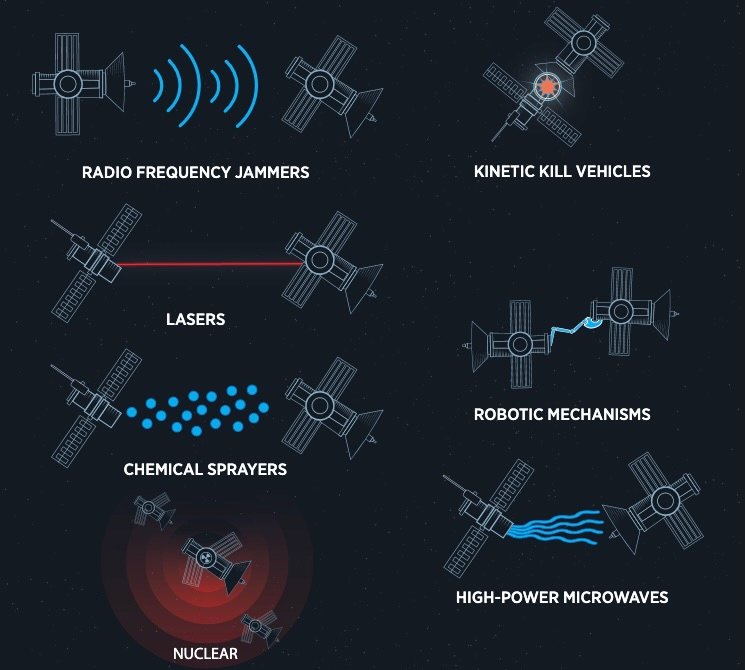
Even so, the assessment highlights the strategic value military planners attach to the ability to affect spacecraft without necessarily destroying them. Satellites support communications, navigation, intelligence gathering, warning systems and other functions used by military and civilian users. A capability that can interfere with spacecraft can therefore have consequences far beyond a single satellite.

Reversible and permanent effects
Directed-energy systems may be attractive in part because their effects can vary. The DIA describes reversible attacks as including signal jamming and temporary blinding of satellite optics. A laser dazzler, for example, could temporarily impair a sensor without physically destroying the spacecraft.
Nonreversible effects could be more damaging. The report says the PLA probably considers directed-energy weapons ideal counterspace systems precisely because they can support both temporary and lasting outcomes. That flexibility may complicate attribution and escalation decisions, especially when an affected satellite is vital but has not been visibly destroyed.
The assessment notes that PLA media in 2021 said laser weapons were entering a “golden age” and identified dazzling as an operational use. That public discussion does not reveal the full state of operational capability, but it offers context for why US intelligence is tracking the field closely.
Why orbit changes the picture
Ground-based systems can already be used against targets in space, but a space-based directed-energy system would change the geometry of a potential confrontation. An orbital platform could potentially operate from positions that differ from fixed terrestrial sites, while satellites themselves travel through a domain where distance, line of sight and orbit determine what is possible.
The DIA specifically says the projected systems could threaten satellites in higher orbits. That point is significant because space infrastructure is spread across different orbital regimes, and satellites in higher orbits can provide broad-area services. The report does not describe engagement ranges, power levels or operational limits, so it should not be taken as a public technical blueprint for the capability.
What it does provide is a warning about direction of travel. Counterspace competition is no longer limited to concepts of physically intercepting a spacecraft. Electronic interference, optical disruption and other forms of directed energy can create ways to affect satellites that may be less immediately visible than debris-producing destruction.
A broader security assessment
The DIA report is based largely on open-source information and has a cutoff date of July. It addresses growing threats to global interests in space from China, Russia and the emerging space powers Iran and North Korea.
Its publication also comes as the United States has become more open about its own anti-satellite capabilities. The article citing the report notes that US military officials acknowledged last month that the United States has weapons in orbit. The timing underscores how space security is increasingly discussed not only in terms of launches and exploration, but also in terms of deterrence, vulnerability and military capability.
For policymakers and satellite operators, the core issue is resilience. If spacecraft can be jammed, dazzled, degraded or damaged, continuity of service depends on understanding threats and designing systems that can withstand or recover from interference. The DIA’s warning does not establish that a Chinese orbital directed-energy weapon is imminent. It does indicate that US intelligence believes it is a plausible near-term development.
What remains unknown
Public information leaves major questions unanswered. The report does not say what specific directed-energy technology China may field in space, how it would be powered, which satellites could be targeted, or whether an operational system exists today. It also does not provide a timeline more precise than the late 2020s.
Those uncertainties are not a reason to dismiss the assessment. They are a reminder to separate an intelligence forecast from confirmed deployment. The practical message is that space systems are becoming a more contested part of national security, and that counterspace capabilities may increasingly include tools designed to disrupt or disable satellites without creating the obvious physical evidence associated with a destructive intercept.
- The DIA says China may field space-based directed-energy systems by the late 2020s.
- The assessment says such systems could threaten satellites in higher orbits.
- It does not identify the specific technology or confirm an operational deployment.
- Directed-energy effects can range from temporary jamming or sensor dazzling to potentially permanent damage.
This article is based on reporting by twz.com. Read the original article.

Originally published on twz.com