A fresh look at an unusual electric-aircraft program
New images appearing online seem to show a full-size demonstrator of China’s CE-25A, an all-electric commuter aircraft concept associated with the state-owned Commercial Aircraft Corporation of China, or COMAC. The aircraft is configured for 19 seats and uses a distinctive distributed electric-propulsion arrangement built around multiple ducted fans.
The images provide a new public view of a program COMAC outlined in 2023. They also raise a basic question that remains unanswered: how far has the demonstrator progressed in testing? There is no clear public confirmation that the pictured aircraft has flown, and its precise role in the CE-25A development effort is not publicly established.
That uncertainty is important. The appearance of a full-size aircraft can indicate substantial progress in a development program, but it does not by itself demonstrate flight testing, certification progress, or a timetable for commercial service. Even so, the photographs suggest that COMAC’s interest in distributed electric propulsion has advanced beyond a concept-display stage.
What the images appear to show
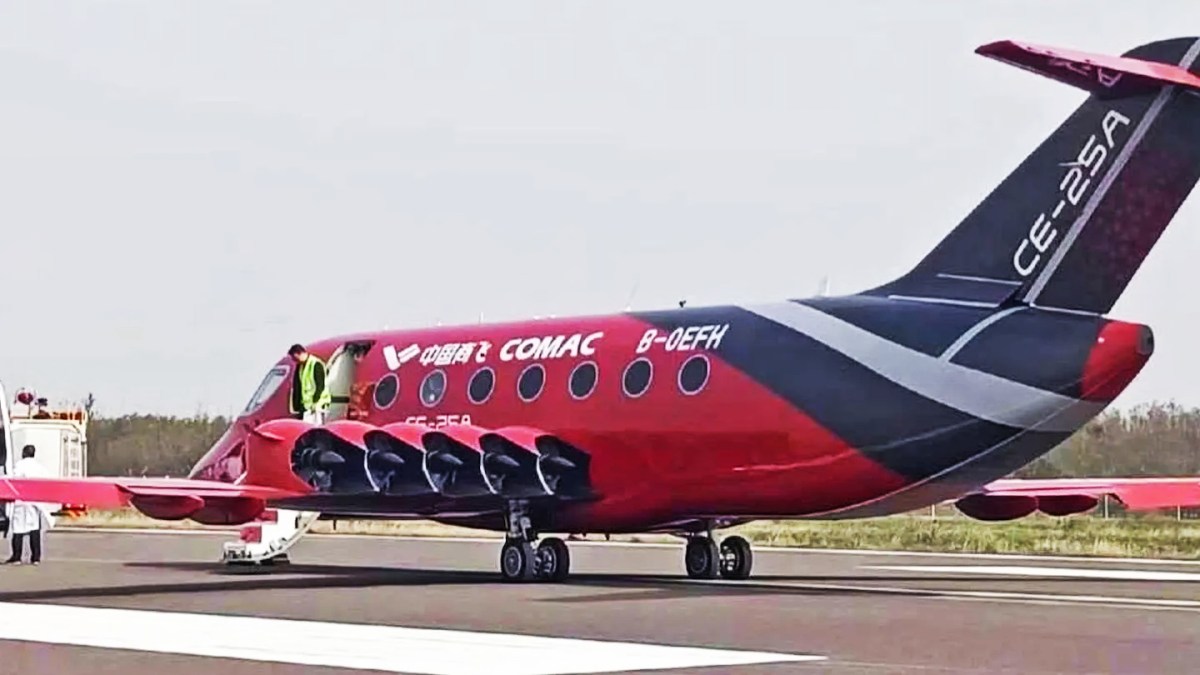
The photographs were apparently first shared on October 28 by Chinese automotive blogger Han Lu. They show a red-and-black aircraft with a silver cheatline and visible COMAC and CE-25A markings. The aircraft carries the Chinese civilian registration B-0EFH.
The authenticity of the images cannot be established with certainty from the available material. An examination using multiple AI image-analysis models reportedly found no major signs that the imagery had been artificially generated. That is not the same as independent confirmation of the aircraft’s identity, status, or capability, but it provides some reason to take the sighting seriously while retaining caution.

A rear three-quarter view gives the clearest look at the vehicle’s propulsion system. Rather than relying on a conventional pair of engines, the CE-25A uses an array of ducted-fan propulsors. This is the central feature of the design and the one with the broadest implications for future aircraft development.

COMAC’s 19-seat electric concept
COMAC first presented the CE-25A concept at the China International Import Expo in Shanghai in November 2023. The company described it as a 19-seat, all-electric commuter aircraft intended for short- and medium-distance passenger transportation as well as business aviation.
Published design specifications called for a cruise speed of about 400 kilometers per hour, or 248 miles per hour, and a range of roughly 400 to 500 kilometers, or 250 to 310 miles. Those figures describe the concept as presented by COMAC; the available information does not establish that the apparent demonstrator has achieved them in operation.
The proposed capacity and general role place the CE-25A in the commuter-aircraft category. That is a more constrained mission than long-haul airline service, but it is a relevant space for electric aviation. Shorter routes and modest passenger loads are among the use cases often associated with efforts to make battery-powered aircraft practical.
Why distributed electric propulsion matters
The CE-25A’s multiple ducted fans make it notable even before its testing status is known. Distributed electric propulsion spreads thrust production across several smaller propulsors rather than concentrating it in one or two conventional engines. COMAC’s continuing work in this area could help inform future aircraft development even if the CE-25A itself never enters commercial service.

Electric propulsion can give aircraft designers more flexibility in arranging motors and propulsors, because electric motors can be smaller and placed in locations that are difficult to use with conventional engine layouts. The CE-25A appears to explore that flexibility through its unusual fan array.
At the same time, a visible demonstrator is only one part of the path from concept to an operational aircraft. The available reporting does not provide confirmation of a first flight, details of the aircraft’s test program, certification plans, battery performance, or a service-entry schedule. Those unknowns limit what can be concluded from the new images.
A civilian project with wider technology relevance
The CE-25A is presented as a civilian commuter-aircraft project, but the underlying technologies are not limited to one market. Electric motors, energy storage, power electronics, thermal management, flight-control systems, and distributed propulsion architecture can all inform a range of future aerospace programs.
That does not mean the CE-25A should be treated as evidence of a near-term operational breakthrough. Instead, the strongest conclusion is narrower: images now appear to show a full-size aircraft connected to COMAC’s publicly described electric commuter concept, and they offer a clearer view of the distributed-propulsion approach the company is exploring.
As with many emerging electric-aircraft programs, the next meaningful indicators will be independently confirmed test activity, details on the demonstrator’s role, and evidence of how the design performs beyond static display or ground development. Until then, the CE-25A remains an intriguing and visually distinctive sign of China’s interest in electric regional aviation.
This article is based on reporting by twz.com. Read the original article.
Originally published on twz.com