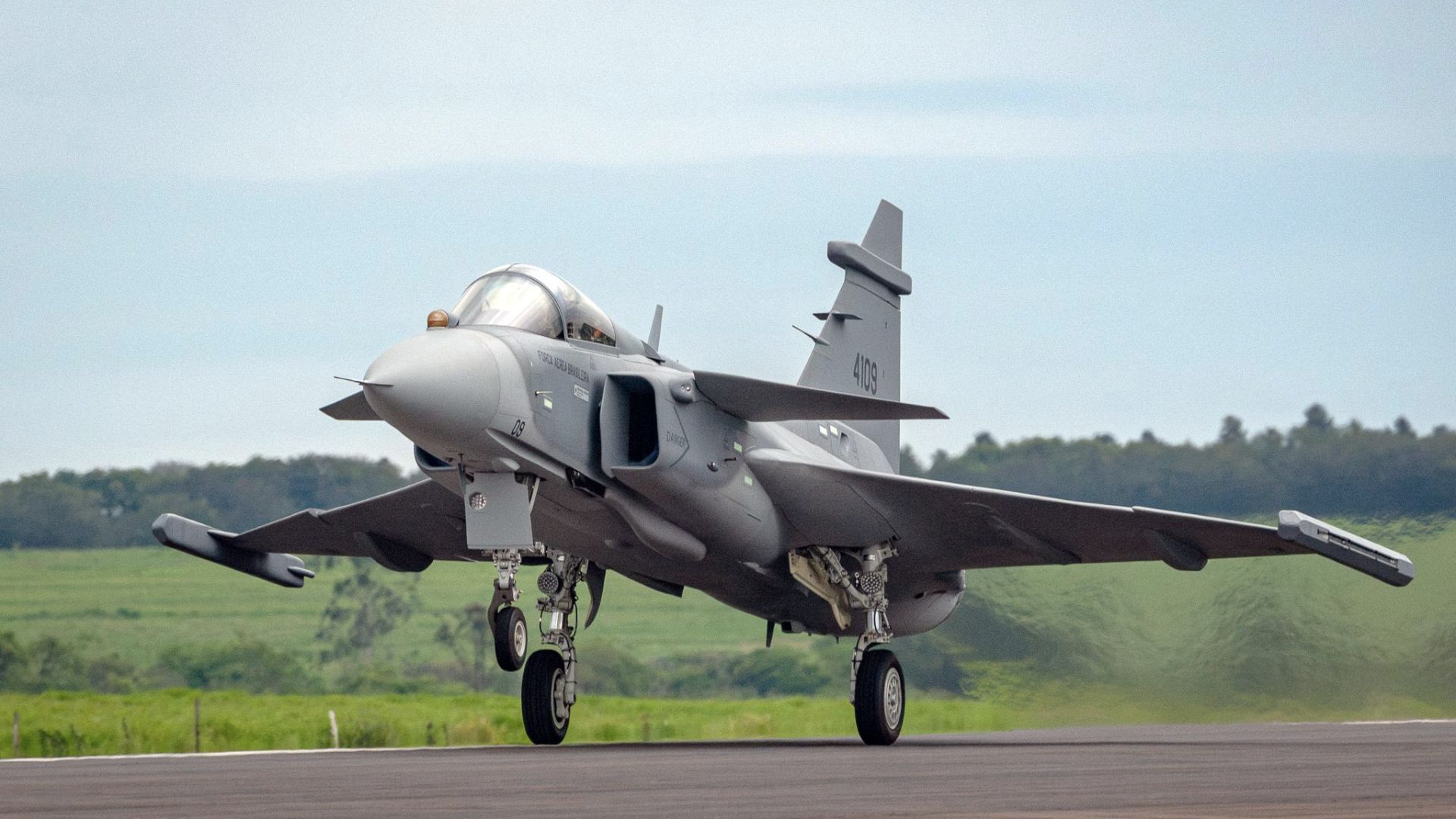
A newly built fighter aircraft has completed its maiden flight, with the sortie used to verify how the jet's main systems perform in the air. The aircraft is the first Gripen E produced in Brazil — a milestone that blends flight-test engineering with a broader industrial strategy: building advanced combat aircraft on South American soil rather than importing them fully assembled.
The achievement matters on two levels. As a flight-test event, a first sortie is the moment an airframe stops being a collection of verified components and becomes a flying system, with every subsystem interacting for the first time under real aerodynamic and thermal loads. As an industrial event, it demonstrates that the local supply chain, assembly workforce and quality-control processes behind the program can, in fact, deliver an aircraft that is ready to leave the ground.
A Maiden Flight That Doubles as a Data-Gathering Mission
In modern fighter programs, a first flight is rarely a simple demonstration of airworthiness. It is an instrumented experiment. The aircraft typically flies with extensive telemetry equipment, and engineers on the ground watch streaming data from hundreds of parameters in real time rather than waiting for the pilot's debrief.
The reported outcome of this mission — that it verified the performance of the main systems — is the standard shorthand manufacturers use when a first sortie goes as planned. That single sentence covers an enormous amount of engineering ground, because a maiden flight is designed to answer a long list of questions at once.
- Flight controls: whether the fly-by-wire system and control surfaces respond as predicted across the tested speed and altitude range.
- Propulsion: how the engine behaves at takeoff thrust, in cruise and during throttle transitions, and whether inlets and exhausts perform as modeled.
- Avionics and sensors: whether the core computing, navigation, communications and sensor suite power up, stay stable and talk to one another in flight.
- Structures and landing gear: whether the airframe behaves within expected loads and the gear cycles cleanly at the speeds the flight plan allows.
- Environmental and electrical systems: whether pressurization, cooling and power generation keep pace with demand from the rest of the aircraft.
Each item on that list is a test point, and each test point generates evidence that the certification and acceptance process will later depend on. A clean first flight does not prove the aircraft is finished; it proves the baseline design is sound enough to begin expanding the flight envelope in a disciplined way.
Why first flights are flown conservatively
Maiden sorties are deliberately limited in scope. Test crews keep the aircraft within a narrow band of speeds, altitudes and maneuvering limits, with chase aircraft nearby and emergency procedures rehearsed in advance. The goal is not to explore the aircraft's limits but to confirm that nothing fundamental is wrong. Data gathered on that first hop then shapes the test card for the weeks and months that follow, when the envelope is opened up step by step.
Why the Gripen E Matters to Brazil
The Gripen E is a single-engine multirole fighter developed by the Swedish manufacturer Saab, designed around networked operations, sensor fusion and the ability to carry a range of air-to-air and air-to-ground weapons. Brazil selected the type in the early 2010s after a competition that drew proposals from several of the world's major fighter manufacturers.
That deal was structured unusually. Rather than a straightforward purchase of finished aircraft, it combined delivery of flying jets with extensive technology transfer and a commitment to local production, so that Brazilian industry would take on an increasing share of the work over time. Embraer is the principal local partner, and the facilities involved host the assembly activity that produced the jet now entering flight test.
That structure explains why a maiden flight of a locally assembled fighter carries more weight than a routine rollout. The aircraft is simultaneously a product and a proof of capability — evidence that the industrial ecosystem around the program has matured to the point where it can turn supplied components and locally manufactured parts into a functioning combat aircraft.

The sustainment argument behind local assembly
The case for building fighters domestically is not only about prestige or jobs. Operating a fighter fleet means decades of spares, software updates, engine overhauls and structural inspections. If every one of those activities depends on a foreign supplier and a foreign supply line, cost and availability become strategic vulnerabilities that can constrain how often aircraft are ready to fly.
Local production and local participation in the supply chain change that equation. They give the operator more control over availability, shorten the loop between identifying a problem and fixing it, and build a domestic pool of engineers and technicians who understand the aircraft at component level rather than only at the pilot's interface. For a country that intends to fly the type for decades, that depth is as valuable as the aircraft themselves.
What Remains on the Test Card
A successful maiden flight opens a campaign; it does not close one. The aircraft that just flew will now enter a structured program of incremental expansion, typically progressing through a predictable sequence.
- Repeated baseline flights to confirm that the first sortie's results are repeatable rather than a one-off.
- Gradual expansion of speed, altitude and load-factor limits, with each expansion backed by analysis before it is flown.
- Testing of mission systems in realistic conditions, including radar, electronic warfare and communications equipment.
- Store carriage and separation trials, where the aircraft carries and releases external payloads in controlled conditions.
- Interoperability checks, verifying that the jet exchanges data correctly with other aircraft and ground networks.
- Formal acceptance steps that allow the aircraft to move from the manufacturer's hands to the operating service.
Only after that progression is complete does an airframe transition from a test asset to a frontline aircraft that squadrons can plan around. The timeline depends on how smoothly each stage goes, and it is common for programs to adjust schedules as data accumulates.
A Crowded Fighters Market
The Gripen E competes in one of the most contested segments of the global defense market, where few buyers remain genuinely undecided and political considerations weigh as heavily as performance figures. Its pitch has generally rested on a combination of modern networked avionics, relatively low operating costs for its class, and flexible industrial arrangements that let customer nations participate in production and sustainment.
Brazil's assembly line strengthens that pitch in a specific way. A second production source outside Sweden offers reassurance to buyers worried about supply concentration, and a Brazilian-built aircraft gives the country a credible position from which to pursue regional customers of its own. Defense exports are rarely just commercial transactions, but an established production base is a prerequisite for competing at all.
What to watch next
The natural follow-ups to this milestone are the pace of subsequent test flights, the point at which the aircraft is formally handed over to the operating service, and how quickly the local production line establishes a steady rhythm of completed airframes. Each of those data points will say more about the health of the program than the first flight alone, which is best understood as the beginning of the measurable phase rather than its conclusion.
The Bottom Line
The first Brazilian-produced Gripen E has flown, and the maiden mission confirmed that its primary systems perform as intended in the air. For Saab and its partners, that validates an industrial model built on technology transfer rather than simple export. For Brazil, it marks the point where a domestic aerospace sector can credibly claim to assemble a modern combat aircraft — a capability whose value will be measured over decades of fleet operations, not in a single flight.
This article is based on reporting by Interesting Engineering. Read the original article.
Originally published on interestingengineering.com