Battery-electric cars pass petrol in a key UK sales milestone
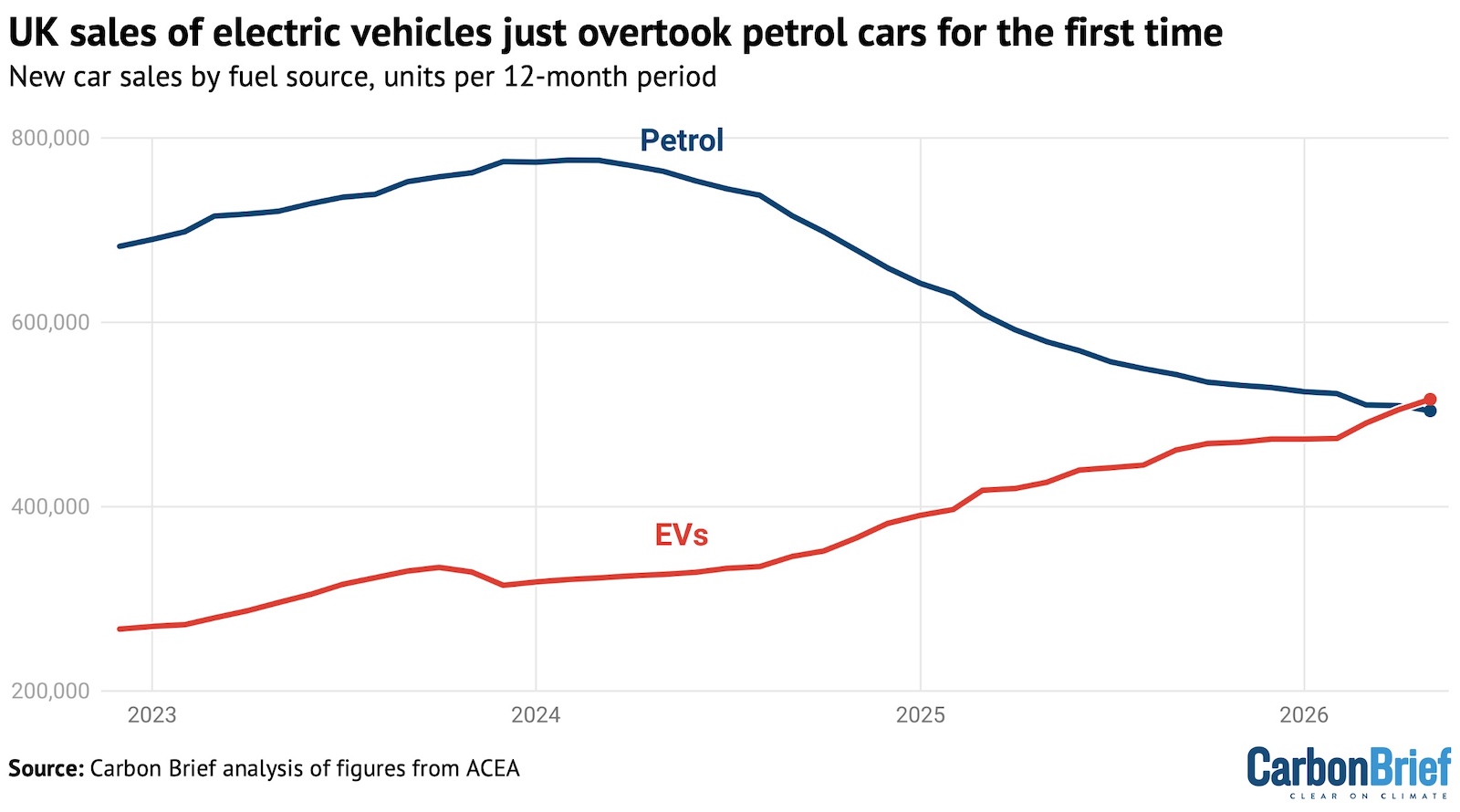
Battery-electric vehicle sales in the UK have moved ahead of petrol car sales over a rolling 12-month period for the first time, according to Carbon Brief analysis cited in the source material. The shift is small in absolute terms, but it is politically and industrially significant because it lands in the middle of an argument over whether the UK should weaken its zero-emission vehicle mandate.
In the 12 months to May 2026, UK consumers bought 516,490 new battery-electric vehicles, compared with 504,010 new petrol cars. That marks a notable threshold in the transition away from conventional internal-combustion models. The result does not mean electric cars have become the dominant format across the whole market, but it does show that pure EV demand has grown enough to overtake petrol on this measure.
The timing matters. Carmakers and some unions have been pushing to water down the UK’s zero-emission vehicle, or ZEV, mandate. The policy requires a rising share of new car sales each year to be zero-emission vehicles, primarily battery-electric models. Critics argue demand is too weak to meet the target. The figures in the source text point the other way: EV demand has continued to grow, and the industry has already over-complied with the mandate to date.
Why the data matters
The analysis referenced in the source uses figures from the European Automobile Manufacturers’ Association, or ACEA. That data set classifies hybrids separately from petrol and diesel cars. The distinction matters because UK market discussions can look different depending on which body’s definitions are used.
The source notes that the UK Society of Motor Manufacturers and Traders uses a slightly different categorisation for hybrids. ACEA treats hybrids as their own group, while the SMMT counts so-called mild hybrids under petrol and separates full hybrids into another category. That difference can change how large or small the petrol segment appears in headline comparisons.
Even with that caveat, the direction of travel is clear in the supplied figures. Hybrid sales remain the largest segment in the UK, but growth there has been relatively slow. In May 2026, 56,321 hybrids were sold, up by 1,181 from a year earlier, or about 2% growth. By contrast, EV sales reached 43,931 in the same month, a 34% year-on-year increase. Petrol car sales fell 14% to 35,068.
Plug-in hybrids also rose quickly, climbing 24% year on year in May 2026 to 22,167. Those vehicles still use petrol engines, but they can also be charged from the grid and driven electrically for part of their use. Together, those numbers suggest that buyers are steadily shifting toward electrified powertrains, even if many are still choosing options short of a full battery-electric vehicle.

More than a one-month spike
The latest result is especially notable because it was measured across a full 12-month period rather than a single standout month. The UK had previously seen battery-electric sales beat petrol sales in an individual month in December 2022. Short-term spikes can reflect seasonal buying patterns, model launches, or registration timing. A 12-month rolling lead is harder to dismiss as a blip.
The source also points to a related European milestone: across the EU, more battery-electric vehicles were sold in December 2025 than petrol cars. The UK result builds on that broader shift, showing that electrification is not just a continental policy story but an increasingly measurable consumer-market trend.
That does not settle the debate over the pace of transition. Automakers still face pressure on pricing, charging infrastructure remains a factor in consumer confidence, and hybrid vehicles continue to appeal to buyers who want lower fuel use without depending entirely on public charging. But the sales figures weaken the argument that consumer demand for EVs is fundamentally absent.
What it means for policy
The ZEV mandate has become one of the main policy battlegrounds in the UK auto market. Supporters see it as the mechanism that forces investment, keeps model supply flowing, and gives manufacturers a predictable path for the transition. Opponents argue the targets risk getting ahead of market realities and could impose costs on industry and workers if demand stalls.
The data in the source strengthens the case for keeping pressure on. If battery-electric sales are already outpacing petrol over a 12-month period, policymakers can argue that the market is responding to a combination of regulation, model availability, and changing buyer preferences. In that reading, weakening the mandate could interrupt momentum just as EV adoption is becoming structurally visible.
At the same time, the figures show the transition is uneven rather than complete. Hybrids remain the single most popular vehicle type in the UK market using the ACEA categorisation. That means the practical path to lower-emission road transport still includes buyers who are not ready to go fully electric. The policy challenge is to preserve EV growth without ignoring those constraints.

Why this is a meaningful shift
The significance of the milestone is not that petrol cars suddenly disappeared from the market. It is that a technology that was recently treated as niche has now exceeded petrol sales over a sustained period in one of Europe’s major car markets. That changes how industry claims about weak demand should be judged.
It also changes how the next phase of competition may unfold. Once EVs move beyond symbolic gains and start surpassing legacy segments in rolling sales totals, attention shifts from whether the category can scale to how quickly manufacturers can defend margins, secure supply chains, and differentiate products in a more crowded electric market.
For the UK, the message from the supplied numbers is straightforward. Consumer demand for battery-electric cars is no longer hypothetical. It is large enough to beat petrol cars over a full year, growing much faster than hybrids and moving in the opposite direction from conventional petrol models. That does not end the political fight over the ZEV mandate, but it gives that fight a new set of facts.
- Battery-electric vehicle sales reached 516,490 in the 12 months to May 2026.
- Petrol car sales totaled 504,010 over the same period.
- In May 2026 alone, EV sales rose 34% year on year to 43,931.
- Petrol sales fell 14% year on year in May to 35,068.
- Hybrid sales remained the largest segment, but grew only 2% in May.
This article is based on reporting by CleanTechnica. Read the original article.
Originally published on cleantechnica.com