Waymo says full autonomy needs more than cameras
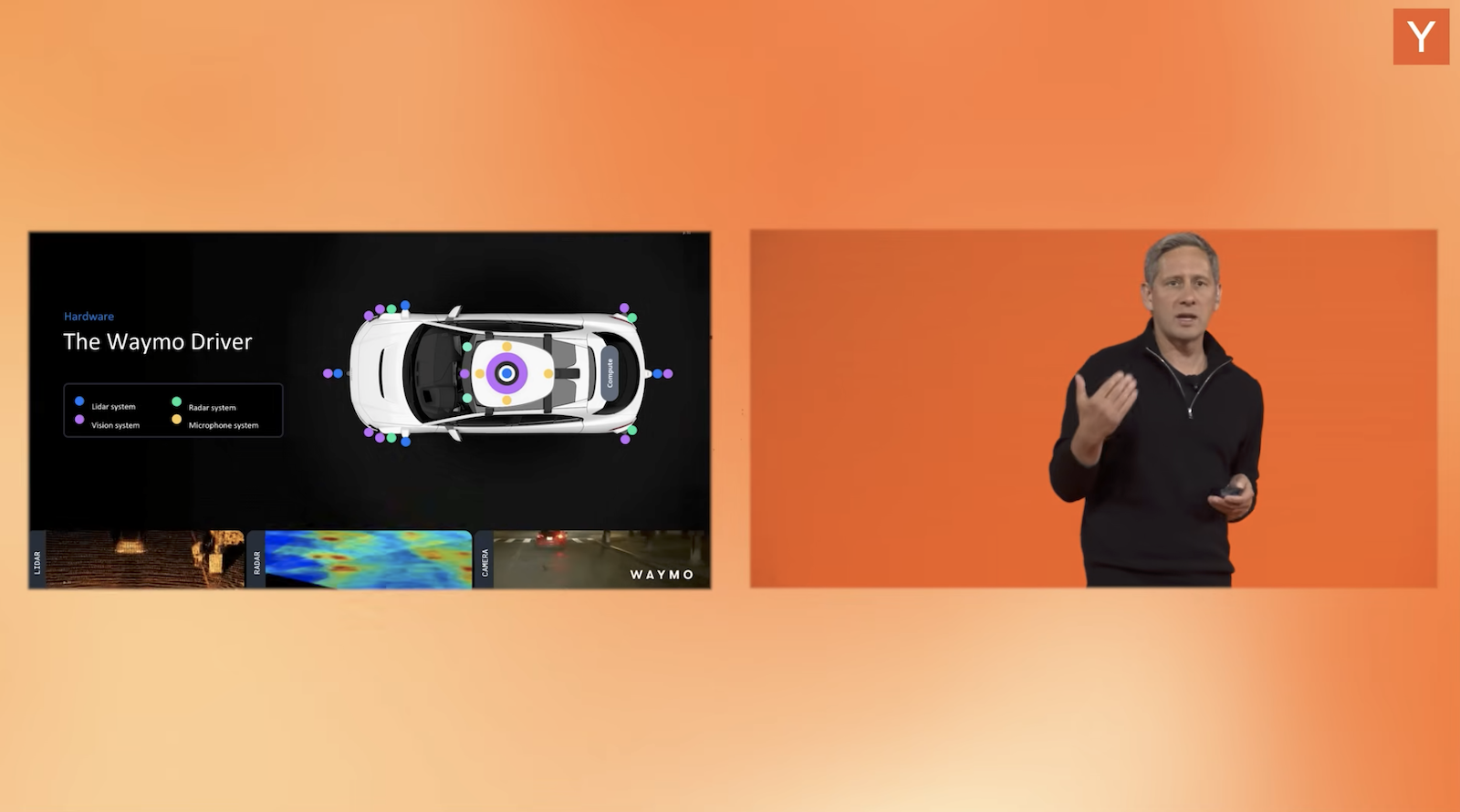
Waymo is making its clearest recent case yet against vision-only self-driving. In remarks highlighted from a recent Y Combinator presentation, Waymo co-CEO Dmitri Dolgov argued that camera-only systems may be workable for driver assistance or for approximating human performance, but they run into limits too early if the goal is full autonomy with safety beyond that of a human driver.
The argument matters because it cuts to one of the longest-running technical and commercial disputes in automated driving: whether software trained on camera data can eventually do the entire job, or whether robust autonomy requires multiple kinds of sensors working together. Dolgov’s comments place Waymo firmly in the second camp and frame the disagreement not as a matter of engineering taste, but as a question of what safety target the industry is actually trying to hit.
According to the cited remarks, Dolgov described the tradeoff directly. More sensors can raise performance, he said, but they also increase system complexity. If the objective were only to roughly match how people drive, or to build an assistance product, relying on cameras could be considered reasonable. But if the objective is fully autonomous driving and what he described as strongly superhuman performance, he said weak sensing causes the safety curve to flatten out too early.
That phrasing is significant because it reframes the benchmark. Human driving is not the ceiling in this argument. Human driving is the baseline, and the technical stack should be judged by whether it can continue improving past that point with enough confidence across edge cases and difficult environments.
Why Waymo keeps betting on three sensor types
Dolgov’s explanation, as summarized in the source material, is that Waymo uses cameras, lidar, and radar because each one covers weaknesses in the others. Cameras provide high resolution and color information, helping a system interpret the scene in ways that are visually rich. But cameras are passive sensors, and he said they degrade in darkness and in glare.
Lidar, by contrast, directly measures the three-dimensional structure of the world around the vehicle. Radar adds a different strength: it performs well in environmental conditions such as fog, rain, and snow, and it can directly measure velocity through Doppler effects. Dolgov also emphasized that lidar and radar are active sensors, meaning they can function effectively even in pitch darkness and in visually punishing scenarios such as driving into a blinding sunset.
Taken together, that is Waymo’s core technical case. A self-driving system meant to operate without a human fallback should not depend too heavily on one channel of perception, especially when that channel is vulnerable to common real-world failures. The company’s position is that sensor diversity is not optional redundancy. It is the mechanism that allows the vehicle to preserve awareness when one mode of sensing becomes unreliable.
This is a more demanding standard than simply recognizing lanes, vehicles, and pedestrians in favorable conditions. It assumes deployment in the messy world where lighting changes rapidly, weather interferes with visibility, road users behave unpredictably, and rare but consequential situations matter as much as everyday ones.
The deeper industry split is about product category
Dolgov’s comments also suggest that some of the disagreement around self-driving is really a disagreement about product category. A driver-assistance system and a fully autonomous system may look similar from the outside, but they can be built to very different assumptions about failure, responsibility, and acceptable performance margins.
If a human driver remains responsible and attentive, then a system can hand back the problem when it reaches uncertainty. If the vehicle itself is supposed to handle the full task, uncertainty has to be resolved within the machine’s own sensing and decision-making stack. That is where Waymo appears to believe a camera-first or camera-only approach becomes insufficient.
The commercial side of that split is equally important. More hardware generally means more cost, more integration work, and potentially more maintenance complexity. Vision-only advocates have long argued that simpler hardware can scale more efficiently. Dolgov’s response, based on the supplied source text, is that the cost and complexity question cannot be separated from the safety target. A cheaper sensing approach may be attractive, but only if it still supports the intended level of autonomy.
That makes this more than a technical debate about which sensor is elegant. It is a strategic argument about whether a lower-cost perception stack can keep improving when the remaining problems become rare, difficult, or safety critical.
What the remarks signal for the self-driving race
The source text casts Dolgov’s comments as a direct challenge to Tesla’s approach, though the most defensible takeaway from the supplied material is broader. Waymo is signaling that it sees multimodal sensing as essential to the next stage of autonomous driving and that it believes the road to dependable driverless performance runs through complementary perception, not minimal hardware.
That does not settle the industry debate, but it sharpens it. The question is no longer just whether a vehicle can drive itself in many situations. The question is whether a given architecture can continue improving once the straightforward gains are gone and the remaining errors come from darkness, glare, weather, ambiguous motion, or unusual geometry on the road.
By focusing on the idea of a safety curve that flattens too early, Waymo is arguing that the problem with weak sensing is not simply that it makes systems worse today. The deeper problem, from its perspective, is that it can cap how far the system can improve tomorrow.
For the broader transportation and energy ecosystem, that distinction matters. Autonomous vehicles are often discussed in terms of software breakthroughs, but deployment at scale depends just as much on what the machine can reliably perceive under stress. Dolgov’s remarks reinforce a view that hardware choices remain central to the business and safety case for autonomy.
In that sense, Waymo’s message is straightforward: if the industry wants truly driverless systems rather than advanced assistance, then the sensing stack has to be built for conditions where human vision, and by extension camera-only perception, is not enough on its own.
This article is based on reporting by CleanTechnica. Read the original article.
Originally published on cleantechnica.com