Fusion's Most Persistent Cliché Meets Its Hardest Design Brief
For as long as most people have been paying attention, fusion energy has carried the same reputation: the technology that is perpetually one generation away from commercial reality. The UK's STEP programme — the Spherical Tokamak for Energy Production — is one of several international efforts attempting to bury that joke for good. According to reporting by Interesting Engineering, the project is advancing design work on a next-generation fusion plant, with efficiency positioned as a central objective rather than a distant aspiration.
That emphasis is more significant than it first appears. For most of fusion research's history, the headline goal was simply reaching and sustaining the conditions required for fusion reactions — ignition, or at least a convincing net energy gain. Efficiency was treated as a problem for a later phase, one that a future generation of engineers would inherit. Designing a plant around efficiency from the outset forces teams to confront the entire system at once: the plasma, the heat, the fuel cycle, the materials and the maintenance regime.
Why Efficiency Is a Fundamentally Different Target
A fusion power plant is not judged solely on how much energy its plasma releases. It is judged on how much electricity it can sell after powering itself. Confining a plasma requires enormous magnetic fields, which require cryogenic cooling; heating the plasma consumes more energy; pumping, control systems and shielding all draw from the same pot. The difference between the energy produced and the energy recirculated back into the machine determines whether a plant is a power station or an elaborate experiment.
Efficiency gains can come from several directions at once. Stronger magnetic confinement can allow a given performance level from a smaller, cheaper device. Improved heating and current drive systems can raise the fraction of injected power that actually reaches the plasma. Better thermal conversion can extract more electricity from the neutrons that carry fusion energy out of the reaction chamber. Each improvement compounds, and each is an engineering problem as much as a physics one.


What Next-Generation Means for STEP
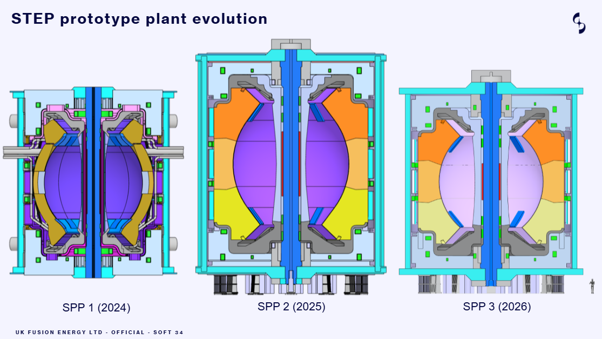
STEP is built around a spherical tokamak, a compact, cored-apple-shaped relative of the conventional doughnut geometry. Spherical tokamaks trade some of the simplicity and well-understood stability of larger conventional machines for a configuration that can, in principle, deliver strong performance from a smaller and less expensive device. For a programme aiming at a prototype power plant rather than a physics experiment, that trade-off sits at the centre of the design.
Compact Geometry, Compressed Margins
Compactness cuts both ways. A smaller machine leaves less room for bulky components: shielding, the breeding blanket that would generate fresh fuel, and the exhaust system that must handle searing heat loads at the plasma edge. In this context, efficiency is not only about generating more power — it is about making every subsystem fit and function within tighter spatial, thermal and structural limits. Design decisions that would be routine in a larger device become coupled constraints in a compact one.
From Physics Experiment to Power Plant
A power plant must operate reliably for long stretches, produce or recover its own tritium fuel, and be maintainable by remote handling because no human can enter an activated vessel. A prototype must therefore demonstrate availability, not merely plasma performance. That changes what efficiency means: a design that achieves excellent plasma results but demands frequent, lengthy shutdowns is not efficient in any commercially meaningful sense.
The Engineering Bottlenecks That Decide the Outcome
Several subsystems will determine whether an efficiency-focused design translates into a credible plant.
- Heat exhaust: The plasma edge directs extreme power loads onto a small area. Managing that heat without eroding components or forcing frequent replacement is one of fusion's hardest engineering problems.
- Tritium breeding: Fusion fuel must be generated inside the plant itself, typically by capturing neutrons in lithium-bearing materials. Breeding performance directly affects whether the plant can sustain itself.
- Materials under bombardment: Structural components face years of neutron damage, which changes their properties and limits their service life. Durable materials extend operating periods and improve overall economics.
- Remote maintenance: Every intervention in the vessel is a robotic operation. Simplifying components and standardising connections reduces downtime, which is itself a form of efficiency.
- Recirculating power: Magnets, cryogenics, pumps and control systems consume a share of the plant's output. Trimming that internal demand raises net electricity for the same fusion power.
- Grid integration: A plant that produces power in a form the electricity network can absorb, at the times it is needed, delivers more value than one that cannot.

Fusion's Credibility Problem
The reason the old cliché has proved so durable is that fusion milestones are easy to misread. A machine can achieve a scientific first while remaining nowhere near a commercial power station, and optimistic projections have repeatedly slipped. Framing design work explicitly around efficiency is one way to address that scepticism, because it shifts the question from whether fusion can happen to whether a plant can deliver usable electricity at a competitive cost.
It also imposes discipline. Efficiency targets force trade-offs early, when they are still cheap to make. A design that defers heat management, maintenance access or fuel self-sufficiency to a later stage tends to accumulate problems that no amount of plasma performance can offset.
What to Watch Next
Progress on a programme like STEP tends to arrive in unglamorous increments: engineering design reviews completed, component prototypes tested, blanket and divertor concepts narrowed down, regulatory and site questions resolved. Each of those steps either strengthens or weakens the efficiency case.
The more telling signal will be whether the programme's publicly stated ambitions stay aligned with what the engineering allows. Fusion has never lacked bold targets; what it has lacked is a design philosophy that treats the whole plant — not just the plasma — as the thing that must work. If the next-generation STEP design genuinely embeds efficiency at its core, it will be judged on the same terms as any other power project: how much electricity comes out, how reliably, and at what cost.
That is a far less romantic standard than the promise of limitless clean energy. It is also the only standard that ultimately matters.
This article is based on reporting by Interesting Engineering. Read the original article.

Originally published on interestingengineering.com