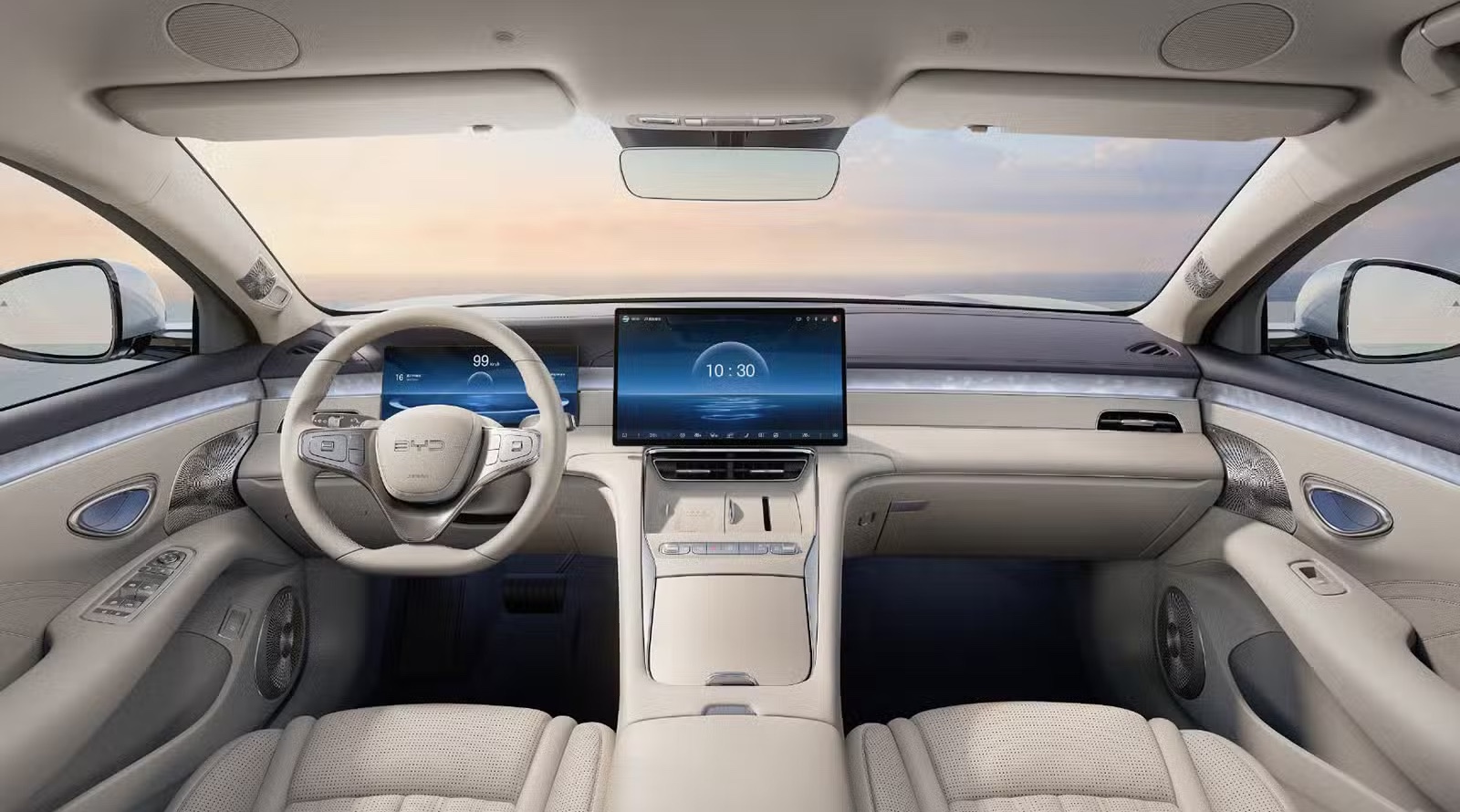
BYD prepares to unveil its Seal 08 sedan
BYD is set to officially launch the Seal 08 on July 2, marking the debut of what the company is positioning as the flagship sedan in its Ocean lineup. Ahead of that launch, the vehicle is already appearing in dealer stores across 20 Chinese cities, and pre-orders are open, indicating that BYD is trying to build momentum before full commercial rollout.
Based on the details disclosed so far, the Seal 08 is aimed at a part of the market where speed of charging, perceived luxury, and platform technology matter as much as range or headline price. The early messaging around the car centers on a new battery generation, an 800-volt electrical architecture, and a package of ride and comfort features that push the model further upmarket than a conventional family sedan.
Fast charging is central to the pitch
The most consequential claim in the pre-launch information is charging performance. BYD says the Seal 08 can charge from 10% to 97% in nine minutes when using its “Flash Charging” system on an 800-volt high-voltage platform. If that figure holds under real operating conditions, it would place the Seal 08 among the most aggressive fast-charging electric vehicles discussed publicly this year.
That matters because charging time remains one of the most important friction points for battery-electric adoption. Manufacturers have steadily improved battery density, charging curves, and thermal management, but many consumers still judge electric cars against the time it takes to refuel a combustion vehicle. BYD’s pre-launch framing suggests it sees charging convenience, not only sticker price, as a decisive lever in the next phase of competition.
The Seal 08 also uses BYD’s latest generation of the Blade Battery. The source material does not provide technical specifications for what has changed in that generation, but the company is clearly pairing the battery update with the fast-charging narrative. In practice, that combination signals an effort to present the Seal 08 as more than a styling refresh. BYD wants it seen as a platform statement.

A flagship sedan with premium hardware
The Seal 08 is described as either a midsize or large sedan, depending on how the segment is measured, which places it in an important part of the Chinese market: large enough to feel aspirational, but still in a format suited to high-volume urban and intercity use. BYD is also loading the model with equipment more commonly associated with premium competitors.
Among the listed features is the company’s DiSus-A body control system, which replaces coil springs with adjustable air springs. According to the source text, the system can dynamically alter ride height, stiffness, and aerodynamics depending on driving conditions. In simple terms, BYD is using chassis hardware not just for comfort, but as part of the vehicle’s broader efficiency and handling strategy.
The interior specification follows the same logic. BYD says the car includes front zero-gravity seats, along with ventilation, heating, and massage functions throughout the cabin. The Seal 08 is also said to include electric soft-close doors and double-layer acoustic glass. These are the kinds of details buyers notice immediately in a showroom because they change the sensory impression of the vehicle before performance figures or energy consumption are even discussed.
Taken together, those features suggest BYD is trying to collapse two categories into one product: a high-tech EV and a comfort-oriented executive sedan. That is a familiar strategy in China’s electric vehicle market, where domestic brands have become increasingly adept at combining advanced electrical systems with heavily featured cabins at prices that challenge foreign rivals.
Battery-electric and plug-in hybrid versions widen the market
Another notable detail is that the Seal 08 will not be limited to a fully electric version. BYD also plans a plug-in hybrid DM-i variant. That dual-powertrain approach broadens the model’s addressable audience and reflects BYD’s habit of avoiding an all-or-nothing stance where market conditions remain mixed.
For buyers ready to commit to a battery-electric sedan, the BEV version offers the headline charging story. For buyers who want lower fuel use without depending entirely on charging infrastructure, the DM-i version provides an alternative. This matters especially in markets and user segments where charging access, travel patterns, or residual concerns about long-distance use still shape purchase decisions.
It also reinforces a wider point about BYD’s strategy. The company has not relied on a single drivetrain formula to scale. Instead, it has built share by offering multiple propulsion options under strong product branding, then competing hard on equipment and value. The Seal 08 appears to continue that playbook, but with more emphasis on premium execution.
Why this launch matters beyond one model
Even before pricing is officially detailed in the source material, the Seal 08 launch is significant because it shows how quickly the competitive baseline is moving. Ultra-fast charging, high-voltage systems, active body control, and extensive comfort features are no longer being reserved for niche halo cars. They are increasingly appearing in high-volume models from Chinese manufacturers.
That has implications well beyond BYD. Every mainstream automaker trying to sell electric sedans will be judged against the convenience, hardware, and cabin expectations created by launches like this one. If the Seal 08 reaches market with its advertised charging performance and feature set intact, it will add pressure on rivals that still treat fast charging or premium ride systems as optional extras rather than core product attributes.
The launch also fits into BYD’s broader cadence. The company is using the Seal 08 as one step in a larger sequence, with the Sealion 08 SUV expected to follow. That suggests the underlying technology and design language are not one-offs, but part of a wider product family intended to reinforce BYD’s strength across body styles.
For now, the key facts are straightforward: BYD has fixed July 2 as the official launch date, dealer visibility has already begun in multiple Chinese cities, and the Seal 08 is being introduced with a strong emphasis on charging speed, updated battery technology, and premium cabin and chassis features. In a market where product cycles are compressing and consumer expectations are rising, that combination is likely to make this launch one of the more closely watched EV debuts of the week.
This article is based on reporting by CleanTechnica. Read the original article.
Originally published on cleantechnica.com