Lower Saxony’s Hydrogen Rail Bet Is Reaching Its Cost Reckoning
Lower Saxony’s hydrogen passenger trains were once promoted as a flagship example of zero-emission rail outside fully electrified corridors. Now the project appears to be entering a more difficult phase, one defined less by technology evangelism than by long-term capital discipline.
According to the source material, the central issue is no longer whether hydrogen trains can run in principle. It is whether the state should continue recapitalizing a specialized hydrogen ecosystem just as battery-electric alternatives are becoming the more practical path it has already begun to select. That reframes the debate. Instead of arguing abstractly about competing clean propulsion options, decision-makers are nearing a point where they may have to compare specific bills: extending the life of a dedicated hydrogen system or accelerating a transition toward battery-electric multiple units.
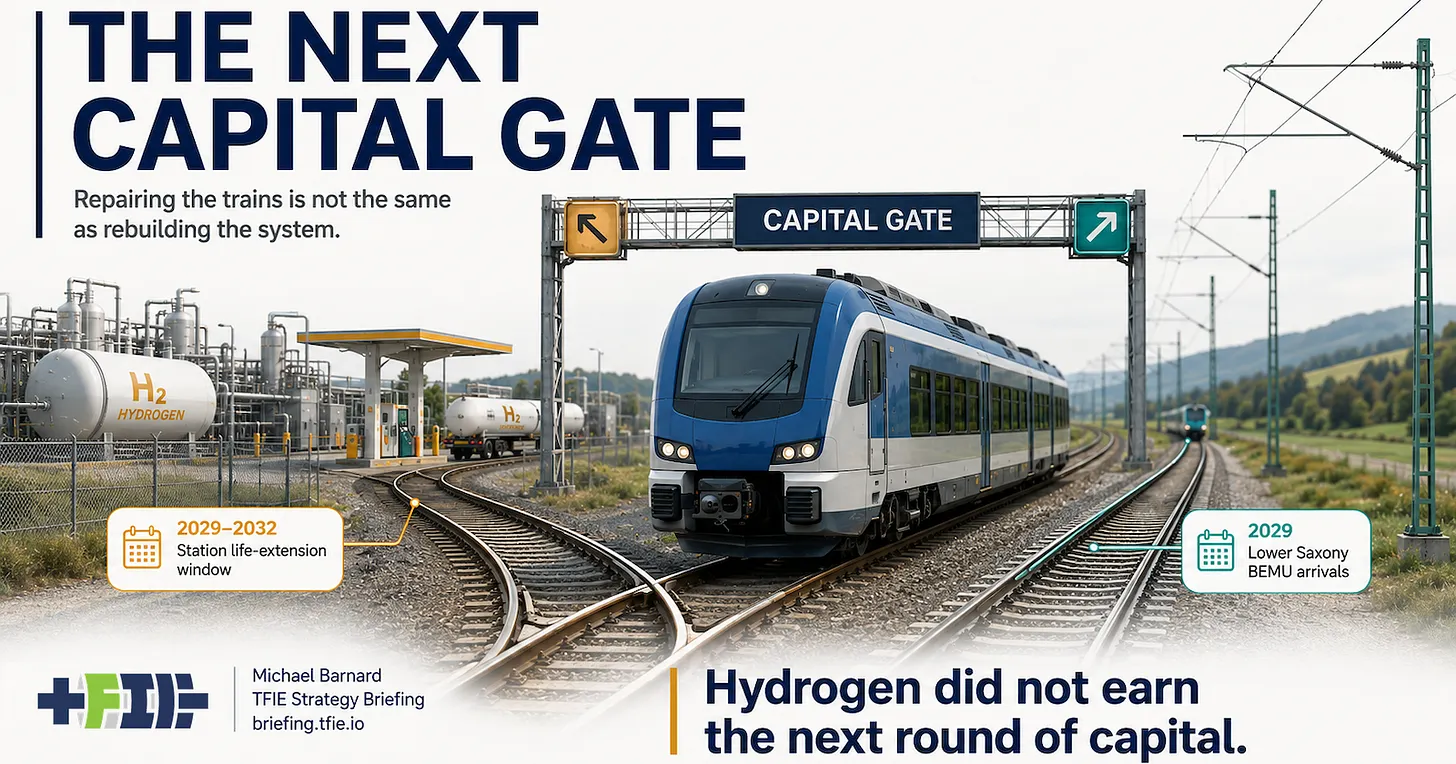
The timing matters. The source says the first major station recapitalization is likely to arrive around 2029 to 2032. Lower Saxony’s first major battery-electric multiple-unit fleet is also expected from 2029. Those overlapping timelines could force a direct infrastructure choice, turning what had been a technology showcase into a capital allocation problem.
A Tightly Coupled System Under Pressure
The case against the long-term resilience of the hydrogen setup, as presented in the source, is not limited to reliability complaints. It is structural. Lower Saxony’s system depends on multiple interlocking components retaining value at the same time: the trainsets, proprietary fuel-cell modules, a dedicated refueling station, industrial hydrogen delivered by truck, and extended maintenance commitments. If one part underperforms, the economics of the whole system worsen.
That is a meaningful weakness in transport infrastructure, where operators usually prefer flexible assets, interchangeable supply chains, and maintenance arrangements with broad vendor support. A specialized system can work when scale grows, costs fall, and suppliers deepen their commitment. But the source suggests the opposite dynamic may be taking shape here.
One cited fleet-specific figure from August 2025 illustrates the strain: EVB reportedly said that only four of 14 Coradia iLint trainsets were operating because replacement fuel-cell modules had not arrived. Diesel units were covering some of the service gap, though not all of it. For a project meant to demonstrate dependable clean regional transport, that kind of availability problem carries both operational and political consequences.
Service reliability matters at least as much as emissions in public transport. A low-emission fleet that requires diesel substitutions, bespoke repair chains, or prolonged downtime can quickly lose its strategic advantage, especially if alternatives begin offering lower complexity and better availability.

Supplier Moves Signal Consolidation, Not Expansion
The source also points to an April 2026 transaction in which Alstom bought Cummins’ rail fuel-cell engineering, product, and support activities. Alstom reportedly framed the move around reliability improvement, support for the installed fleet, and completion of contracted programs in Germany, Italy, and France.
That can be read in more than one way, but the supplied text draws a clear implication: the acquisition looks more like support and liability management for existing commitments than evidence of a propulsion platform attracting broader market momentum. In other words, the industrial base around hydrogen rail may be consolidating around support obligations rather than expanding through fresh demand.
That distinction matters because transport technologies become durable not only through engineering merit but through ecosystem depth. Operators need confidence that components, service expertise, and future upgrades will remain widely available. If support narrows to a smaller circle of legacy commitments, the financial logic of staying with the platform weakens.
The Money Already Committed Is Significant
Lower Saxony’s hydrogen rail experiment was never a small pilot in budget terms. The source says the state committed 81.3 million euros to the trains, while the federal government added about 8.4 million euros. The original arrangement also included 30 years of maintenance and energy supply. Linde built, owns, and operates the dedicated refueling station, which the source estimates at 10 million euros and says was supported by federal funding.
Those figures underline why the next decision will be difficult. The project already carries sunk costs, and governments are often reluctant to pivot away from highly visible infrastructure once large sums have been committed. Yet sunk costs are not the same as forward value. The more relevant question for the next phase is whether additional spending preserves a system with improving prospects or merely prolongs one with narrowing advantages.
If the refueling station requires another major round of spending just as battery-electric fleets become available, policymakers may have a rare side-by-side comparison between two zero-emission pathways at a moment when one has already shown signs of operational fragility.
Battery Trains Change the Comparison
The source frames battery-electric trains as the future Lower Saxony has effectively already chosen. That does not mean hydrogen disappears overnight. Existing assets may continue operating until maintenance economics or infrastructure renewal decisions make retirement unavoidable. But the arrival of battery fleets changes the benchmark.
Hydrogen rail was often justified for routes where full overhead electrification was impractical and batteries were considered insufficient. If battery-electric multiple units now cover more use cases with less specialized infrastructure, hydrogen loses one of its strongest strategic arguments. Batteries still bring constraints, especially around charging, route length, and power management. But they may offer a simpler system architecture, which is often decisive in regional rail.
Simplicity has real value in public transport. Operators tend to benefit from technologies that reduce dependency on one-off fueling systems, minimize bespoke parts exposure, and align with broader electrification trends. If battery fleets can meet service requirements while using a less orphaned supply chain, they become attractive even before pure cost comparisons are complete.
What This Means Beyond Lower Saxony
The significance of Lower Saxony’s next steps extends beyond one German state. Hydrogen has been pitched across several sectors as a versatile decarbonization tool, but transport applications face increasingly strict competition from direct electrification where that is feasible. Rail is one of the clearest examples because fleet uptime, infrastructure utilization, and lifecycle maintenance are so easy to compare.
If Lower Saxony ultimately treats its hydrogen fleet as a transitional experiment rather than a durable operating model, that would send a broader signal to transport planners: specialized hydrogen systems may struggle when battery alternatives improve fast enough to catch them before the next recapitalization cycle.
That would not settle the hydrogen debate in every transport niche. Heavy industry, long-duration storage, shipping, and some other hard-to-electrify applications remain separate questions. But in regional passenger rail, the burden of proof appears to be shifting.
For Lower Saxony, the test ahead is not ideological. It is financial and operational. When the next major infrastructure bill arrives, officials may have to decide whether they are preserving a strategic asset or managing an orderly exit from a technology path that no longer looks like the strongest option.
This article is based on reporting by CleanTechnica. Read the original article.

Originally published on cleantechnica.com