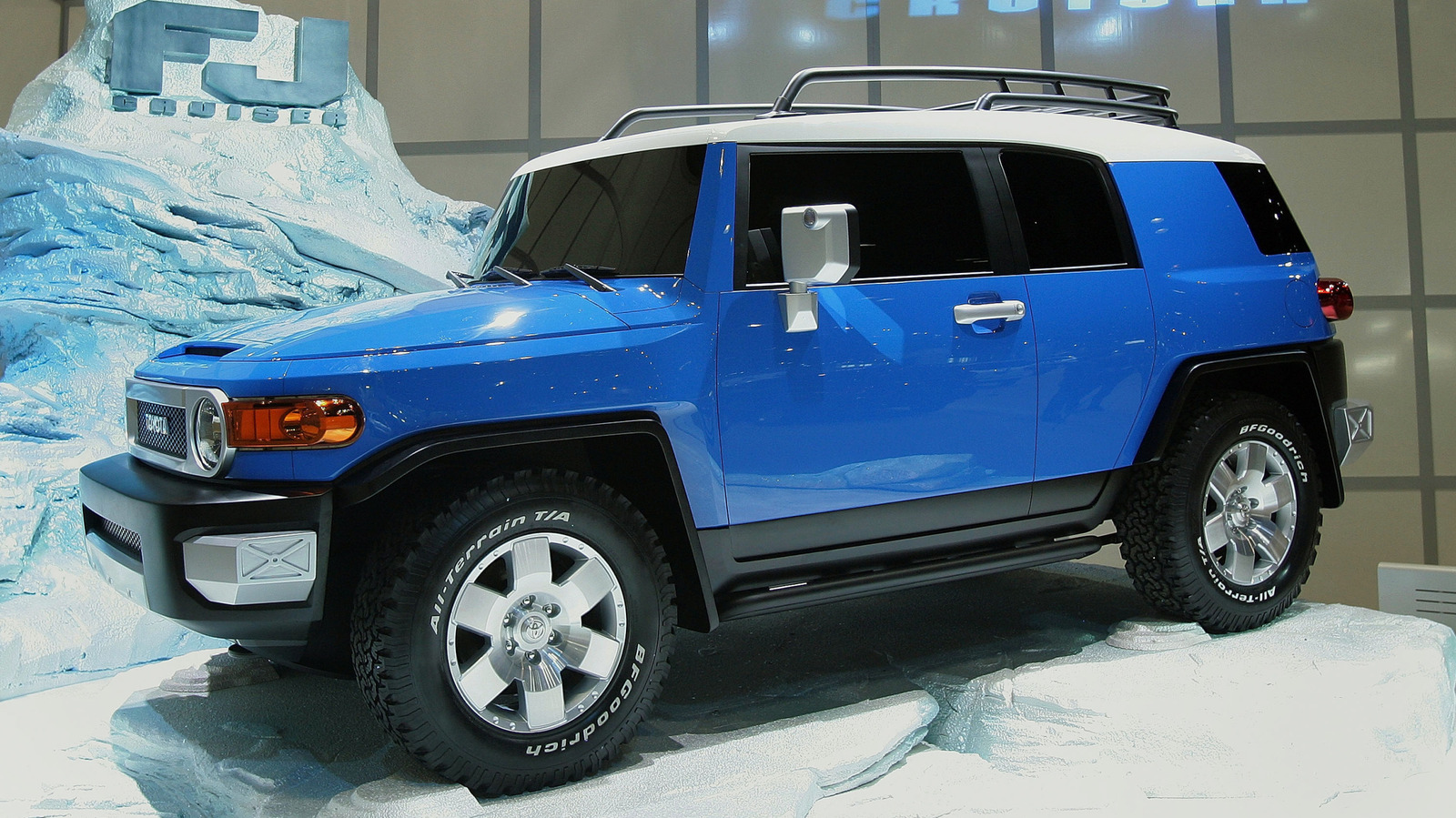
The Toyota FJ Cruiser has been absent from U.S. showrooms since 2014, but it still refuses to behave like a typical 12-year-old used vehicle. Examples with fewer than 100,000 miles routinely carry asking prices that match or exceed what the retro-styled SUV cost when it was new. For shoppers drawn to its Tonka-truck proportions and genuine off-road hardware, that means doing serious homework before handing over a check.
A Cult Truck With Stubborn Resale Values
Toyota's long-standing reputation for durability already props up resale values across the lineup, and the FJ Cruiser enjoys that halo. Yet a second force is at work: the truck is simply cool. It looks like an oversized toy with legitimate trail capability, and it was sold in colors that made it stand out in any parking lot. That combination keeps demand running ahead of a supply that will never grow again.
The sales arc tells the story of a vehicle that arrived with momentum and then faded quietly in North America. Toyota moved 56,225 FJ Cruisers in the United States during 2006. By its final year on the continent in 2014, volume had slid to 14,718 units. The model then carried on essentially unchanged in global markets including Chile, the Middle East and South Africa until 2022. North American buyers never received a direct replacement, so the used pool is fixed and gradually shrinking through attrition.
Pricing reflects that scarcity. A nationwide search on Autotrader surfaces FJ Cruisers listed between $35,000 and $55,000 when the odometer reads under 100,000 miles — a range that lands at or above the final MSRP of these vehicles when brand new. Landing one of the few examples priced below $10,000 means accepting a truck with well over 300,000 miles. Compared with some other Land Cruiser variants, though, that still counts as reasonable money.

Land Cruiser DNA Underneath the Retro Sheet Metal
The FJ Cruiser draws on serious Land Cruiser heritage. It was built on the same chassis as the global workhorse, the Toyota Land Cruiser Prado, and the hardware list backs up the styling. Buyers get:
- 9.6 inches of ground clearance for clearing obstacles
- Strong departure angles for steep, technical descents and climbs
- Available A-TRAC, or Active Traction Control, for managing grip on loose surfaces
- An available rear electronic locking differential for serious low-speed traction
Toyota did not rely on brochures to make its case. Before the FJ's release, engineers put it through its paces on trails around Grand Junction, Colorado, and Moab, Utah — terrain chosen specifically to prove the truck was capable in rough country.
Engine, Drivetrain and Fuel Costs
Motivation came from a proven 4.0-liter V6. Output started at 239 horsepower when the FJ arrived in 2007 and climbed to 260 horsepower by 2012, so model year matters if peak power is a priority. Underneath sits a body-on-frame chassis shared with other Toyotas of the era, using independent front suspension and a live rear axle — a stout, overbuilt arrangement that also explains the truck's appetite for fuel.
Buyers also face a meaningful choice between two drivetrain layouts. The manual transmission was paired with full-time four-wheel drive, while the automatic version was offered with a rear-wheel-drive-only option. Official EPA figures average roughly 17 mpg in the city and 20 mpg on the highway, varying by model year and configuration.
Reliability Ratings and the Rust Problem
Broadly speaking, the FJ Cruiser earned a solid reputation. J.D. Power scored it between 84 and 86 out of 100, and owners posting on Kelley Blue Book rated it 4.8 out of 5 across model years. Those are strong numbers for a vehicle with this much capability baked in.
The caveat is rust. It is a documented issue across the production run, and the concerning kind is deep, frame-eating corrosion rather than cosmetic surface blemishes. Because the FJ is a body-on-frame design, structural rust deserves far more attention than paint or trim condition. A thorough inspection from below is not optional on these trucks.
A Practical Pre-Purchase Checklist
- Inspect the frame and underbody closely for the deep corrosion reported across all model years
- Confirm which configuration you are buying: manual with full-time four-wheel drive, or automatic with the rear-wheel-drive-only option
- Check the model year to know whether you are getting 239 hp or the later 260 hp tune
- Benchmark the asking price against mileage, given that sub-100,000-mile trucks commonly list from $35,000 to $55,000
- Account for running costs, since EPA ratings sit near 17 city and 20 highway
Is an FJ Cruiser Worth the Money?
For the right buyer, the answer can be yes. The FJ Cruiser pairs Land Cruiser Prado underpinnings with approachable dimensions, distinctive styling and factory capability that would cost real money to replicate through aftermarket modifications. It has been out of production in North America for more than a decade, but it has not yet aged into true classic status, which leaves it in an unusual pricing zone where values stay firm without the volatility of collector cars.
The flip side is that you are paying near-new money for an old truck. Fuel economy is modest, the frame demands scrutiny, and any example cheap enough to feel like a steal will likely carry extreme mileage. Shoppers who accept those terms and budget for a proper inspection should find the FJ Cruiser delivers exactly the combination of character and capability that made it a cult favorite in the first place.
This article is based on reporting by Jalopnik. Read the original article.
Originally published on jalopnik.com