A Freight Job That Looks Like a Stunt
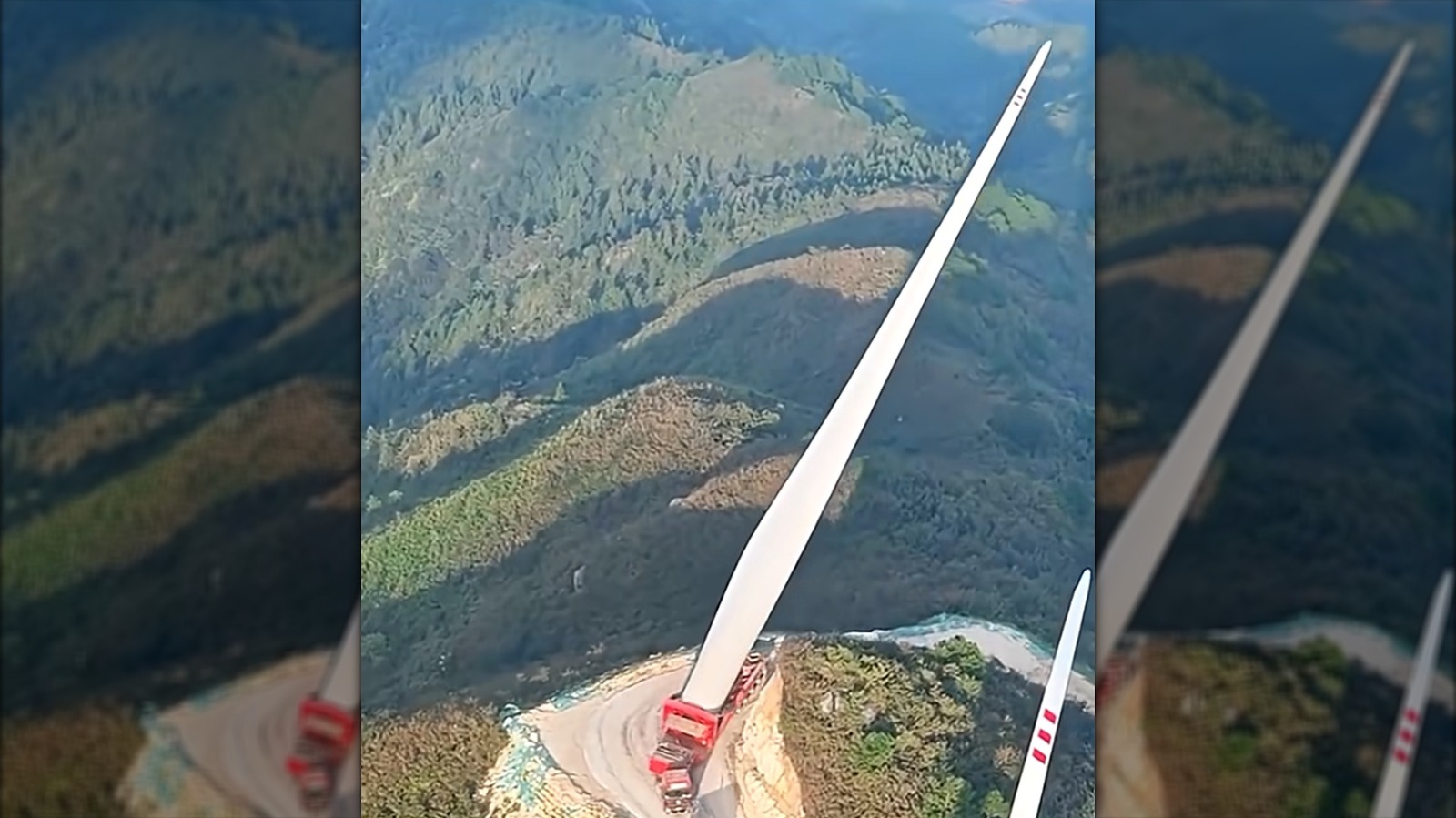
Driving for a living wears people down. High speeds, heavy machinery and human judgment all have to line up perfectly, hour after hour, for anything to go right. Now imagine doing it with a load hundreds of feet long, on a narrow mountain road, with a drop of several stories waiting just beyond a shoulder that has no guardrail. That is the reality captured in a new video released by CGTN Europe, which shows what hauling wind turbine blades through China's Nanling Mountain Range actually looks like. Jalopnik flagged the footage, and the reaction was immediate: this may be one of the most stressful jobs on the planet.
The drive climbs toward Baoding Mountain, which stands roughly 1,312 feet high. The roads are remote, exposed and windy — not just in the sense of curves, but in the sense of moving air. Threading a load of that size along a hairpin in those conditions is the freight equivalent of passing a needle through cloth while a storm pushes at your hands.
Just How Large Is the Cargo?
The blade in the footage is described as roughly 172 feet long and about 80 tonnes, while the headline attached to the same story cites a 387-foot blade. Either figure sits far beyond the dimensions of ordinary road freight, and both explain why a standard trailer would be useless here.
Wind turbine components are not built with highways in mind. They are engineered to catch as much moving air as possible, which makes them long, wide and awkward. Getting one from a manufacturing site to a mountain ridge means treating the road as an engineering problem rather than a commute.
The Hardware That Makes It Possible
Specialised trucks and trailers are constructed to the specifications of the blade they will carry. The root of the blade — its thickest, strongest section — is mounted to a frame on the carrier. That frame is fitted with hydraulic lifters, and those lifters are the trick that makes the entire operation feasible.
Why Blade Lifters Matter
A blade lifter can raise the cargo upwards of 60 degrees, and in some clips the angle looks close to vertical. Tilting the blade changes its footprint on the road dramatically. Instead of sweeping out across the full width of a turn, the blade can be lifted over the obstacles that would otherwise stop the convoy: houses, tree lines, power lines, bridges and anything else that happens to sit beside a mountain road.
On tight corners and hairpins, that adjustment is the difference between a completed delivery and a truck hanging off the side of a mountain with a blade acting as a lever. The lifters also help the truck physically fit through gaps that were never designed for industrial freight.
An Escort Operation, Not a Solo Drive
The semi carrying the blade does not travel alone. Escort vehicles move ahead and alongside, surveying the route and removing obstacles before the truck reaches them. Crew members communicate by radio, which becomes essential when the blade and truck have only a few feet of clearance and every correction has to be measured in small, precise inputs.
This is a team sport played at walking pace. Someone has to watch the blade's tip, someone has to watch the shoulder, and someone has to watch the road ahead for anything the convoy has not yet accounted for.
When the Wind Fights Back
There is a cruel irony built into moving turbine blades: they are engineered to capture wind, and they do not stop capturing it just because they are strapped to a trailer. On an exposed mountain road, a gust hitting a blade broadside adds a threat the driver cannot steer around. Weather therefore raises the difficulty of an already precarious transport, and it is one more variable the crew has to respect.
The Human Cost of Concentration
The stress of this work is not abstract. A single day on a route like this is the kind of shift that ages a driver, because the margin for error is essentially zero for hours at a time. There is no cruise control for this. Every metre requires the same vigilance as the first.
That is also why the skill on display deserves recognition. Navigating remote, narrow, wind-whipped mountain roads demands a level of concentration most jobs never ask for, and the drivers who do it are operating at the top of their craft.
What the Video Tells Us About Wind Power
Renewable energy is often discussed in terms of turbines, grid connections and policy. The unglamorous middle step — physically moving a component the size of a small building from a factory to a ridge — rarely gets the same attention, but it is a real constraint. Every wind project depends on someone successfully completing a journey like the one in this footage.
Videos like this one are a reminder that the energy transition is also a logistics story. The blades have to arrive intact, and getting them there can involve specialised equipment, a coordinated crew and roads that were never built for the load.
Key Details From the Footage
- Location: the Nanling Mountain Range in Hunan, China
- The climb: Baoding Mountain, roughly 1,312 feet high
- The load: described in the article body as about 172 feet and 80 tonnes; the headline cites a 387-foot blade
- The equipment: a carrier frame and hydraulic blade lifters that can tilt the blade upwards of 60 degrees
- The support crew: escort vehicles that clear obstacles and radio guidance through tight clearances
- The hazards: missing guardrails, steep drops, narrow hairpins and crosswinds that catch the blade
For anyone watching from a desk, the takeaway is simple: the next time a turbine appears on a ridgeline, remember that someone had to drive it there.
This article is based on reporting by Jalopnik. Read the original article.
Originally published on jalopnik.com